


Endangered monkey making a comeback in Tibetan reserve
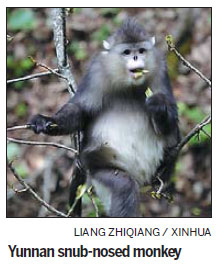
The Hongla Mountain National Nature Reserve, in Markam county of the Tibet autonomous region, has seen a steady increase in recent years in the number of Yunnan snub-nosed monkeys, a severely endangered species, according to a local official.
The population of the monkeys, which are under China's level-one protection, has grown from fewer than 400 in the 1980s to nearly 800, thanks to a special national fund and the enhanced awareness of local residents, said Rentsing Pyingtsuo, head of Markam's Bureau of Forestry.
The Hongla Mountain area is a major habitat of the Yunnan snub-nosed monkey. In 2003, the area was established as a national-level nature reserve to protect the rare species.
The reserve is located 71 kilometers from Markam. It's an area of 185,300 hectares, of which over 70 percent is covered by forest and most of which is uninhabited by humans.
The mountains rise from 2,200 meters to 4,700 meters above sea level. Research has found that the reserve is home to 447 kinds of vascular plants and 158 types of vertebrates, including other animals under national level-one protection, such as the clouded leopard, snow leopard and wild ox.
Since 2003, the State Administration of Forestry has invested more than 10 million yuan ($1.61 million) to improve infrastructure in the reserve, including construction of management and protection stations, monitoring points, a wildlife rescue center and the purchase of vehicles and equipment.
In recent years, the local forest bureau has hired 10 full-time patrollers to better protect the snub-nosed monkeys and collect relevant data.
The animal lives between 3,500 and 4,600 meters above sea level, the highest habitat of any known primate, and it feeds on lichens and pine cones, according to Pyingtsuo.
The area now has three groups of the monkeys, compared with only two when the reserve was set up as a county-level reserve in the mid-1980s, Pyingtsuo said.
"The largest group has more than 300 individuals," said Silang Tsering, who has been a full-time forest guard for 14 years.
He and his colleagues patrol the reserve once a month during the rainy season and three times during the dry season, mainly to guard against fires.
Each patrol takes about three days. They walk more than 15 kilometers a day in the mountains, taking along dry food and sleeping bags, and they often spend the night at deserted farm shacks.
"We take note of every animal we encounter," said Silang, adding that monitoring the monkeys has been their main task.
They have drawn three patrol routes based on the monkeys' sphere of activity.
After working years in the reserve, the forest guards are familiar with the habits of the animals.
With his naked eyes, Silang can count the snub-nosed monkeys in a group by waiting until they gather to rest on trees toward evening.
"After doing the job for so many years, I have developed an affection for the monkeys and other animals, and I don't want to give up the work," said the 38-year-old, who earns 2,200 yuan a month. The income is relatively low compared with working in a city.
In addition to the full-time forest rangers, the local government has hired 520 villagers from nearby as part-time forest guards.
Hunting was once a major threat to the monkeys. However, many former hunters have now become protectors, according to Pyingtsuo.
Their responsibilities include guarding against fires, illegal hunting and other potential threats. They receive a steady subsidy, with the highest being 1,700 yuan per month, from the local government.
liuxiangrui@chinadaily.com.cn
















