


Historic preservation aids Wuxi ancestral temples
|
Jichang Park in Huishan ancient town in Wuxi, Jiangsu province. Feng Yongbin / China Daily |
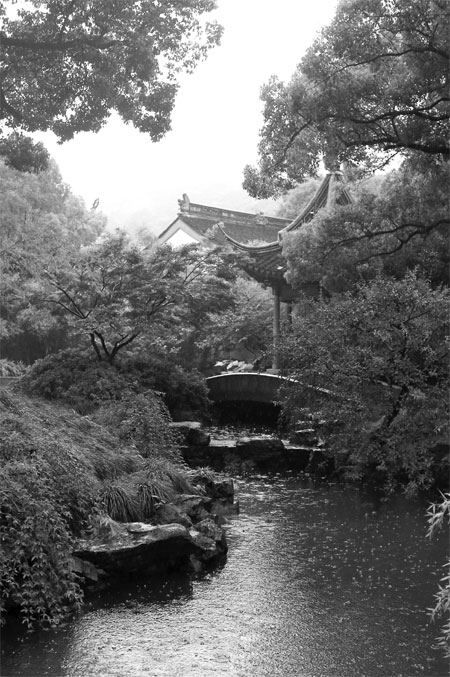
Many Chinese cities are losing their historical buildings and memories amid the largest urbanization in human history. The people of Wuxi are lucky because they can still commemorate their family ancestors in the well-protected ancestral temples not far from the western part of the city at the foot of Huishan Hill.
Many people living in Shanghai and the other parts of the Yangtze River Delta regard the ancestral temples in Wuxi as a place to cherish the memory of their ancestors because their ancestral hometown is Wuxi.
The Huishan ancient town, which perches along a branch of an ancient canal in an area of 103 hectares, is famous for its 120 ancestral temples, several private gardens and shops selling local foods, teas and clay figures, a Wuxi art specialty.
The ancestral temples lie one by one along the stone road. Each ancestral temple represents a big family active in Wuxi's history.
Nine of the families with their temples located in prominent position on the street produced dozens of capable premiers since the Warring States period (475 BC-221 BC), especially after the Tang Dynasty when China was one of the most prosperous nations in the world. Most of the other families have also produced several officials or prestigious scholars.
It is believed that building a beautiful ancestral temple showed the family's glorious past and power and also produced a competition of building ancestral temples among the big families.
The ancient town was first constructed in the Tang Dynasty (618 -907) and boomed in the Ming Dynasty (1368-1644) and the Qing Dynasty (1644-1911). Most buildings and gardens were rebuilt on the site several years ago by the government according to their old look.
Wood, black tiles, bricks and white limes are the main building materials. Overhanging eaves cap white walls. The ancestral temples vary in size, but are mostly in the same structure.
A big hall, in which wooden memorial tablets of ancestors and their preaching are worshipped, separates a courtyard in the front to the street and a little garden in the back. Artificial hills, trees, waters, bridges and pavilions are standard configuration of the temple gardens.
The five biggest family temples belong to the Xue, Rong, Tang, Yang and Qin families. Although their offspring are living around the world today, the temples serve as an indispensable site for them to get together on important occasions.
Visiting the ancestral temples in Huishan can intrigue a visitor's interest in Chinese history and literature because the more people know about the important figures worshiped there, the more feelings they can experience while stepping into the temples.
The Qin family leaves not only its ancestral temple, but also one of the most famous gardens in China, named Jichang Garden, at one end of the Huishan ancient town.
Parents in Wuxi believe seeing the ancestral temples teaches children history while visiting Jichang Garden is a good way to let them appreciate the fabulous mixture of natural beauty and architecture.
Jichang Garden, located on the east slope of Huishan Hill, was built by Qin Jin, a national defense minister in the Ming Dynasty in 1527, then passed to his son Qin Liang, a deputy governor of Jiangxi Province in 1560, and then on to Liang's nephew, Qin Yao, the governor of Hubei and Hunan in 1591.
Embroiled in a palace fight, Qin Yao was sacked 20 years before his death. He spent the 20 years building the garden from a normal one into a classic which was well protected until now.
The garden covers an area of 9,000 square meters. But the architects designed a long path meandering through the water, trees, pavilions and artificial hills. The garden appears much larger than its real size.
Qin Yao is good at borrowing views from the natural beauty by carefully setting up some visual blocks of trees, walls, artificial hills, which are the middle-range view. The skyline of the Huishan Hill in the far decorates the garden from different angles as a distance view when the visitors walk from one spot to the other. The flowers, stones and waters are the nearby view.
The multiple-layer views change throughout a day and a year, as the light, plants and water change their intensity, thickness, color and reflection. The dynamic views in the garden make it alive. Moreover, the view is also auditory. Qin Yao calculated the falling of water drops in designing the artificial hills above the pools, which makes rain and spring-water drips sound melodious.
Kangxi and Qianlong, two succeeding emperors in the mid Qing Dynasty had visited the garden six times each when they visited South China. They liked the garden so much they copied some views from Jichang in the backyard garden of the Forbidden City, their palace in Beijing.
Jin Shisheng, an architect in Wuxi, said: "I studied the garden for nearly three decawdes. I am always fascinated with new views I find in the garden. For me, studying the garden is like discovering some enigmas left by the Qin family."
liyang@chinadaily.com.cn
















