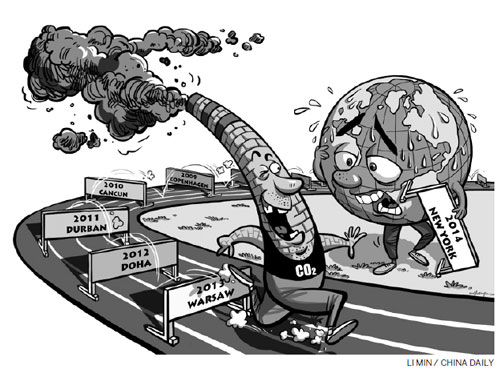
More bitter truths about climate change
The word "risk" has been used 351 times in the 127-page final draft of the synthesis report that the UN Intergovernmental Panel on Climate Change sent to governments across the world last month. The report combines three earlier, massive tomes of documents by the IPCC, all of which have gone unheeded by a world which has its priorities in all the wrong places.
The IPCC report reiterates global warming is a reality and caused by humans. And most alarmingly, it says the process could be irreversible. The report connects, in the starkest language possible, all the scientific disciplines studying the problems caused by the burning of fossil fuels.
Issuing a harsh warning, the IPCC once again illustrates what's causing global warming and what it will do to the environment, and thus humans. And, as it has been doing for years, especially since its path-breaking report in 2007, the IPCC has suggested how the problem can be mitigated, saying this is perhaps the last chance to prevent temperatures from rising by about 3.7 C by the end of this century.
A rise of 3.7 C in the average temperature worldwide may not appear to be catastrophic to people used to the comforts of air-conditioners but it means an end to the world as we know it today.
For one, it could change the map of the world. Many islands could vanish, coastlines in many parts of the world, especially in low-lying cities like Shanghai, Mumbai and New York City, could move deeper inland, and huge deltas could vanish into the seas. Glaciers from the Himalayas and the Alps to the Andes could recede drastically, if not altogether dry up, leading to a severe water crisis and droughts. More hurricanes and typhoons could wreak havoc on the Atlantic and Pacific coasts. And agricultural land could shrink creating an unfathomable global food crisis. The list of consequences is unending.
But the worst part of such a horrifying scenario is that the poor and vulnerable, and people in countries that are least, or not at all, responsible for turning nature into a fury, will be the worst sufferers.
"Continued emission of greenhouse gases (GHGs) will cause further warming and long-lasting changes in all components of the climate system, increasing the likelihood of severe, pervasive and irreversible impacts for people and ecosystems," says the IPCC report, which will get its final shape after governments and scientists go through it thoroughly at a conference on the Durban Platform for Enhanced Action in Bonn in October.
But before that, UN Secretary-General Ban Ki-moon has invited world leaders, from governments, civil society, and financial and business sectors, to a special climate summit in New York to galvanize and catalyze climate action.
The outcome of the New York conference can be in doubt, but the IPCC report says without any doubt that climate change will worsen violent conflicts and refugee problems, and could hamper efforts to grow more food. If we do not reduce GHG emissions, "climate change risks are likely to be high or very high by the end of the 21st century".
In 2009, countries across the globe set a goal of limiting global warming to about 2 C above current levels by the end of this century. It seems they have already failed to honor that agreement because, as the report says, temperatures are more than likely to shoot past that point by the middle of this century.
These are one set of facts. The other is corporate interest. The ecological revolution needed to prevent our planet from spinning out of control is not possible as long as corporate interests take precedence over the environment and thus the very existence of the human race or, for that matter, all life forms. In our pursuit of economic growth, we have broken out of the natural circle of life and entered a man-made linear production system where most goods are produced to be discarded after being used only once, polluting the already heavily polluted land, sea and air, because such an arrangement best suits economic growth.
Unbalanced urbanization and rampant overexploitation of resources, which have become the norm across the world, if not stopped, can only lead to doom. If governments across the world are really serious about securing the future of their people, as opposed to paying just lip service, they have to stop serving the interests of corporations and change the pattern of production.
Since the more goods we produce the more we destroy nature, we have to strike the right balance between production and environmental protection. Or else, as the IPPC report says, we will seriously "risk" the future of humans.
The author is a senior editor with China Daily. oprana@hotmail.com