Pollution tests show water project's next route clean, safe
As a key section of the South-to-North Water Diversion Project prepares to go into operation, water quality tests show the battle against pollution is being won.
The first phase of the central route of the South-to-North Water Diversion Project is scheduled to be launched in late October.
The water quality of 80 percent of the 49 monitored cross sections met mandatory standards last year, proving the water flowing in the central route is clean and safe, said Yu Youjun, deputy director of the State Council's office of the diversion project commission.
"Through 10 years of pollution control, the goal of supplying clean water will be achieved when the central route commences next month," Yu said.
The water transfer project, which is the world's largest, aims to transfer almost 45 billion cubic meters of water every year from the Yangtze River in the south to help curb water shortages in the north, including Beijing.
This will be achieved via three water diversion routes - an eastern route that started to supply water in December, as well as central and western routes.
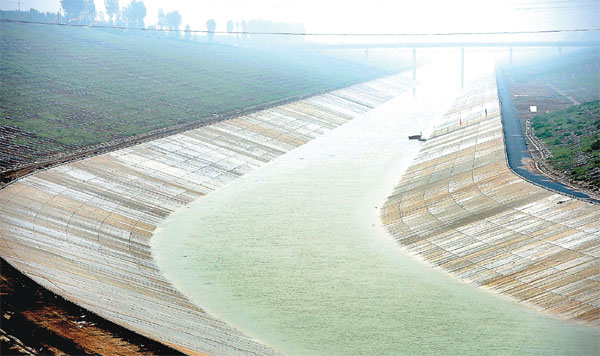
Next month, the central route will transfer 9.5 billion cubic meters of water every year through 1,277 kilometers of canals and pipes from the Danjiangkou Reservoir in Hubei province through Henan province to reach Hebei, Tianjin and Beijing in the north.
Unlike the eastern route that saw an upgrading of the Beijing-Hangzhou Grand Canal for a water diversion channel, the central route involves raising the height of the Danjiangkou Reservoir from 162 meters to 176.6 meters and building canals and pipes to divert water from the reservoir to North China.
The South-to-North Water Diversion project office has long been concerned about water contamination in areas along the central route from industry, domestic sewage and waste from urban and rural areas.
"Some rivers like the Jianhe and Guanshan (from Shiyan, Hubei province) flowing into the reservoir were polluted and even grayish-black in color because of contamination," said Shi Chunxian, an environmental protection official at the diversion project office.
"After years of pollution control, the water quality has improved."
As the water of the central route is mostly transferred in tunnels and pipes, pollution prevention measures focus on reservoir protection as well as protection of the rivers flowing into it, Shi said.
In order to guarantee the water quality of the central route, authorities invested about 8 billion yuan ($1.3 billion) to build 174 sewage treatment plants with a treatment capacity of 1.5 million metric tons per day. This was complemented by 98 waste plants processing 8,500 tons every day in the reservoir area, according to statistics from the diversion project office.
Another 2 billion yuan was invested to tackle pollution of rivers flowing into the Danjiangkou Reservoir, and more than 1,000 polluting companies, including paper plants and mines, were closed, the office said.
Zhao Yingmin, director of the pollution prevention department under the Ministry of Environmental Protection, said the pollution control measures were "effective", with only 5 percent of the water flowing into the reservoir failing mandatory water quality standards.
From January to August, the water quality of the Danjiangkou Reservoir maintained standards above Grade II, according to the Ministry of Environmental Protection. Grade III is lower than Grade II and the minimum standard for drinking water after treatment.
"After going into operation in October, samples of water from seven cross sections will be tested to identify 24 items including dissolved oxygen, odor and color," Zhao said.
By then, the project will provide about 30 percent of Beijing's annual water consumption.
The capital also set up three 24-hour water quality monitoring centers in the Huinanzhuang pumping station, the Daning surge tank and Tuanchenghu lake to tackle emergency pollution incidents, said Qiu Wenshun, director of the water diversion center under the Beijing office of the project.
"Once a water contamination incident occurs, we will shut off sluices to prevent polluted water entering the water supply system and use the Miyun Reservoir as a backup source," Qiu said.
In addition to Beijing, the new water supply will come as a huge relief to northern provinces and regions, which suffer from severe water scarcity caused, in part, by excessive groundwater pumping.
Research by the China Geological Survey showed the North China Plain is one of the most vulnerable areas facing land subsidence due to excessive groundwater pumping and economic development, with the surface level of Cangzhou, Hebei province, sinking 2.4 meters since the 1970s.
"Without the project, Beijing and Tianjin may face severe land subsidence due to years of excessive groundwater pumping, threatening city security," Yu said.
While easing the diminishing water table, he said, a 30- to 60-meter-wide green belt of grass and trees is being built along both sides of the central route.
As of the end of July, about 249 billion yuan, or 98 percent of the project's total investment, has been spent, official statistics showed.
wangqian@chinadaily.com.cn
|
A channel leads to Danjiangkou Reservoir, the main water source of the South-to-North Water Diversion Project's central route.? Xiang Mingchao / China Daily |