


Chinese consumers can be a big growth driver in Asian markets
|
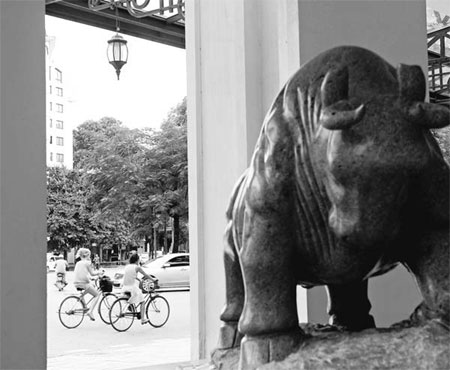
A statue of a bull stands at the entrance of the Hanoi Stock Exchange. Vietnam's stock exchanges are expected to benefit from the country's strong economic performance and the loosening of restrictions on foreign companies. Photo by Agence France-Presse |
Vietnam is the darling of frontier markets. It is big enough to attract investors and has enough infrastructure in place to drive an already impressive market performance - although hurdles remain.
Current efforts toward integrated stock exchanges in the Southeast Asian region, alongside similar programs in other parts of Asia, are expected to further boost Vietnam's liquidity.
In August, Vietnam's stock markets outperformed those of other members of the Association of Southeast Asian Nations after three straight months of growth. By Sept 12, the Ho Chi Minh Index was trading at 632, up more than 115 points in four months.
The booming economy of this Southeast Asian country of 90 million people is easily seen in its GDP. In the second quarter of this year, its GDP rose 5.25 percent, according to data released in June by the General Statistics Office in Hanoi. In the first three months of the year, GDP climbed 5.09 percent.
The national currency, the dong, has dropped in value as part of an effort to spur exports. Bank lending has been rising. Direct foreign investment in the first half of the year was around $5.75 billion, up almost 1 percent from a year earlier.
Analysts believe the best way for investors outside Vietnam to tap into this growth would be through the stock markets in Ho Chi Minh City and Hanoi.
"We believe that there will be tremendous growth in the future from IPOs (initial public offerings) or recapitalization," says Thomas Hugger, CEO of the Asia Frontier Fund, a relatively new fund that invests directly in Vietnam.
Nguyen Chi Dung, Vietnam's deputy minister of planning and investment said: "Vietnam has a target to become an industrialized country by 2020 with GDP per capita of about $3,000. Investment is key to improving the economy and development."
At the moment, a series of barriers and an inordinate amount of red tape make it very difficult even for institutional investors to tap into the stock markets in Ho Chi Minh City and Hanoi. Also, the existing 49 percent maximum foreign ownership rule for listed companies prevents investors from plunking more money into Vietnam's stock markets. Some companies are already at the limit.
But institutional reforms are already underway.
Speaking at a conference in Ho Chi Minh City in June, Nguyen said that the country was embarking on a path of institutional and infrastructure reforms. Infrastructure reforms (such as better ports and airports) are relatively easy to undertake. The institutional reforms may take longer.
Last month, for example, Vietnam issued its first domestic exchange-traded fund and raised about 200 billion dong ($9.4 million) as a result. That is about twice what it was aiming for.
To spur trading and valuations on its stock markets and be on par with Singapore, Hong Kong or Malaysia, Vietnam must open the doors wider to foreign investors.
Otherwise, "there is a long way to go for Vietnam", says Bui Quang Ngoc, CEO of FPT, a Vietnamese conglomerate.
A series of initiatives in Asia could help the country reverse this direction. More bourses are working together to facilitate mutual investment and a growing web of cross-investment deals is already visible and poised to grow.
In the Asia-Pacific region, there are different forms of mutual market access, explains Melody He, head of capital markets at CSOP Asset Management. As the 2015 launch of the ASEAN Economic Community, a single regional market, approaches, many of the 10 members of the association are already working more closely together than ever before.
On Aug 25, three ASEAN stock markets - Singapore, Malaysia and Thailand - took the first solid steps toward more integrated markets after years of planning. The ASEAN Collective Investment Scheme framework allows fund managers to offer cross-border funds directly to retail investors in these countries.
The program works on the back of ASEAN capital market integration, which aims to allow brokers in one country to trade in the others.
The ASEAN project is just one of several in the region. A similar effort between the Shanghai Stock Exchange and the Hong Kong stock exchange could facilitate more access to investors in both markets.
This upcoming Shanghai and Hong Kong MMA agreement, known as the 'through train scheme', will allow investors from the Chinese mainland that meet certain conditions to invest in Hong Kong stocks while opening the door for more investors in Hong Kong to invest in Shanghai.
Observers expect the through train scheme to benefit both sides. On the one hand, the outflows of capital out of China could grow as investors pour money into more transparent Hong Kong stocks. This could help with the ongoing internationalization of the yuan. A recent study by the Bank of England suggested China's gross international investment position could increase from 5 percent to over 30 percent of global GDP by 2025.
If successful, the through train scheme could lead to the inclusion of Shanghai A shares (denominated in yuan) in global stock indices as early as 2016.
Such inclusion could generate as much as $8.3 billion in new demand for these stocks, says Francis Cheung, head of Mainland-Hong Kong strategy at investment brokerage CLSA.
Credit Suisse's head of China research, Vincent Chan, agrees that the inclusion would increase the internationalization of the A share market, but says the impact of the internationalization of the Asia market is likely to be more limited until Chinese institutional investors become big investors in overseas markets.
"For global investors, their investment interests in China could largely be satisfied by China stocks listed in Hong Kong and the US," says Chan. "Global investors are definitely interested in the scheme, but they still have some hesitations in areas like taxation, foreign ownership and settlement."
Will Stephens, Deutsche Bank's Asia synthetic equity and derivatives strategist, says the MMA is a "significant opportunity for regional and global investors" and will help drive liquidity coming into the region.
As the links between China and markets in the region grow, developments in one increasingly have an impact on the other.
Marc Faber, a long-time Asia-focused investor and author of the Gloom, Boom & Doom report, expects markets in Asia, like those in Vietnam, to start posting strong performances.
Asian markets are down about 50 percent, on average, from the peaks they reached in 2007. Meanwhile those in the United States continue to set records, almost on a daily basis.
It is conceivable, he says, that bourses in developed markets will start to come down and "markets like Vietnam start to grow".
"The export performance of Vietnam has been the best of the emerging markets," he says.
With much of the population of the world living in emerging markets "this is where the future opportunities will be".
A big driver of the growth in Asian markets like Vietnam will be the Chinese consumer market, which "has risen faster than in any country in the history of the world", Faber says.
As things stand today, the valuations of listed companies in Vietnam are not only reasonable but attractive, and a slow but inexorable push toward markets opening up will help investors take advantage of these opportunities.
Investors in Asia, particularly China, are likely to benefit first, not only because that is where much of the foreign direct investment is coming from but also as a result of deals like the one between ASEAN stock markets or the through train scheme between Shanghai and Hong Kong.
"The big opportunity for Vietnam is in China, not the US or Europe," says Faber.
Don Lam, founding partner of Vietnamese asset management firm VinaCapital, agrees. Foreign investors, he says, are likely to pour into markets like Vietnam. But while Europeans are cautious, Asian investors are more bullish.
"Vietnam has received the highest FDI commitments of all countries in Asia except China and India," he says.
With valuations that are cheaper than elsewhere in the region, stability and the prospects for greater openness, stock markets in Vietnam are poised for growth.
















