Asia-Pacific trade pact given APEC support
Experts say regional accords are not mutually exclusive
In what Chinese President Xi Jinping called a historic step, Asia-Pacific Economic Cooperation members agreed on Nov 11 to launch an effort to build a regional free trade framework.
Leaders of the 21 member economies agreed in Beijing to start work on the Free Trade Area of the Asia-Pacific. Xi praised the agreement as a show of APEC's willingness to advance regional integration.
APEC member economies will begin studying issues surrounding the free trade area and will submit recommendations by the end of 2016, according to a statement released after a two-day meeting of APEC leaders.
The new free trade area comes as the Washington-led Trans-Pacific Partnership trade negotiation has stalled due to disagreement between the US and Japan over agricultural tariffs.
China's goal is to "counter the growing trend of fragmentation in the region that directly undermines economic integration, not the TPP or any other specific free-trade agreement", says Tang Guoqiang, president of China National Committee for Pacific Economic Cooperation.
Xi said in his APEC speech that the new free trade area does not go against existing free trade arrangements and can be the aggregate of existing free trade arrangements to consolidate regional integration and define long-term goals.
Chinese experts say the free trade arrangements in the region are not mutually exclusive and they highlighted the leaders' desire to explore different means to achieve the goal of promoting trade and removing protectionism.
Fu Xiaolan, director of the Technology and Management for Development Center at the University of Oxford, says APEC's Beijing road map for promoting the new free trade area will further strengthen free trade cooperation and competitiveness in the Asia-Pacific. The collaboration among APEC members will prove beneficial for China's integration with the global trade system, Fu says.
Meanwhile, APEC members adopted a blueprint on Nov 11 to strengthen physical, institutional and people-to-people connectivity and promote regional bonds. The blueprint asks members to make substantive moves and meet agreed-upon targets by 2025.
Xi said leaders of the APEC economies agreed to invest in Asia-Pacific connectivity in all dimensions under the blueprint.
The document contains existing connectivity-related initiatives and encourages revival of those requiring further progress, and it proposes future initiatives for a more efficient flow of goods, services, capital and people to drive the organization's progress. It is broad in scope and was characterized as being adaptable to the ever-changing conditions in the Asia-Pacific region.
"We envision this blueprint accelerating and encouraging balanced, secure, sustainable and inclusive growth, as well as connecting growth poles in the region and bringing the APEC community closer together," Xi said at a news conference on the achievements of the APEC Economic Leaders' Meeting on Nov 11.
Despite the organization's progress in promoting connectivity in previous years, many challenges remain. On physical connectivity, there is still a disparity in access to, and quality of, physical technology infrastructure throughout the region, as well as a significant gap in the ability of existing institutions to promote connectivity due to various regulatory constraints.
On people-to-people connectivity, much work needs to be done to ease existing barriers to interaction and mobility, and to develop joint endeavors that will support seamless flows of people.
To tackle these issues, Xi said the APEC members will focus on raising more funds for infrastructure development and breaking the financing bottleneck - for example, through public-private partnerships.
The APEC economies, especially China, South Korea, Thailand and the United States, are keen to encourage people-to-people connectivity to drive advances in the educational sector and assist member nations or regions to better respond to natural disasters such as extreme weather, earthquakes and tsunamis.
Contract the writers through zhangyunbi@chinadaily.com.cn
Zhong Nan contributed to this story.
|
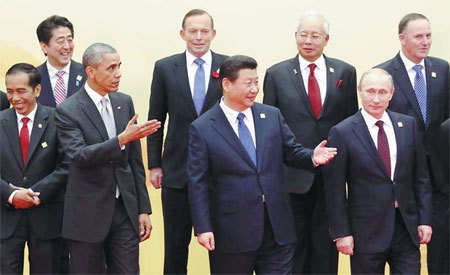
Leaders at the APEC meeting in Beijing on Nov 11. Pictured are President Xi Jinping (center, front), US President Barack Obama (left) and Russian President Vladimir Putin (right), and in the back are Japanese Prime Minister Shinzo Abe, Australian Prime Minister Tony Abbott, Malaysian Prime Minister Najib Razak and New Zealand Prime Minister John Key. Wu Zhiyi / China Daily |