


EU: China can do more to limit CO2
Europe may pressure China to ramp up its efforts in fighting climate change, legislator says
The European Union may pressure Beijing to "scale up" its climate change commitments so that China's carbon emissions peak at 2025, says Jo Leinen, chairman of the European Parliament's delegation for relations with China.
The call for stronger action comes days after China and the United States announced new limits on CO2 emissions at the recent Asia-Pacific Economic Cooperation meeting in the Chinese capital. In the deal, President Xi Jinping said China would make every effort to have its CO2 emissions peak around 2030.
|
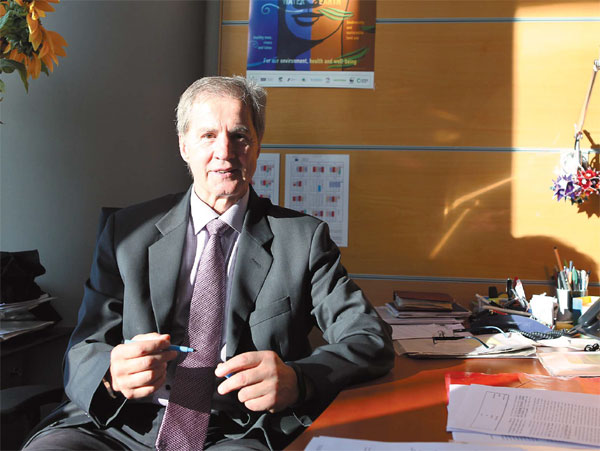
Jo Leinen, chairman of the European Parliament's delegation for relations with China, says the EU and China should work on an emissions cap and trade system to impose prices on carbon emissions. Fu Jing / China Daily |
US President Barack Obama vowed that the US would cut its own emissions by 26-28 percent by 2025 from a 2005 base.
But Leinen, who was also the chairman of the European Parliament's committee on the environment, says: "Both Brussels and Beijing need to scale up their commitments."
There is the opinion in Brussels that China's carbon emissions could peak in 2025, he says.
As part of the deal with the US, Xi said that around 2030, 20 percent of its energy would come from renewable sources.
The EU has taken a stronger course of action on climate change in recent months. In October, it struck a deal that legally binds its member countries to cut their greenhouse gas emissions 40 percent below 1990 base levels by 2030.
"All (countries) need to scale up and Brussels needs to do more," Leinen says.
While he calls for China to employ a stronger climate change plan, he also says the country has been more outspoken in global climate talks and there are signs from the Chinese leadership it will discuss the deal's time contingency in Paris.
"That will help a lot because the uncertainty of the peak year in China is putting the whole global system in doubt," he says." So the peak year (put on the table) would be good. 2030 is too late and it has to be earlier."
He says Brussels would like to see China hit a peak of its C02 emissions by 2020, but a compromise between 2020 and 2030 could be reached. He also admits the EU's 2030 target of cutting their greenhouse gas emissions 40 percent below 1990 base levels is not good enough to stabilize global warming.
"I think we can do better. There is a review clause in the decision by the European Council. By 2020, we can review these goals and improve upon them," he says.
In addition to reviewing its climate change goals, the European Parliament could put more pressure on member countries to create tougher renewable energy and efficiency targets, he says.
But one major challenge has loomed large since the 2008 global recession: getting member states in economic straits to be more ambitious in the absence of a binding international agreement on the environment.
"If in Paris, the biggest emitters - the United States and China - have ambitions, goals and objectives, I would say Europe is ready to do more," says Leinen. "Unilaterally, I doubt that the political will (in the EU) exists for us to be far ahead of anybody in the world."
Leinen says the EU needs its ambitions to be matched by the world's major economies, which includes China and the US.
The EU and China currently are cooperating on several climate protection projects that include technology transfers, power generation, transportation and heating and cooling.
"I think this intensive cooperation should be more intensive. And I hope the next EU-China Summit will focus on these areas of sustainability, especially on climate protection," Leinen says.
Despite its continuing transition from a developing country to a more developed one, China has a strategy for the future to have a clean country, clean industries and clean cities that will benefit the nation and the world, Leinen says.
"That is I think most welcome. China is one country with two faces: the old face and the new," he says. "Its responsibility is always for more than their own territory."
He says the EU and China should work on an emissions cap and trade system to impose prices on carbon emissions and create competition between different market players to further reduce emissions. He compliments the nation for its considerable investment plan in renewable energies and advanced battery technologies for electric cars, though he also wants to see the nation modernize its modes of transportation, energy production and urban construction.
"A lot of these quickly built cities of the last 30 years in China are not sustainable. They are more like copies of the cities around the world that are also not sustainable," he says.
Despite his criticisms of China, Leinen agrees that public sentiment about the European Parliament is "not good" but that "we always try to improve our image, our profile".
What makes the European Parliament unique is its diversity, he says.
"We have hundreds of legislators, 65 different political parties from 28 member states. So we are quite diverse in our opinions, our interests and sometimes it looks, from the outside, quite complicated and difficult."
Though some countries in Europe are aiming criticism more directly toward human rights issues in China, others might look toward advancing economic cooperation.
"Then it's the question of how you look upon China. If you look at economics, then you have hopes; if you look at its politics, you could see problems," says Leinen. "But under my leadership, I will take care of our relationship and develop it."
Leinen says he will try to improve the relationship between Europe and China to achieve a common mutual understanding about political systems and cultural systems in order to solve problems as they arise.
"The bilateral relationship can be complementary in economic development, as well as in the major issues ranging from climate protection, free trade and space exploration policies to cooperation on satellites."
Contact the writers through fujing@chinadaily.com.cn
















