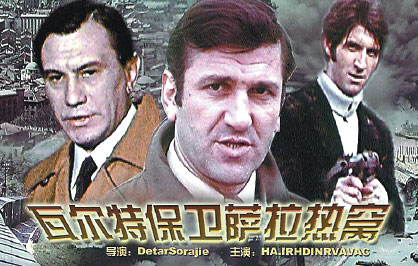
Generation of Chinese film goers took Yugoslav drama into its heart
For Chinese people who have hit the half-century mark, scenes from a film depicting wartime Yugolsavia can be recalled with almost consumate ease.
The 1972 Serbo-Croatian language production on underground partisans during World War II, Walter Defends Sarajevo, which is perhaps unfamiliar to most Western filmgoers, is an important collective memory for one generation of Chinese people.
The film shows the twists and turns as Walter's partisans fight the Nazis. At the end of the film, a Nazi officier stands on a hill overlooking Sarejevo and realizes that the reason he could not defeat Walter is that the city is Walter.
"It's romantic, not didactic," said Lu Fei, an actor from Beijing Film Studio, who dubbed the partisan leader Walter's voice in Chinese. "My love for this story encouraged me to put all my emotion into creating the voice," Lu said.
"Every time I was introduced to others, I was called 'Walter', and people were always amazed."
"I watched the film five times in a row when it was released in the late 1970s," recalled screenwriter Wang Xingdong, deputy director of the China Film Association. "Also as a Socialist country, Yugoslav aesthetics for art shared many similarities with China. However, the film stunned me."
It was among the first foreign films to be screened after the "cultural revolution" (1966-76), and together with another Yugoslav World War II-themed film, The Bridge, opened horizons for a Chinese audience eager for knowledge of the outside world.
"I still clearly remember one man sitting by me in the cinema who kept murmuring about the Western furniture in the scenes," Wang said with a smile.
"Though China also produced many revolutionary films, they generally lacked a detailed portrayal of humanity. However, the old Yugoslav films express the conflicts of human nature while conveying strong patriotism."
The vagaries of history also played a role.
"Due to the political split between China and the Soviet Union in the late 1960s, Yugoslavia, Romania and Albania were the only Eastern European socialist countries that still exported films to China at that time," explained Wang Yao, a 30-year-old film critic and doctoral candidate at Beijing Film Academy who focuses on Eastern European films.
"Most of these imported films were only circulated among film professionals as references," he said, adding that Walter Defends Sarajevo and The Bridge were among the few that were released to the public.
"Chinese filmmakers in the 1980s tended to mimic their styles in creating stories," Wang said.
Today it is a different situation. Apart from award-winning director Emir Kusturica, few modern Serbian filmmakers' names are familiar among Chinese filmgoers nowadays.
"In the time of DVDs, Kusturica is probably the only globally acclaimed director not only from Serbia, but from Eastern Europe," Wang sighed. He readily admits that his reason for studying Eastern European films is the nostalgia shown by his tutor.
"Eastern Europe's cinemas are confronted by the strong impact of Hollywood movies. In some countries, their domestic films only account for less than 3 percent of total box-office revenue. But that never means the art standard is mediocre."
However, film co-production agreements have become more common during Chinese leaders' visits overseas, and Premier Li Keqiang's visit to Serbia will probably arouse public interest in whether closer screen collaboration will follow.
Embassies are the major organizers of film promotion. Serbia held its first Chinese film festival in its capital, Belgrade, in 2012, and Ruma hosted an outdoor Chinese film exhibition in August. Beijing's Broadway Cinematheque, known for its preference for art house productions, staged Serbian film exhibitions twice, in 2010 and 2013.
wangkaihao@chinadaily.com.cn
|
A poster for Walter Defends Sarajevo. Provided to China Daily |