


China grapples with shale gas as long-term energy solution
Concerns over import dependency force firms to search for other fuel sources
With their eyes on long-term diversification of domestic energy supplies, Chinese oil giants will maintain their shale gas exploration drive this year even as global crude prices have tumbled.
Affected by weakening demand from China, the world's second-largest oil consumer, and a glut in the global market, the spot price for West Texas Intermediate Crude plunged below $50 (42.5 euros) per barrel on Jan 5, the lowest since April 2009.
|
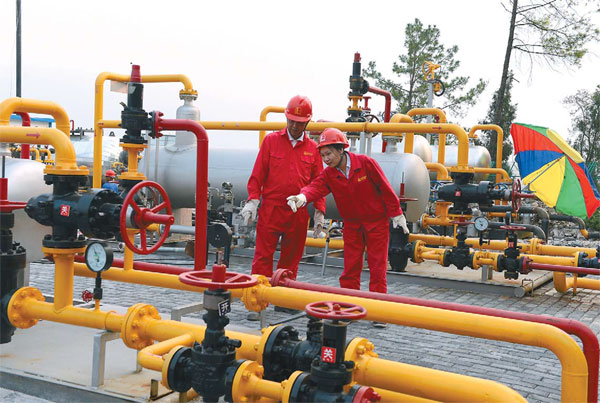
Workers check shale gas transmission pipeline in Chongqing. Provided to China Daily |
Another benchmark, Brent crude, fell to about $51 per barrel, a decline of more than 55 percent since June.
These declines will affect China's top three oil companies' performances in 2015, especially China National Petroleum Corp and China National Offshore Oil Corp, which mainly focus on the upstream end of the business, says Liu Yijun, a professor at the China University of Petroleum.
"The oil companies may reduce their investments in unconventional oil and gas exploration this year because the falling crude price makes imports more economical," he says.
However, Liu says that developing unconventional energy sources, especially shale gas, is mandatory in the long term, considering China's growing dependency on imports. The nation receives up to 60 percent of its oil from imports.
Another factor is the government's determination to increase clean fuel's role in the energy mix.
Melissa Stark, managing director of consultancy Accenture Plc's new energy business, says traditional major crude producers such as Mexico do not have any incentive to explore unconventional energy sources like shale gas due to their low economic growth rates and rich oil reserves.
But China is different because of its growing domestic demand.
"Some traditional crude producers in the Middle East are looking at alternative energy sources or making their crude more valuable by extending industrial chains," she says.
"Facing growing demand and imports of crude oil, China must develop shale gas as a national strategy for long-term benefits, considering its huge reserves."
An anonymous official with CNPC says the company has lowered its profit outlook for this year because of falling crude prices, but it will not change its shale gas development plan.
CNPC, the nation's biggest oil and gas producer, is increasing the role of its natural gas unit. It produced only 100 million cubic meters of shale gas in 2014, but plans to increase that to 2.6 billion cubic meters this year.
China Petroleum & Chemical Corp (Sinopec), the largest refiner in the country, is leading the domestic shale gas industry with annual production capacity of 2 bcm. It aims to raise that figure to 10 bcm by 2017.
Lyu Dapeng, a spokesman for Sinopec, told reporters in December that the company's upstream unit had experienced "huge losses" because of the crude oil price decline, but it would not slow down its shale gas development.
According to Jiao Fangzheng, vice-president of Sinopec, the drilling cost of each shale gas well is about 100 million yuan ($16.2 million). "The cost of shale gas is still high in China, but it will go down as economies of scale improve and the technology matures," says Jiao.
However, some industry sources expressed concern that falling crude prices will affect shale gas exploration.
Tang Yanchuan, a researcher with CNPC, says there will be no profit margin for domestic shale gas explorers if the crude price stays below $70 per barrel in the long term.
Yue Laiqun, a researcher with the Ministry of Land and Resources, says: "Compared with large enterprises, private companies should pay more heed to the high risks of shale gas development."
He says that large, state-owned energy companies possess the capital, technology and human resources that private ones lack.
Private energy companies' enthusiasm for shale projects has waned in the past two years.
During the first and second rounds of China's shale gas block auctions in 2012, there was a lot of enthusiasm among private companies that saw huge potential in the industry, boosted by government support and subsidies.
However, the president of a private oil company who declined to be identified says that his company will not join the third round of shale gas block auctions, which will be held soon. "The crude price fall is a big factor and shale gas is not attractive for us anymore," he said.
dujuan@chinadaily.com.cn
















