China's dairy enterprises leave a sour taste with farmers
If Chinese dairy enterprises, with local governments as their large stakeholders, do not improve their technology, marketing and credibility among Chinese enterprises, more and more dairy farmers will go bankrupt, as imported dairy products flood the Chinese market.
The price of raw milk has fallen about 30 to 40 percent in New Zealand, Australia and the European Union since last August because the EU plans to cancel its milk quota, and Russia will strengthen its control on food imports.
The surplus milk from the developed countries is mostly turned into milk powder and sold around the world. Chinese dairy enterprises turn the cheap milk powder back into milk, further squeezing the raw milk market at home.
Some dairy farmers have slaughtered their milk cows and poured fresh and raw milk into gutters in northern China starting in August. Ironically, such actions used to be criticized in China's political science textbook as evidence of the weakness of the Western capitalist system, which was said to be unable to prevent periodic economic crises stemming from overcapacity and a widening income gap.
The Agricultural Ministry urged dairy enterprises to purchase the raw milk from the farmers, and asked local governments to help the farmers overcome difficulties.
Some experts even suggest launching an anti-dumping investigation into imported dairy products from developed countries.
But those measures cannot solve the root cause of the problem within China's dairy industry.
Chinese dairy enterprises are expanding their foreign investment and importing large sums of normal-temperature milk.
The current poor sales of raw milk in China are caused by changes in international markets as well as the global development strategy of Chinese dairy enterprises.
China's dairy cow-breeding industry operates on medium and small scales. The dairy farms' production costs are markedly higher than their counterparts' in developed countries. China's milk cows are of poorer breeds and lack high-protein feed.
The "melamine scandal" in 2008, which involved dozens of famous Chinese dairy enterprises and has caused kidney stones in hundreds of babies - because the dairy farmers put the industrial chemical into raw milk to increase its protein content to pass the dairy enterprises' test- has ruined the credibility of China's dairy industry among Chinese consumers.
China urgently needs to construct a comprehensive dairy industrial system of pasteurization, epidemic prevention and hybridization, which should be put under supervision to ensure food safety. India has done so from the 1970s, and now Indians drink only Indian milk, which is of high quality and cheaper than foreign milk.
China's dairy industry developed extremely fast after the 1990s, under a loose supervision system.
In the excessively fast expansion of dairy markets, few enterprises paid attention to improving the quality of their products or the technology of their production. Increasing subsidies for the industry or decreasing imported dairy products only extend the crisis of the Chinese dairy industry.
Chinese people mainly consume normal-temperature milk, which can be stored longer, rather than the pasteurized fresh milk, which has a much shorter shelf life, higher requirements for raw milk and is more nutritious.
That is a main reason why China's dairy industry is easily influenced by changes in the international dairy market, in which the normal-temperature milk is the main good.
To lower the prices of imported formula powder at home so as to meet the strong demands of Chinese consumers for high-quality formula powder, Chinese authorities conducted an anti-monopoly investigation into the dealers.
It is ridiculous for a country to impose both anti-monopoly and anti-dumping investigations against the same products at the same time.
Protecting the backward national dairy industry does no good in the long run. As more and more Chinese people can afford to drink milk, China's demand for dairy products will steadily increase.
China consumes about 40 million to 43 million tons of raw milk each year, and China's annual raw milk output is about 35 million tons.
|
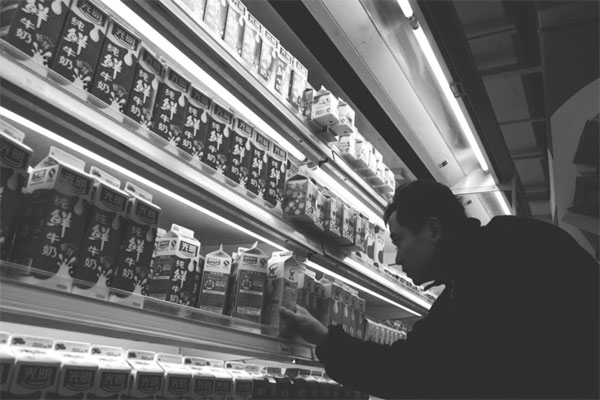
A consumer is choosing milk in a supermarket in Shanghai. Dairy products produced byChinese enterprises need to rebuild their credibilityamong domestic consumers. Gao Erqiang / China Daily |