All the way on autopilot
|
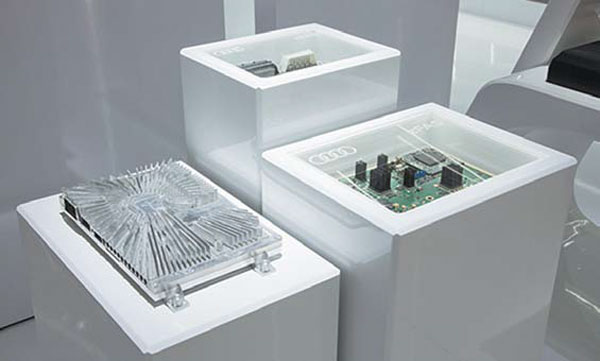
Audi's zFAS driving systems on its autonomous driving model. |
The cars of the future seem to be just around the corner
"Ladies and gentlemen, as we prepare to take off, please ensure your food tray is still out, your foot rest is still down, and your seat is still fully reclined." Welcome aboard the car of 2035.
As it gains cruising speed and you sit back and read the electronic device that turned the iPad into a museum exhibit a few years earlier, your personal pilot, a small box in the boot, will make the complicated calculations that will get you to work safely.
That may all seem like pie in the sky, but it gives you a rough idea of what many traditional carmakers have planned for the motoring of the future.
They do not necessarily agree on the technological route they will take in building their self-driving cars -although most foresee the steering wheel being with us for many years to come - but they do see such cars as inevitable.
That is no doubt one reason why the prototypes of these cars make a big splash at consumer fairs, one of the latest being the International Consumer Electronics Show in Las Vegas in January. Almost every major auto brand, including Audi, Ford, Mercedes-Benz and Nissan, had prototypes, or plans for them, on display.
It seems that in a very short time these cars, until recently figments of fantasy, have made it from the drawing board into the showroom.
Ten years ago, competitions began to be held in the United States that pitted driverless cars against one another. Initially they were held in deserts, with no passengers, few rules and a destination 240 km away. None were smart enough to complete the task, which makes the progress that has since been achieved all the more remarkable.
In fact these vehicles have evolved into motoring marvels that can weave their way through city streets and roundabouts effortlessly, unscratched and without hurting a soul.
Dieter Zetsche, president and CEO of Mercedes-Benz, calls self-driving cars "the hottest next wave" in the car industry, and the US market study institute Lux Research predicts that 120 million of them will be sold in 2030, sales in China accounting for 35 percent of them.
The body of the Mercedes-Benz on show in Las Vegas was replete with sensors and scanners. The interior had all the hallmarks of the luxury associated with the brand, with high-resolution touch screens and four seats that could be fully rotated. Passengers can communicate with the car using hand gestures, touch screens and eye movement.
The same day that Mercedes introduced its car, an Audi drove itself into the exhibition center from Silicon Valley - 900 km away.
The Audi is equipped with a digital camera, a laser scanner and a radar that are said to enable it to give it full awareness of its surroundings. However, its driverless capabilities remain limited, coming into play only on highways.
The brains of the car, half the size of a shoebox, are in the boot, eight computers that perform different functions. Further illustrating the rapid progress in developing the technology, two years ago these brains took up the whole boot.
Nick Jaynes of the website Digitaltrend test-drove the Audi in Las Vegas. He wrote that when the driver pretends to fall asleep an alarm sounds, and if the driver fails to react in 10 seconds by stepping on either the brake or the accelerator, or touching the steering wheel, the car slows and eventually stops.
As admirable as that feat in protecting life and limb may be, a driverless car that Google is developing and that has no steering wheel has traveled a little more than 1 million km with no human control.
So for the moment some observers are saying the kinds of cars that Mercedes or Audi are putting through their paces are little more than fancier versions of their current premium cars that are equipped with deviation alarms and adaptive cruise control systems.
Even if the carmakers share some basic understandings of safety, there are many matters relating to self-driving cars that have them divided. Reuters has reported that "standards are not yet defined, winners and losers are not sorted out and major players disagree sharply about the best way to bring the promise of safer, smarter cars to market".
Such questions have long remained academic, but that has begun to change, given that Google put a driverless prototype last year, Audi says it will be mass producing a self-driving car in three to five years, and that Nissan says it will put one on the market by 2020.
Thomas Ruchatz, head of Audi driver's assistance system and vehicle safety division, says Audi will add more driverless elements into the car until it becomes totally autonomous.
Self-driving cars will not obviate the need for people to be licensed to drive. Indeed in their current state of development the cars require additional driving skills, motorist needing to be at the ready to handle situations that computers cannot.
California and Nevada already have regulations specifically for self-driving cars, among them being that drivers must undergo training before taking to the road in the new vehicles.
Despite the remarkable progress being made in self-driving cars, it is clear that human beings remain the most competent drivers. While the self-driving cars can dodge obstacles protruding from the ground, they are notoriously unreliable for spotting and avoiding pits or holes.
Chris Urmson, head of Google self-driving cars, says the cars lack the nous to tell a paper ball from a stone, and the only reaction is to steer clear of the obstacle. Neither can these smart cars discern that the person ordering a motorist to stop is a police officer.
Because of those limitations it is not hard to find those who are unimpressed by the idea of self-driving. He Hangen of the National University of Defense Technology in Hunan province says he does not think that cars can drive themselves in any real sense.
"Self-driving cars are designed to help human beings and make them safer and more comfortable," he says. "But the intelligence of cars and humans are complimentary rather than replaceable."
He acknowledges that these cars can complete missions in dangerous situations such as fires, nuclear pollution and in battle, adding that the US has said that one-third of its military vehicles will be driverless by 2020.
wangchao@chinadaily.com.cn