


Many Chinese tourists on a learning curve
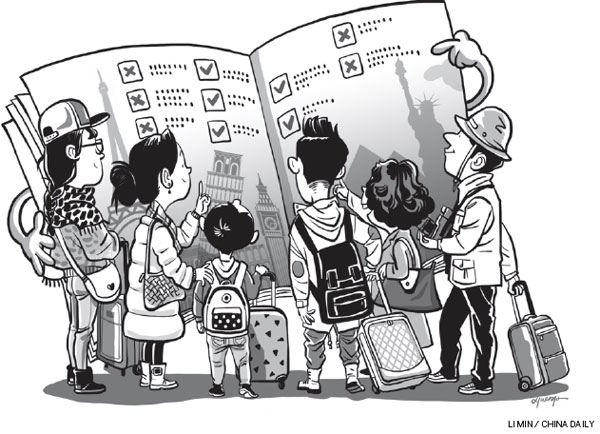
As the number of Chinese travelers taking trips abroad is projected to be greater than those travelling domestically during the upcoming Spring Festival, we are likely to hear more about the antics of some Chinese tourists abroad in the media this year. Last year's high-profile incidents were aptly put into perspective by most media outlets - the few outrageous incidents were hardly representative of Chinese tourists overall given more than 100 million Chinese traveled abroad last year. But Chinese tourists can expect more scrutiny simply because they are a relatively new phenomenon.
Another reason for the visibility of Chinese tourists, especially in some countries in Asia, where their numbers have become substantial, is that a greater proportion of Chinese compared to travelers from most other countries travel in groups. A propensity to travel in tour groups is partly due to time-restrictions (most employees can only take their holidays during specific times of the year such as the Lunar New Year "shutdown") and partly due to inexperience or timidity - most Chinese are unable to speak English, many are on their first trip abroad. So these new tourists feel safer in groups. But groups of like-minded compatriots tend to become a gaggle, raucous, boisterous, and oblivious to their hosts' finer sensitivities.
This is not much different than groups of tourists of other nationalities, and when I hear in Thailand - where I am writing this from - the lament that Chinese groups can be loud and socially inept, it reminds me of the place where I grew up, in a Mediterranean island, where groups of Germans or English also behaved with loutish offensiveness when I was young. It's not only certain types of Chinese who are oblivious to cultural sensitivities, although this doesn't of course excuse any Chinese - or other national - from bad behavior.
Yet the point to make is that these tourists aren't consciously disrespectful, for even within Chinese these same people can appear crude and loud among the more urbane Chinese. After all, there are many people in China who have acquired wealth before a concurrent assimilation of sophistication; it's not only the educated and cultured Chinese who travel.
Moreover, for many Chinese tourists, an inability to speak or read English, tourism's de facto lingua franca, makes their interactions awkward and makes them unaware of subtle sensitivities. Chinese tourists can often be seen eating instant noodles, I am sure they would like to sample the local food if only they could read the menus or have the courage to make fluent enquiries in a restaurant. But the unadventurous abroad often resort to familiar comfort foods. In this sense, any offensive or uncouth behavior is not so much rudeness but clumsiness; it's largely a case of bewildered-tourists-abroad acting clumsily due to lack of knowledge and inability to communicate.
There is certainly a learning curve ahead for many Chinese tourists, and the Chinese government's publication of a code of conduct for travelers will obviously expedite that process. Moreover, President Xi Jinping, who is often said to be China's preeminent tourist, has been highlighting these issues, and his recent call to Chinese tourists to eat less instant noodles is welcome precisely because his words serve to inspire.
So, although the Chinese media and government have a part to play in educating the Chinese about sensitive and immersive travel, in time people in places where Chinese travel will get used to the particular quirks and whims of Chinese travelers. In the meantime people in host countries should bear in mind that many of the Chinese they come across will be making their first tentative forays out into the world beyond - and first steps are often awkward.
The author is a freelance writer that specializes in culture, travel, and lifestyle.
??????????????????????????????????????????????????????????????????
???????????????????????????????????
















