


Flip-flop man treads new path by identifying market needs
|
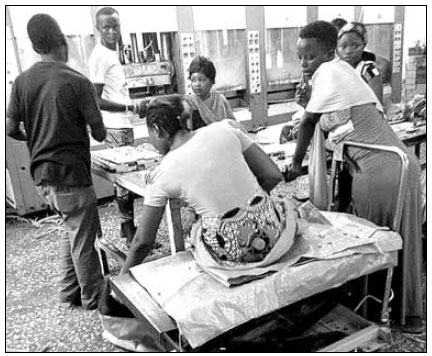
Local employees at a workshop in Dar es Salaam, Tanzania. Provided To China Daily |
Trade in commodities has been the dominant feature of China-Africa relations over the past 20 years, but many traders, particularly those who arrived in Africa early, are now well aware that there must be more to the relationship than that.
"It's very important to set up a factory in Africa to ensure that one's products have staying power in this market," says Wu Quanman, owner of Li Lai International in Dar es Salaam, which makes flip-flops.
He first came to Africa in 1998, to Rwanda, and moved to Uganda in 2000, and set up the factory in Tanzania in 2006.
When the opportunity presented itself to go abroad in 1998, he came to Africa rather than going to the United States, he says, because he had heard tales of what happened to many Chinese who went there.
"I didn't want to end up washing dishes in an American restaurant, but to build up my own business in a new market."
He had been an agent selling video tape recorders before coming to Africa, and he says he knew how important it was to identify market demand, and eventually came up with the idea of selling flip-flops.
"You can't imagine how popular they were.
"We were selling ethylene-vinyl acetate copolymer (EVA) flip-flops in Uganda in 2000 and we sold nearly 1.2 million pairs in a year. We then expanded into neighboring countries."
That success did not come without considerable pain, much of it in China as he scoured the country looking for flip-flops that would not only have aesthetic appeal to African buyers but would be cheap as well. That work kept him away from his family for long periods.
"Tax of more than $10,000 was slapped on each container of footwear, and given that these things don't sell for much anyway, that squeezed a lot out of our potential profits.
"At the same time, more African traders were going to China to shop, so our competitive advantages quickly began to erode," Wu said.
Another problem was that demand in the country slumped, and because trade from Africa alone could not fill the gap, many factories closed.
"If we wanted to grow this business, building a factory in Africa seemed to be the only solution, and it was certainly ideal for us. After thinking carefully about the possibilities, we decided to build the factory in Tanzania, given that Rwanda is landlocked and the Ugandan market was limited."
The factory, in Dar es Salaam, covers more than 3,000 square meters and produces on average 100,000 pairs of flip-flops a day in eight production lines imported from China.
Due to culture and language issues, transferring skills to Africans is often regarded as a daunting task but, Wu says, it does not have to be that difficult if you choose the right field at the right time. On the other hand, he says, because Africa is still at only a preliminary stage of industrialization, anyone trying to bring in a top-of-the-market industry that has very special manufacturing demands is likely to be disappointed.
Teaching the skills needed in a basic, simple industry is likely to be a lot easier.
"We employed more than 600 local workers and only have five Chinese technicians for some tough mechanical problems. It took time for us to train them initially but they can handle everything now, including working with the production line, cutting, and packing."
Production does not involve a lot of complicated technology or highly developed skills, Wu says.
It is possible he will build shoe factories in the future, and workers who can now make flip-flops will easily be able to learn the additional skills needed in making shoes, he says.
Flip-flops are made of EVA materials imported from China, but now Wu plans to move the production line of the material to Tanzania to reduce overhead.
"Another thing that prompted us to open a factory here was the significance of brand in the market. African customers are very keen on well-established brands, but previously our products in this market were very random, with various brands from China, so we need our own brand and reputation."
One valuable lesson Wu learned in Uganda came directly from the customers. Wu says they complained every time they were given products that they were unfamiliar with, and it was decided that if the business was to be sustainable, it needed to sell a well-known brand.
lilianxing@chinadaily.com.cn
















