


Fresh start, old tradition
Food is a driving force behind Chinese New Year celebrations. Dong Fangyu explores how to eat your way through the holidays.
Americans have their Super Bowl, the annual football feast that keeps a nation transfixed, and Chinese have their eight great bowls, a meal tradition that used to hold national sway, but which has become less and less common.
Just as the American game has gained wings - more than 100 million people are said to have watched the latest event on Feb 1 - some chefs in China are now looking to breathe new life into the revered eight great bowls. As Spring Festival is just around the corner, high-end hotels in Beijing are coming up with novel ideas for resurrecting traditional Chinese food culture to attract customers.
|
Clockwise from top left: Jing Yaa Tang roast duck. Provided to China Daily; One of the eight-bowl dishes at Jewel, wok-fried lamb with cumin and coriander; the dining area of Jewel; noodle soup with shrimps and spinach; Four Joy Meatballs; chef Jacky Fan. Photos by Feng Yongbin / China Daily |
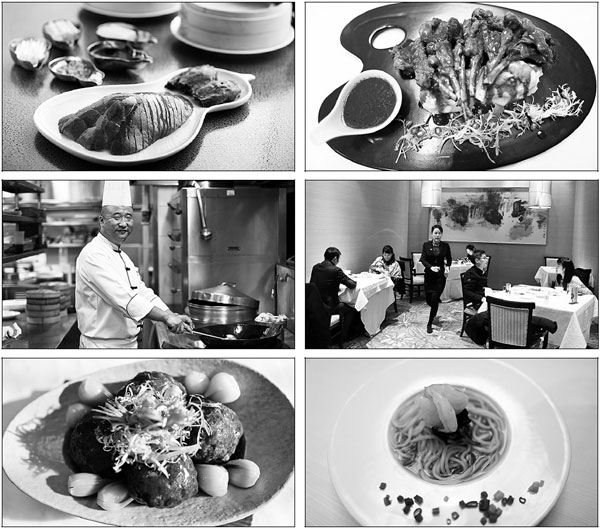
Jewel Chinese restaurant at Westin Beijing Financial Street presents the eight-bowl dishes for its Year of the Sheep dinner.
This is the perfect time of year to do it, given that eight bowls used to be traditional fare for families on important occasions since Qing dynasty (1644-1911). Though the food tradition is less common in urban families, the folk practice is still embraced in some rural parts of China.
Chef Jacky Fan, 41, executive chef of Jewel Chinese restaurant, says that within the modern art of Chinese cooking, old Chinese traditions are making a comeback. "Spring Festival banquets at hotels tend to go more culture-oriented, and family-style, instead of focusing on the expensive and exotic ingredients," he says.
The eight-bowl banquet has many variations. There is no set rule for what should be included in the eight bowls. But eight cold dishes and eight warm ones, involving the various Chinese cooking techniques, are usually prepared, says Fan. After all, the concept of having eight bowls stands for a lucky number and a happy reunion.
One of the eight-bowl dishes that will be on Jewel's menu is Four-Joy Meatballs, which are minced pork balls, each with a whole egg wrapped inside. The "Four-Joy" has many interpretations. Some believe it means having good fortune, prosperity, longevity and happiness.
Nian gao, the Chinese New Year cake made from glutinous rice, once didn't appeal to refined diners at luxurious hotels, but it's a hot ticket now. Eating nian gao (literally translated as "year higher" in Chinese), has been a tradition among Chinese families - the practice is believed to improve your luck in the forthcoming year.
To catch the eyes of customers, hotels' nian gao are made into delicate auspicious shapes, such as a fish, or a shoe-shaped gold ingot with different flavors, priced about 200 yuan for a gift box. The Peninsula hotel in Beijing just opened a series of cooking classes on the pastry art of nian gao.
A few years ago, says Li Dong, 40, a Beijing native and chief chef of Jing Yaa Tang at the stylish luxury hotel The Opposite House, "a New Year banquet at top hotels wouldn't seem to give a lot of 'face' if without shark fins, abalone, and other expensive stuff. But now, it's going down to cultural and creative items."
Jiang Yaa Tang's Year of the Sheep dinner menu is priced at 248 yuan per person for a feast of 12 set dishes. "The price is more affordable to common people's wallet compared to our last year's deal," he says.
The set menu will include the restaurant's signature Beijing roast duck, and traditional Chinese New Year's food with a twist, as such steamed cod with mushrooms and pickled vegetable. Having a fish dish in a traditional Chinese banquet symbolizes abundance.
"I think it's a process when more people tend to care about the folk culture," Li says. "Having had delicious and healthy food, we now turn our attention to something relating to tradition, and a sense of rusticity."
Chef Fan at Jewel restaurant says Westin is promoting a folk food series based on the 24 solar terms in Chinese lunar calendar throughout 2015. "We have just celebrated two of them: La Ba festival on Jan 27, and Li Chun on Feb 4."
"On La Ba Festival, an important day during the Major Cold, the 24th solar term, we provided free La Ba porridge to our guests." That festival is celebrated on the eighth day of the 12th month in the lunar calendar, when people usually have porridge that has eight (ba) kinds of mixed grains, a tradition since ancient times.
Having the porridge on this day is said to pay tribute to the land, show thanks for a good harvest at year's end, and pin hopes on the next year. Legend also has it that La Ba marks the day in which Sakyauni, the founder of Buddhism, reached enlightenment and became immortal. People would have porridge on this day in memory of their ancestors.
For Li Chun, meaning "the beginning of spring" in the Chinese lunar calendar, the chefs at Jewel presented a pancake set meal for 68 yuan which included pancakes, saut??ed shredded pork with green chives, sauteed egg, wok-fried bean sprouts with black vinegar, and marinated pork knuckle. At that time, people have the traditional custom of eating spring pancakes, a practice called "biting the spring", symbolizing eating something new to welcome the start of a new season.
Contact the writer at dongfangyu@chinadaily.com.cn
















