


Wales sets the table for Chinese investors
High throughput crop phenotyping at the Institute of Biological Environment and Rural Sciences, Aberystwyth University. Han Jiwan / For China Daily
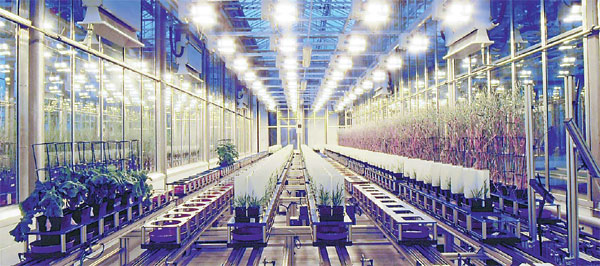
Welsh government aims to grow sales in food and agricultural industry
Trade between China and the United Kingdom?is surging, and was worth 54.3 billion pounds (73.6 billion euros) last year, a rise of 15.3 percent from the previous year, according to figures from China's embassy in Britain.
But as China expands its investment in the UK, especially in energy, infrastructure, property and transport, Wales, best known for its food and drink as well as its agricultural industries, is keen on drawing some of that investment its way.
The Welsh government says foreign investors are offered lots of financial support and a multitude of grants as well as quick processing of their applications.
The Welsh food and beverage industry employs nearly 170,000 people and it contributed 17.3 billion pounds in gross sales last year. Workers in the industry work not only in retail, wholesale and hospitality, but also fill vital roles in research and development centers and primary production and manufacturing sites.
A Welsh government report published last June and titled "Towards Sustainable Growth - An Action Plan for the Food and Drinks Industry 2014-2020", aims not only to grow industry sales by 30 percent but also to grow the industry's international profile and reputation.
Welsh academics are developing new technologies and solutions to advance the science of food production. Research and education centers in Wales include the Institute of Biological Environment and Rural Sciences, Aberystwyth University, the Center for Food Safety and Nutrition Research, Cardiff Metropolitan University, Center for Complex Fluids Processing and Swansea University.
Trade between China and the United Kingdom is surging, and was worth 54.3 billion pounds (73.6 billion euros) last year, a rise of 15.3 percent from the previous year, according to figures from China's embassy in Britain.
For China to improve its food quality, agricultural security and supply chains, collaboration with these institutes could be a natural way forward.
Several institutional collaborations are being developed between Wales and China.
Take, for example, the Wales' grasslands project, led by Professor Mike Humphreys at IBERS, Aberystwyth University.. In collaboration with the Beijing Academy of Agriculture and Forestry Sciences and Shanxi Agricultural University, Humphreys aims to reduce environmental pollution by using novel grass varieties to restore soil quality.
Festulolium hybrids, bred by Humphreys and his team, have been successfully helping to restore grassland soiled by mining pollution at Merthyr Tydfil in South Wales.
"We have spotted the parallels with the issues that have been addressed in Shanxi with what we are trying to do in South Wales. Same species are growing successfully in China in the areas where heavy pollution exists. So I see a great deal of potential, in terms of plant material growing naturally in China, where we can actually use that material to develop plants that could grow well in China's conditions and in our conditions," Humphreys says.
"Festulolium, which are defined as natural hybrids between ryegrass and fescue species, are very much the grasses of the future. They are the way ahead for sustainable livestock agricultural practices."
David Chadwick, professor of sustainable land use systems at Bangor University in North Wales, is also deepening ties with Chinese institutes.
His links with China began with a collaborative project funded by the UK's Foreign and Commonwealth Office on improving efficiencies in the production and use of nitrogen fertilizer in China.
His expertise is in food products before they leave the farm and how resource efficiencies can be improved in producing more sustainable products, such as goods whose production entails lower carbon emissions.
"With the increasing population in China, and the growing demand for livestock products, more livestock will be reared in intensive systems in the peri-urban areas of China's cities. Hence, manure management from these growing numbers of intensive farms needs to be done carefully to avoid nutrient losses to the environment. We need to optimize the supply chain to reduce the production of organic material wastage, and develop technologies that allow us to use the nutrient and organic matter from these resources on agricultural land, and importantly to develop value-added products from those organic 'wastes'."
Chadwick says new research funding will allow him and his researchers to develop value-added products from livestock manure.
"Then there will be every opportunity for us to work with both Welsh and Chinese companies in commercializing those products - both here in Wales and in China."
According to the Welsh government's food division, food and drink exports from Wales to China rose 82 percent last year, to 254 million pounds ($333 million), making China its second largest non-EU market.
Keith Smyton, head of the Welsh food division, predicts that it will continue to grow significantly, driven by increasing disposable income, urbanization and an escalating demand for international food, and quality, in China.
One company well on its way to creating a strong presence in China is the Lobster Pot.
Run by the third generation of the Wilson Family at Church Bay on the Isle of Anglesey, the Lobster Pot has been supplying high-quality, sustainably sourced seafood for more than 65 years. The company shipped 350 metric tons of live shellfish to China last year in comparison to 70 tons five years ago, says Tristan Wood, the company's managing director.
"I believe the increase of export quantities to China lies in the taste of our lobster and crab. Also, with the growing number of upper-income consumers in China, there is a great demand for high-quality products from regions in the UK, such as Wales." Tristan says.
Another Welsh company creating a larger presence in China is Penderyn, a whisky brand. Managing Director Stephen Davies says the light and delicate style of Penderyn is well-suited to the Chinese market.
"We are working with a company called Everlast with a view to exporting a range of our premium single malts to China. This will include our house style 'Madeira Finish' and other cask maturations, as well as some limited quantities of our single cask expressions," says Davies.
Nin Hui contributed to this story.
Sponsored content.
wangmingjie@mail.chinadailyuk.com
















