


New normal model of growth picks up steam
After an economic slowdown in 2014, there are encouraging signs that the long awaited rebalancing of the Chinese economy is underway.
Data points to an accelerated shift away from an investment-led, credit-driven economy toward a consumption-driven, service-fueled economy.
Consumption contributed 51.2 percent of GDP growth in 2014, up from 48.2 percent a year earlier, and slightly higher than the 48.6 percent contribution from capital formation, according to the National Bureau of Statistics. Consumption contributed more to GDP growth than investment for the third year.
|
China's service industry is expected to create more jobs over the next few years. Provided to China Daily |
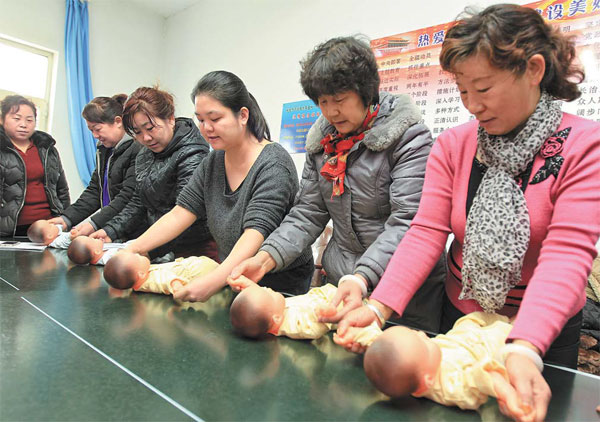
Value added generated from the tertiary, or service, industry took up 48.2 percent of GDP, up from 46.9 percent a year ago. The secondary industry's portion fell from 43.9 to 42.6 percent.
Steady growth in China's service industry helped counter weakening manufacturing activity in 2014, constituting what President Xi Jinping called the new normal model of growth. The country's average manufacturing Purchasing Managers Index was 50.7 last year, while the average service PMI reached 54.4.
"We expect adjustment in the property sector and overcapacity in several industries will continue to weigh on manufacturing in 2015. But the service sector will likely continue its stable expansion. Thus, we expect continued, steady economic restructuring," said Zhu Haibin, China chief economist at JPMorgan Chase.
Economists believe an advancing service sector is the key reason why China's newly created jobs will still surpass 13 million even though GDP growth recorded the slowest expansion since 1990.
An expert with the Ministry of Human Resources and Social Security said 1 percentage point of GDP growth used to create less than 1 million new jobs. Now it creates 1.7 million.
That is a big reason for celebrating as economists, domestic and abroad, have for years criticized China's highly skewed growth model. Runaway loan growth, a property bubble, redundant industrial capacity, excessively high government consumption, low private consumption and environmental degradation are all byproducts of the model.
"A major reason for the enormous downward pressure China faces is the relatively slow shift away from its traditional investment-driven growth model," said Kuang Xianming, an economist with the China Institute for Reform and Development. He said once the economy becomes consumption-driven, with more household consumption exceeding 40 percent of GDP, there is no doubt that China could achieve 10 years of 7 percent growth.
China's slow rebalancing is also good news for the world, even though it will affect commodity-exporting economies in the short term, economists said.
Slower growth in investment means a diminished appetite for minerals and energy imports. For the past decade China's surging demand for metals has pushed metal prices up more than 200 percent. Reining in investment in China is already leading to softer commodity prices.
That said, a gradual rebalancing in the distribution of national income toward the household sector means opportunities elsewhere. Booming demand for dairy products have tripled New Zealand's exports to China in five years and appetite for beef is driving exports in Australia, Uruguay and Argentina.
"China's rebalancing presents disadvantages for some developing economies, but opportunities as well. A world without Chinese rebalancing, on the other hand, is likely to be more volatile," said David Dollar, a senior fellow with the Brookings Institution. Economists generally believe consumption-driven economies are less prone to boom-bust cycles than investment-driven ones.
Double-digit growth in workers' wages also means China is losing its comparative advantage in labor-intensive activities, which Dollar said would make way for lower-wage developing economies.
China's rebalancing also means lower domestic saving rates and greater outbound investment. China is already rapidly emerging as a major source of foreign direct investment, which could benefit economies around the world.
zhengyangpeng@chinadaily.com.cn
















