


No shortcut to national success in soccer
Promoting sport on campus is welcome, but extreme measures could hamper the goal of overall fitness
Earlier in March, the State Council, China's Cabinet, issued a blueprint for the reform and development of soccer, which many believe could change the face of the game in the country.
The program to reform Chinese soccer is a three-step - short-, medium- and long-term - strategy and is aimed at promoting soccer on campus, building playing fields, better managing professional clubs and lotteries, and overhauling the sport's management system. And its ultimate goal is to enable the Chinese men's team to qualify for the World Cup and Olympic Games.
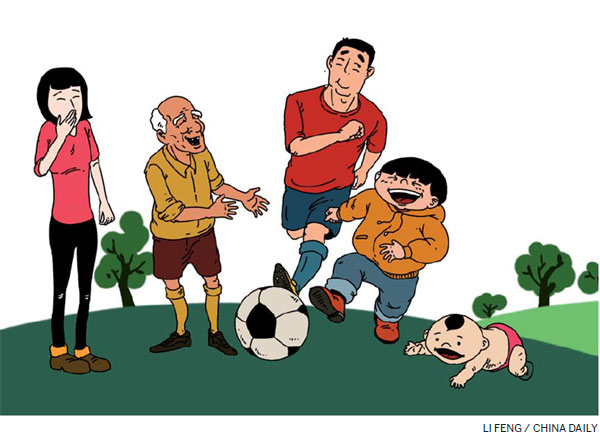
The record of China's men's team may be poor and the soccer played in the country may not be up to international standards, but the reform program has the potential to cure Chinese soccer of its maladies and give it a new, healthy life.
China chose soccer as the first sport to be developed at the professional level, but two decades of efforts have failed to yield satisfactory results. Measures that have proven effective in other parts of the world have been ineffective in China. In particular, a series of scandals like match fixing and gambling has given Chinese soccer a bad name.
But despite all that, Chinese people's love for the sport has not ebbed. People, especially soccer fans, have urged the authorities to launch sweeping reforms to improve the level of the sport in the country and to build a strong men's national team.
The State Council's ambitious soccer program, if well implemented, can solve the problems facing the sport in the country and help realize the dreams of soccer fans. Besides, the comments of some foreign media outlets will have a positive impact on the reform program. For example, Japan-based Sankei Shimbun cited a British poll to say 7,000 stars like Lionel Messi could emerge across China if the reform was properly implemented.
In fact, some local governments are already competing with one another to make their own ambitious plans for the development of soccer. Hubei province, for instance, reportedly plans to establish 550 to 650 soccer schools in the next three years, while Beijing could build up to 200 such schools. Jiangsu province, even more ambitiously, plans to establish 1,000 such schools in five years. And media reports say that about 50,000 of the schools could be established across the country by 2025.
China may have the world's largest number of soccer fans, but the number of its professional soccer players is small. It has less than 30,000 registered teenage soccer players, while the number in Tokyo alone is more than 60,000. This lack of professional players makes it difficult for China to build a strong national team.
In this regard, promoting soccer on campus is a welcome move, for it will cultivate a large reserve of good players. But the measures taken for the purpose should be based on the concrete conditions in different regions, because any extreme measure would be a deviation from the original intention of making sports part of people's everyday life so that they can stay physically fit.
Therefore, there is no logic in Shandong province declaring that it will stop the inter-university basketball and volleyball leagues to focus on developing soccer. Nor is there any logic in some education officials' plan to add some bonus points to the college entrance examination scores of students who excel in soccer.
It is a matter of concern that despite being a sports power, China has fared poorly in soccer. But there is no shortcut to success in soccer, or in any other field for that matter. Only with patience, perseverance and hard work can the fate of Chinese soccer be changed.
The author is a senior writer of China Daily.
















