


China's war against pollution
The nation must look toward existing technologies to tackle environmental challenges
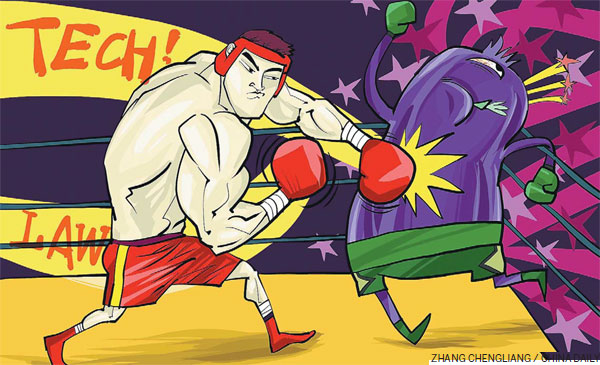
China is stepping up its efforts in strengthening anti-pollution laws. The Environmental Protection Law, which took effect on Jan 1, has increased the responsibility of local governments in dealing with environmental problems and made polluters liable to pay unlimited daily fines for violations.
In December, the country's top legislature reviewed the first amendment to the Law on Air Pollution Prevention and Control since 2000. The draft is reported to have details on dealing with various pollution sources, including the required use of advanced equipment and technology in production.
In addition, the United States and China jointly set ambitious new climate change goals in November. US President Barack Obama pledged to cut US greenhouse gas emissions by 26 to 28 percent below 2005 levels by 2025. President Xi Jinping announced targets to peak carbon dioxide emissions and to raise the share of non-fossil fuels to around 20 percent of total energy use by 2030 or sooner.
The issue now is not whether measures need to be taken; it is about what measure to take. Ironically, the solution could well lie in what is frequently blamed for upsetting the environmental balance in the first place: technology.
During the past 50 years, average life expectancy has increased by 30 percent, child mortality has dropped by two-thirds and per capita income has tripled in real terms. Most of these gains have been driven by technology. The downside has been an increase in demands for energy, which in turn has boosted the production of greenhouse gases that contribute to climate change.
Technologies exist today that can help companies and governments make tremendous strides in coping with environmental challenges almost immediately. New research shows that by 2050, clean, renewable energy could supply 100 percent of the world's energy needs using existing technologies.
Air pollution is a huge issue in China. According to the Ministry of Environmental Protection, out of 161 cities, only nine met the stricter air quality monitoring standards introduced in the first half of 2014.
According to the ministry, the three primary sources of airborne pollutants 2.5 microns or less in size that are capable of deeply penetrating the lungs are transportation, buildings and industrial facilities, and coal burning. Together they account for 50 to 70 percent of China's total air pollution.
One of the most sensible and fundamental solutions would be to curb pollution at the source. That's what the US and Europe did when they were experiencing exactly the same situation that China is suffering today.
Transport is a major challenge for China. In 2013, Chinese automakers produced more than 22 million vehicles, which took the total number on the road to over 137 million, according to the China Association of Automobile Manufacturers.
That's good news for the economy. But automobile exhaust is the primary source of PM2.5 particles. According to local news reports, in Beijing over 31 percent of PM2.5 particles in the air come from vehicles. Automobiles also produce a tremendous amount of carbon dioxide, which contributes to global warming.
One way to both clean the air and cut carbon is to create more efficient engines. Turbocharging technology has proven to be very effective, helping to reduce fuel consumption by 20 to 40 percent, and emissions by up to 30 percent. Turbocharging has now evolved into a mainstream technology in Europe.
Advanced diesel engines can reduce or virtually eliminate air pollution, ensuring cleaner operation and enabling them to meet emissions regulations. The dieselization - or the conversion of a petrol engine to run on diesel fuel - of passenger vehicles is already popular in Europe thanks to its fuel efficiency. The penetration of turbocharged diesel engines is forecast to reach nearly 70 percent in Europe, with annual sales of 16 million turbocharged vehicles.
Aircraft also contribute to air quality and other environmental issues. China's civil aviation system is the world's second largest after the US and ranks fifth in passenger throughput.
China now buys more than 100 new passenger jets every year - more than a tenth of the world's total jet purchases - that all burn fuel and create pollution and greenhouse gases.
The big opportunity to reduce the environmental impact of air travel in China is implementation of next-generation air traffic management systems that can reduce the amount of time and fuel wasted waiting for takeoff clearance or staging for landing. Leading companies have successfully developed advanced systems that can enable airlines to reduce their fuel consumption.
According to the International Energy Agency, residential, commercial and industrial buildings account for 40 percent of global greenhouse gas emissions. By 2030, China will demolish more than half of its existing residential housing but will need 40 billion square meters of new residential and commercial space to replace and support growth.
Buildings offer a tremendous opportunity to save energy and reduce emissions. Improving building management systems by installing intelligent heating, ventilation and air conditioning controls and thermostats could cut energy use by between 20 to 30 percent.
Using the latest technologies, including smart grid demand response, advanced burner technology, wireless sensors, manufacturing execution systems, mobile control rooms, industrial scanning and mobile computers can help push that reduction even further and save money.
New refinery process technologies can already enable the mass production of green fuel from inedible natural oils and from plants such as camelina, jatropha and algae. This can reduce the greenhouse emissions of a gallon of standard diesel fuel by more than 50 percent. Such green fuel made from the inedible jatropha plant grown in Southwest China successfully powered a test flight in China in 2011.
Existing, as well as new, process technologies can also help refiners significantly improve fuel quality and offer higher product yields. For example, advanced burner technology helps petrochemical plants to reduce the emission of mono-nitrogen oxides and other waste gases by allowing for optimal performance on typical refinery fuel gases.
In the smart grid arena, demand side management solutions can enable utilities, factories, commercial customers and homeowners to manage their energy consumption more effectively. They can help balance energy supply with demand in large Chinese cities to reduce emissions.
These savings have been proven. In 2012, the Tianjin Economic-Technological Development Area implemented the country's first smart grid demand response pilot project.
Commercial buildings at the area reduced their power loads by between 15 to 30 percent. In the future, such smart grid solutions could help reduce power consumption in Chinese cities, as well as the coal burned to produce it, resulting in cleaner air while supporting the growing demand for energy.
As one of the world's largest and fastest growing economies, China's air pollution challenge is bigger than most. The government is playing a leading role, cemented earlier this year when Premier Li Keqiang declared "war against pollution".
Both dynamic domestic players and multinational companies have rallied to the call and are already speeding up their operations and research and development to come up with local innovations to help China cope with air pollution.
Most emerging markets face similar air pollution and environmental challenges as their economies grow. Air-related products and solutions developed in China will also support China's ongoing effort to "go global" - transferring China-developed innovations to the rest of the world, especially in high growth markets.
At the same time, the recent joint announcement by Obama and Xi could bring the world's two largest economies together and put pressure on other countries to limit their emissions at this year's United Nations climate change conference in Paris.
China has begun that journey. It is now time for businesses to demonstrate entrepreneurship, speed and rigor. Whether domestic players or multinational companies, all will have to become brainier, more nimble and more global to play a substantial role in this process.
The author is president of Global High Growth Regions at Honeywell. The views do not necessarily reflect those of China Daily.
















