


'Toilet revolution' flush with success
|
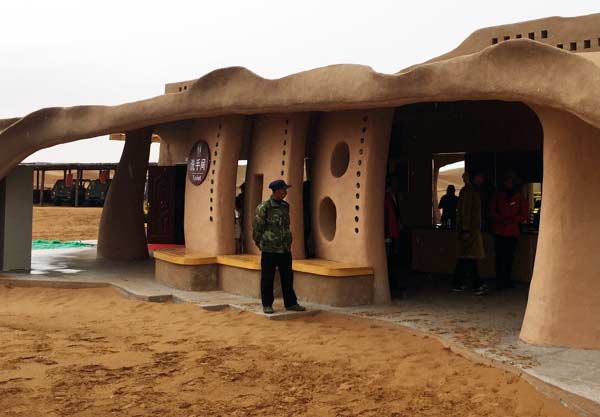 A toilet at the Shapotou scenic zone in the Ningxia Hui autonomous region is not only functional but has also been designed to blend perfectly with the desert landscape. Su Zhou / China Daily |
Every day toilet cleaners at the Shapotou desert scenic zone in the Ningxia Hui autonomous region have to clean not only the regular toilet cubicles but also ones specially designed for Muslims.
The Muslim-tailored cubicles provide shower facilities or clean water in special containers for Wudu, the Islamic procedure for washing parts of the body, typically in preparation for formal prayers but also before handling and reading the Quran.
Ningxia, in northwestern China, has a large Muslim population and a special cultural connection with Arab states.
The special toilet is not only designed to meet the demand of Muslims in Ningxia but also Arab tourists.
"About 20 percent of our 4A-rated and 5A-rated scenic spots have Muslim toilet cubicles, and we expect to have more in the future," said Yang Dengbao, a senior official of the autonomous region's Tourism Administration Bureau. "We do not only make the toilets cleaner, but also make them more friendly to Muslims."
"Ningxia is a less-developed region and not so popular among overseas travelers," added Yang. "To promote tourism and take advantage of the opportunities of the 'One Belt, One Road' strategy, we have to improve our infrastructure first."
Despite China's booming tourist industry, public facilities have not always gone hand-in-hand with development, especially in the less-developed regions.
Shi Wenjing, 28, is a veteran traveler who said the worst part of her trips in the past have always been related to toilet facilities.
"Especially in western provinces," Shi said. "Sometimes I could not find a single toilet after hours of driving. And when I did find one, it was one I would not want to use."
To improve the situation, the China National Tourism Administration launched a three-year campaign in January called "The Toilet Revolution", which aims to build 33,000 restrooms across the nation by 2017 and renovate 24,000 facilities.
Local tourism authorities are also urged to consider the special needs of the elderly, women, children and disabled people when building and renovating toilets.
Narrowing the gap
The revolution already seems to be having an effect. According to the first quarter nationwide tourist satisfaction survey by the China Tourism Academy, the overall feedback on toilet conditions throughout the country is "acceptable".
Rated cities in eastern China, such as Shanghai and Nanjing, tend to have higher scores than cities in central and western China.
To narrow the gap, autonomous regions such as Ningxia Hui and Guangxi Zhuang, and provinces such as Henan, have devoted more resources to provide adequate toilet facilities at tourist attractions.
Henan, for example, will renovate 1,314 toilets and build 2,426 new toilets at scenic spots in the next three years. Management of toilets is now included in the government's standard of performance appraisal.
Besides the special fund of 50 million yuan ($8.06 million) to support toilet construction, the province appropriates another part of the budget as a bonus for well-managed toilets.
A recent inspection by the China National Tourism Administration showed that the majority of toilets at scenic spots meet the national standard.
Sustainability doubted
However, officials of local tourism authorities have concerns about the investment and sustainability.
"We have to invest more than 3 million yuan every year simply to maintain the upgraded toilets in the 38 service areas along highways in Ningxia", said one official of the Ningxia Expressway Management Bureau, who didn't give his name.
Liu Li, a tour guide from Shapotou in Ningxia, said that they have increased the number of toilet cleaners from four to more than 20 at one facility. During the offseason, some toilets will be shut down, and mobile toilets put in place to reduce costs.
Meng Wenhu, deputy secretary-general of Nanning city government in Guangxi, said the current situation regarding toilet facilities relies heavily on government investment and a large number of toilet cleaners, which is not sustainable.
"Some cities have tried to outsource the toilets," said Meng. "As long as the toilet meets the standard, the operator of the toilet can cover their costs by selling tourism souvenirs or advertising."
Xi Jianchao, an associate research fellow at the Chinese Academy of Sciences, said the government's role is vital at the beginning because it can leverage more effective investments from the public and eventually change the standard of toilets in China.
"Toilets for tourism are not only an economic issue but also an issue of public service," said Xi.
suzhou@chinadaily.com.cn
















