


Los Angeles protesters confront Abe face to face
From coast to coast, Japanese Prime Minister Shinzo Abe's visit to the United States was met by Chinese and Korean protesters demanding an apology for Japan's World War II-era wrongdoings.
In Los Angeles, protest organizers considered their action the most successful one.
"We confronted Abe while his car drove slowly by us," Charles Lu, chairman of the Roundtable of Chinese-American Organization, one of the leaders of the protest, told China Daily by phone. "He looked at our signs and appeared uneasy."
|
Hundreds of protesters rally on May 1 near the Millennium Biltmore Hotel in Los Angeles where Japanese Prime Minister Shinzo Abe was scheduled to attend a luncheon. They demanded that Abe apologize for Japan's wartime wrongdoings. Provided to China Daily |
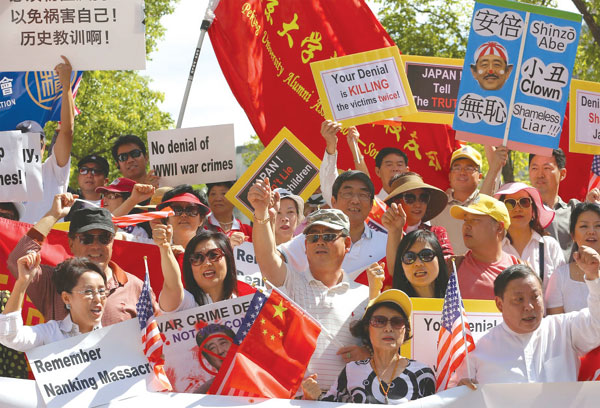
More than 500 people from the Chinese community and about 200 others from the Korean community rallied Friday morning at Pershing Square and then marched about a quarter of a mile to the Millennium Biltmore Hotel, where Abe was scheduled to attend a luncheon, according to Lu.
He attributed their "success" to a piece of timely overheard information.
"There are four entrances to the hotel, and we don't know which one they were going through," he said. "If we arrange people at all entrances, our presence would be reduced a lot," Lu said.
While they were waiting at the front entrance and struggling with a decision around 12 pm, Lu said he overheard a nearby police officer say into a walkie-talkie that Abe was arriving in five minutes and going through the rear entrance.
"I immediately told the crowd via a loudspeaker, and almost all the people moved to the rear entrance at one, leaving the fleet no time to respond," he said.
While Abe's car was driving slowly through the crowd, the protesters chanted slogans such as "Abe liar" or "Abe apology" and held signs with caricatures of him, according to Lu.
After his car entered, 10 other cars in his motorcade couldn't move any further. His entourage of 20 to 30 people had to get out of the cars and walk into the hotel, Lu said.
"I saw them carry briefcases and walk quickly by us," said Philip Mu, chief supervisor of the Global Unified Chinese Organizations from Vietnam, Cambodia and Laos, also an organizer of the protest.
"They saw our signs and heard our slogans," Mu told China Daily by phone. "We sent out our message that the overseas Chinese won't forget history. As long as Abe doesn't apologize, we Chinese will always follow him closely!"
He said the Chinese Americans in Southern California had been monitoring Abe's speeches from Harvard University, to the US Congress and in Silicon Valley.
"Abe didn't offer an apology to the Asian people who suffered immeasurably from Japan's aggression," Mu said. " 'Remorse' is not apology. He is just trying to whitewash its past."
Lu agreed that Abe's lack of an apology not only hurt the feelings of the Chinese and Korean people but also the feelings of the American people.
Just five days ahead of his state visit to the US on April 26, Abe and a handful of other high-ranking political officials sent ritual offerings to Yasukuni Shrine, where 14 Japanese who were found guilty of Class A war crimes are enshrined.
"We see no sincerity from his remarks and actions, but a sign of reviving militarism," Lu said. "He is adding insult to injury. Since he was coming to Los Angeles, we Chinese should take advantage of this opportunity and show him our power."
The organizers didn't get the accurate itinerary until two days before Abe's arrival in Los Angeles. Within two days, they held an urgent press conference, mobilized hundreds of people, arranged six buses for transportation and made hundreds of signs.
In addition to members from the Chinese and Korean communities, a dozen Japanese Americans and African Americans also were invited.
"There were two Japanese Americans who have been very supportive," said Phyllis Kim, executive director of the Korean American Forum of California, an advocacy group for "comfort women," or sex slaves held by the Japanese Army before and during World War II.
They used to live in the US concentration camp, and they received formal apologies from the US government in the 1980s for violation of human rights, according to Kim.
"They understand how important it is for the victims to receive an apology from the Japanese government," she said.
liazhu@chinadailyusa.com
















