


Chinese literature's biggest barriers abroad not language itself
No shortage of talented translators, but publishers put off by cost and risk
Literary translator Nicky Harman cannot hide her excitement when asked her what Chinese book she planned to work on next. "There are so many," she says with a smile.
After 15 years of working with Chinese authors and publishers to bring their work to English-speaking readers, her enthusiasm for the job is as strong as ever.
|
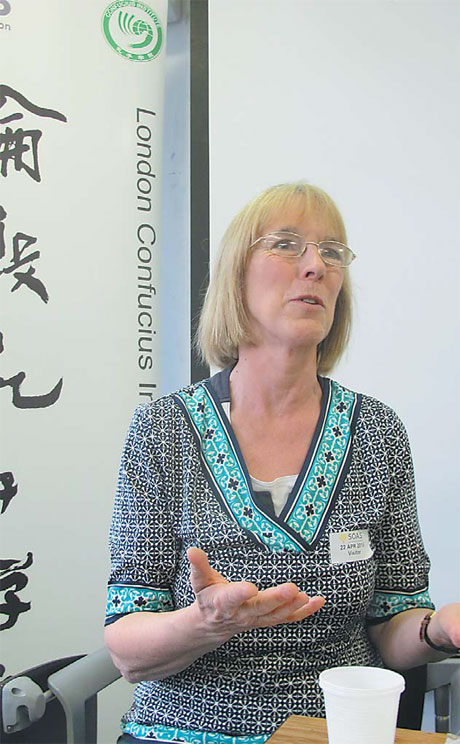
Nicky Harman has translated Chinese books into English for 15 years. Photos provided to China Daily |
"I can think of many people's work I want to translate. I just need to get going and work as fast as possible," she says.
Harman, who specializes in fiction, nonfiction and poetry, began learning Chinese in 1968 and previously taught translation at Imperial College London.
"At the start, my reasons for learning Chinese were superficial. I was fascinated with the culture and the great geographical region, as well as the people and the language," she says. "Everything was different from the West."
Although based in her native Britain, she visits China at least once a year and is in touch with many Chinese authors.
On April 22, Harman, along with Han Dong, an avant-garde poet, novelist and essayist from East China's Jiangsu province, took part in a translation workshop at the University of London organized by the London Confucius Institute and Chinalink, a company focused on cultural communications.
Harman has translated several of Han's works, an experience she described as like practicing meditation. She said another author she admires is Xu Xiaobin, an established female writer in Beijing, for her romantic and intelligent work.
In 2013, the British translator was the first winner in the new Chinese-to-English section of the China International Translation Contest. The prize was for her work on Jia Pingwa's Backflow River.
"It took me ages to translate, even though it's a short story," she says. "Also, sometimes Jia writes about the countryside 30 years ago, for which I need to use Baidu (the Chinese search engine) to look for specific things he describes."
However, the Internet is only a short-term fix, she says. "If I find questions while translating, I highlight them in the text and then ask the author for an interpretation."
Harman says she prefers the answers to such questions in Chinese because it helps her to understand any subtleties.
"If an author explains his or her text in their native language, their response will have more subtlety, more depth and more richness," she explains. "It's like the icing on a cake. It's the extra bonus, being able to talk to authors."
Cultural gap
In addition to Mandarin being a difficult language to master, the translator says her work is also made complicated by cultural gaps.
For example, she says, Women Jia, or My Family, by Yan Ge, a young writer born in 1984 in Chengdu, southwest Sichuan province, was difficult to translate because it deals with a Chinese family dynamic different from those in the West.
"I found the family relationship in the novel difficult to understand, and lots of dialogue was also incredibly difficult, although Yan is a fantastically funny and sharp writer," Harman says.
The novel features a domineering 80-year-old matriarch who forces her children to marry in the hope of boosting the family's fortunes. "The mother and her children are horrible to each other, but in very subtle ways, which is difficult to convey in English," she says.
To ensure accuracy, Harman asks Yan to help with the dialect used in the book and explain the relationships to her.
Equally challenging are Han's novels and poetry, she says, as he uses beautiful words so they needed to be translated beautifully.
"As a translator I need to be a chameleon," she tells Chinese students at the London workshop.
Having a good editor is also vital, she adds. "The translator is the author's first reader and is the closest to their work, and the editor is the translator's first reader and can ask us to think again and tell us where the translated work is not clear."
She says the best time to correct a work is three months after the translation, so as to get some distance from the work and view it with fresh eyes.
Poorly paid
Though many talented translators are able to work with Chinese literature, Harman says they do not get paid much, which means many Chinese works are still not available in the West.
"If you translate a book, you'll want to publish it, but publishers in the West at times don't understand China and its literature," Harman says. "Some things can be lost in translation, but not much.
"Translators understand what is going on in a text, and many good translators are native English speakers and living in China, which can help them better understand the country's works."
Chinese literature is also rarely published abroad because Western publishers either do not have the money or do not want to take the risk, she says.
Also, she adds, topics in some Chinese books are not fashionable in the West, while others may be long novels about China's countryside, which publishers think readers will not buy.
Last year, 30 Chinese books were translated and published in English, 10 times as many as in 2000, according to Harman. "The situation is changing, but there are still barriers, not only cultural understanding, but also economic," she says.
Translators need to be paid, and because the job often requires lots of time, especially turning Chinese works into English, Harman says many have to do part-time jobs.
"They need money to buy food, to pay rent and bring up their children," she says, explaining that few people can afford to work as translators full time.
Harman has been among those few since 2011. "My children are grown up, and I can live on less money than before. It's simple economics," she says.
caoyin@chinadaily.com.cn
















