


All aboard the Made in China express
Chinese business is heading in new directions, and in Europe, trains are the favored way to go
China has spent years bolstering its commercial and industrial skills by looking to Europe as a model. Now, as the continent grapples with its economic downturn and as China grapples with the changing nature of its economy, the business relationship between them is also changing. Chinese companies that used to be interested in little more than selling huge volumes of inexpensive goods to Europe are now angling for a different fish: business partnerships and acquisitions that will help them in their quest to increase their export volumes of high-quality of goods.
The drive for such deals is being fueled by a government strategy called Made in China 2025, which advocates more intelligent manufacturing that focuses on quality, a respect for environmental standards and increasing integration with the Internet.
|
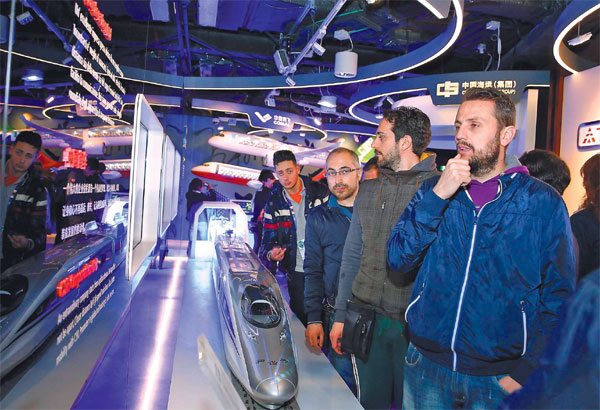
China CNR Corp Ltd and CSR Corp Ltd, China's two largest railway vehicle manufacturers by sales, present their latest high-speed passenger train models at Expo Milan 2015. Provided to China Daily |
The central government hopes Made in China 2025 will give a fillip to manufacturing and help the country maintain medium-to-high economic growth. It has listed 10 industrial sectors that will be given development priority, the first step in exporting more high-end products worldwide.
Under the plan, fast-growing areas such as robotics, aerospace and aviation, offshore engineering and railways are sewing up more alliances and acquisitions overseas and diversifying their localization strategies in Europe and the United States in particular.
At Expo Milan 2015, which opened on May 1 and lasts until Oct 31, one of China's three pavilions is the China Corporate United Pavilion, which is presenting the country's pillar products, ranging from agricultural to aerospace equipment.
The train makers China CNR Corp Ltd and CSR Corp Ltd, China's two largest railway vehicle manufacturers by sales, are presenting their latest high-speed passenger train models and a contact list of their European branches, as well as a product catalog for freight and tanker trains.
Yu Weiping, vice-president of China CNR Corp, says that even though countries in Western and Central Europe have well-developed railway infrastructure and cross-border operations, countries such as Britain, the Czech Republic, Norway and Poland are on the lookout for trains and carriages to modernize rolling stock on certain routes.
"In many cases in Eastern and Southern Europe, rail coverage is not what it should be, and there are problems with infrastructure, and we are keen to supply them," Yu says. "We can also supply tram and metro trains in these areas."
After selling passenger and freight trains to Belarus, Estonia and France over the past six years, CNR is preparing to export bullet trains for a high-speed rail project in Russia that would connect Moscow to Kazan, about 720 kilometers to the east. The length of the line is expected to be about 770 kilometers and will run through seven Russian regions with a total population of more than 25 million.
Even though both CNR and CSR have exported rolling stock to more than 80 countries and regions, China has yet to export high-speed trains that run at more than 250 kilometers an hour.
Yu says this project will be a major focus for CNR this year, and the company has provided an initial technical outline and plan for local production to its partners.
With train sales rising globally, CSR has announced that it will set up a joint research and development center with three British universities, Imperial College London, the University of Birmingham and the University of Southampton, to support its going global strategy.
To end a price war between them in global markets and give the merged entity a clear edge over its rivals, CNR and CSR have begun the merger process to create the world's largest rail equipment conglomerate in terms of sales. The pair have combined market capitalization of $113 billion (102 billion euros).
In the past few weeks the two submitted an application to the Shanghai Stock Exchange to terminate trading in their shares, after gaining approval from the central government and foreign anti-monopoly agencies from countries including Germany, Australia, Singapore and Pakistan.
Last month CNR and CSR discussed with Bombardier Inc of Canada buying a controlling stake in that company's railway unit, but those talks cannot progress until the merger is completed.
Luo Renjian, a researcher at the Institute of Transport Research, part of the National Development and Reform Commission, says that because the proportion of China's state-owned enterprises is still higher than in many other countries, the government has been eager to accelerate SOE reforms to let them expand globally and become more innovative through mergers and acquisitions.
"China's railway vehicle makers can pull in a lot more revenue than other industries such as energy, new materials manufacturing and shipbuilding, and the government-led merger is the country's first step in revitalizing the resource-rich state-owned sector," Luo says.
China's train makers exported equipment worth $4.36 billion last year, 22.6 percent higher than in the previous year, the General Administration of Customs says.
Zhi Luxun, deputy director-general of the department of foreign trade at the Ministry of Commerce, says that even though the merger of CNR Corp and CSR Corp is still in its early stages, it will enable China to quicken its pace in promoting its railway standards abroad.
It will also support the new rail equipment maker in widening its global services and production networks to compete with more established rivals such as Siemens AG of Germany, Alstom SA of France and Mitsubishi Corp of Japan in different regional markets.
China has exported its railway technology to more than 30 countries and regions, including member countries of the Association of Southeast Asian Nations, Argentina, Australia and the United States.
European countries looking to grow their markets and create jobs are keen to offer reciprocal market access to Chinese investors. Chinese companies signed 23 merger and acquisition deals worth $12.3 billion in Europe in the first quarter of this year, 59.7 percent higher than last year, says a report by the Dutch multinational banking and financial services corporation ING Group.
China National Chemical Corporation's $8.1 billion acquisition of the Italian tire maker Pirelli SpA was the largest deal by a Chinese company in Europe in the first quarter. Britain, Germany and Switzerland were the top ranking countries in the value of deals signed.
Zhao Ying, a researcher at the institute of industrial economics of the Chinese Academy of Social Sciences, says Chinese investment in Europe has gone into areas such as biotechnology, energy-saving vehicles, food and machinery.
"Private companies and private equity investment funds are highly likely to become active players in outbound deals, which have previously been dominated by state-owned enterprises," Zhao says.
Wang Jinzhen, general representative for the China pavilion at the expo in Milan, says Chinese companies must be aware that developed countries have scrambled to unveil national plans to revitalize their manufacturing, such as Industry 4.0 in Germany, launched in 2013, and the Advanced Manufacturing Partnership program unveiled by the US government in 2011.
"In those circumstances, the progress of the Belt and Road Initiative between China and its partners will help stimulate business this year between Chinese manufacturers and their customers in Europe along the routes through diversified trade, the demand for big-ticket infrastructure projects, and investment and currency exchanges."
The Silk Road Economic Belt and the 21st Century Maritime Silk Road initiatives were put forward by President Xi Jinping in 2013, putting the world's second-largest economy on track to rejuvenate the two ancient trade routes and further open up markets.
zhongnan@chinadaily.com.cn
















