


Japan sees surge in Chinese tourists
Despite strained relations, number of travelers from the mainland nearly doubles year-on-year
|
A shop selling animation-related products at downtown Tokyo's Akihabara district tries to attract foreign visitors with a sign saying "tax free shop" in languages that include English, Chinese and Korean, in April. Zhang Yunbi / China Daily |
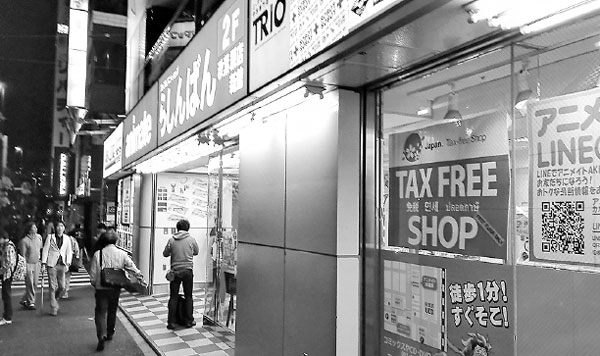
At about 10 pm at a drugstore in Tokyo's wealthy Akihabara district, two Japanese cashiers surnamed Nakayama and Mori were busy closing out their cash registers along with their Chinese colleague, a woman surnamed Xie.
Drugstores selling Japanese-made medicines and cosmetics are employing more Chinese at a time when the number of visits to Japan by Chinese travelers and shoppers has almost doubled compared with last year.
Xie was surrounded by a group of travelers from Shanghai seeking advice. They decided quickly to buy medicines to combat fever, pain and high blood pressure.
Mori told China Daily that the most sought-after medicines are those to stop colds and fevers. Shortly afterward, the Chinese shoppers bought some more medicines after consulting Xie.
One of the visiting shoppers said, "This medicine will last me for quite a long time," adding that the shoppers had just bought five Japanese-made blood pressure monitors at a nearby electronics mall.
Despite relations between China and Japan being strained by historical and territorial issues, the Japan National Tourism Organization says there were more than 1.32 million arrivals from the Chinese mainland in the first four months of this year. This is a year-on-year increase of 98.9 percent, and the Chinese mainland was the largest source of visitors.
South Korea and China's Taiwan took second and third places in the same period with more than 1.2 million and 1.1 million arrivals - year-on-year growth of 43.5 percent and 29.6 percent, according to the figures released on May 20.
In the recent cherry blossom season in Japan, foreign visitors flocked to the country. Reports said more than 90 percent of hotel rooms in downtown Tokyo were booked, and there was a shortage of visa stickers at some Japanese diplomatic missions in China.
Masanori Handa, an official at the Japan Tourism Agency under the Ministry of Land, Infrastructure, Transport and Tourism, said accommodations in Tokyo are facing challenges to a certain degree.
But "the potential is huge overall", and the Japanese government has announced an ambitious target of 20 million visits by foreigners annually by 2020.
Handa is the agency's deputy director of the Inbound Tourism Promotion Office in the International Tourism Division.
Naoki Saito, a professor of international relations at Yamanashi Prefectural University, said the growing number of travelers from China and South Korea has been expected by different localities in Japan that are suffering from sluggish growth and aging populations.
Two favorites
Cheng Yonghua, the Chinese ambassador to Japan, said Japanese-made rice cookers and electronic toilet seats are the two favorite purchases among Chinese shoppers.
A sales stand displaying six rice cookers at an electronic products mall in downtown Tokyo may best illustrate the Chinese spending spree as it boasts a big billboard displaying the Chinese characters for "welcome".
But some believe that Japanese cookers make rice taste better. Others view the toilet seats as being merely trendy gadgets because such products, which are capable of heating automatically in winter and spraying water to clean the body, are still rare in China.
Cheng views the spending spree as spontaneous behavior by Chinese.
The fact that such imports cost more in China has also meant that Chinese resort to "window shopping at high-end malls" at home.
The Chousun Ilbo newspaper in Seoul suggested in an editorial in its Japanese edition on May 23 that South Korea should learn from Japan's duty-free policy extended to foreign visitors.
The average spending by Chinese tourists is falling in South Korea but surging in Japan in comparison with last year.
As shoppers line up to buy electronic products at Tokyo's shopping malls, they can see notice boards stating, "Present your passport and you may get duty free" purchases.
Slogans and commercials in Chinese greet shoppers in downtown Tokyo, stating that payment by China's UnionPay is available and welcome. Meanwhile, the yen has been falling against the yuan since 2012. One yuan bought about 12 yen in January that year but now buys about 20 yen.
In a written summary on May 20, during the cherry blossom season, the Japan National Tourism Organization said the yen's depreciation and the exemption of consumption tax for foreigners have had a "powerful influence on the enthusiasm for shopping" by Chinese travelers.
Even Premier Li Keqiang joined the discussions about the toilet-seat sales boom when he spoke to political advisers from the tourism industry during China's annual two sessions meetings in March.
Li said an open mindset should be adopted and trade barriers opposed because "consumers have the right to enjoy more options".
Historical issues
An imbalance is surfacing, as the number of Japanese visitors to China is falling, and this is an issue of common concern among officials and industry insiders from both countries.
The number of Japanese travelers to China has fallen annually since 2011 and the numbers to South Korea has also dropped for the past two years, according to the Japan National Tourism Organization. There were 2.7 million Japanese arrivals in China and 2.28 million arrivals in South Korea last year.
Leading Japanese media have attributed the falls partly to increased territorial and historical issues between Japan and its neighbors.
Kazuo Ogoura, an adviser for think tank the Japan Foundation and a former Japanese ambassador to South Korea, said Japanese impressions of China and South Korea have become less favorable, and there has been widespread antagonism in Japan against the position taken by these two governments regarding historical issues.
Handa, the Japan Tourism Agency official, said the Japanese population is shrinking and the yen is depreciating, creating fewer choices for Japanese traveling abroad.
Decades ago, "there was a boom in Japanese visitors to China and South Korea. ... Now, many Japanese have no idea about the new attractions in China and South Korea, so better promotion is needed."
















