


Planned district better than urban sprawl
Zhengdong's chief planner says city bolsters Zhengzhou's strategic position in central China
Zhou Dingyou insists Zhengzhou was in danger of coming to a gridlocked standstill if planners had not built a new area of the city.
The deputy director of Zhengdong New District says far from being a "ghost town", the new district - already larger than San Francisco - had created room for the capital of Henan province in central China to breathe.
|
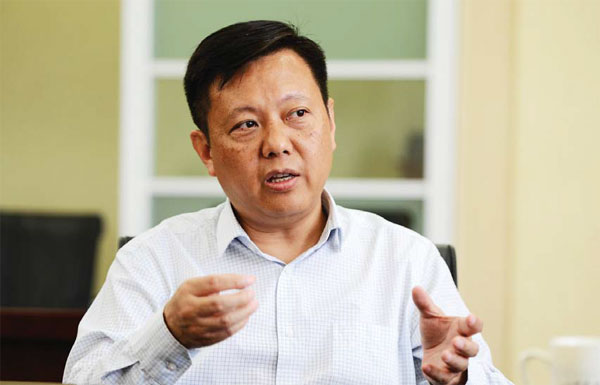
Zhou Dingyou, deputy director of Zhengdong New District, says CBS's 60 Minutes program's depiction of the new district in early 2013 as a "ghost town" chose to ignore the population pressures the main city had been facing. Xiang Mingchao / China Daily |
"We had a situation where, even if the urbanization rate in Henan had been just 1 percent, it would mean some 1 million of the 100 million population moving to the province's cities every year and at least 100,000 moving to the capital. We had therefore to design something that would take 1 million population over 10 years."
The 49-year-old says CBS's 60 Minutes program's depiction of the new district in early 2013 as a "ghost town" chose to ignore any of the population pressures the main city had been facing.
"When you are developing something like this, it is inevitable there are lags with such large-scale construction. First you start off with a blueprint, then you have to build infrastructure like roads and bridges and other major building works first. It is a very long process.
"The human migration can take a lot longer. It is a very complex social issue. Maybe one family member moves first and the rest of the family and their children later. It wasn't exactly very scientific or analytical for CBS to film construction sites, the building of roads and bridges, and say the place was a 'ghost town'."
Zhou, who is also a trained architect and has been involved in the new district since its conception, was speaking in a meeting room at the headquarters of the Zhengdong New District Administrative Committee on the outer ring road of the new district.
He insists that if the new area had not been built, the city would have had to develop organically because of population pressures.
"If there were no Zhengdong, there would have been a Zhengzhou South or a Zhengzhou West. The city would have had to develop somehow. It would have spread out like Delhi and other cities have done. The advantage of Zhengdong is that it could all be done in a very orderly way."
The striking feature of the Zhengdong New District, which will have a population of 5 million by 2020, is just how well planned and conveniently arranged it is - something that could not be achieved with the chaos of urban sprawl.
It is divided into six areas, a central business district, a commercial and transport zone, a university town, a science park and two high-tech parks.
It also boasts luxury homes, boulevards, an opera house and an art museum.
Essential services such as water and electricity are delivered so there can be resource sharing between buildings.
Zhengzhou East Station, a major hub on China's high-speed railway network, is also based in the new district.
With the district also linked to the city's airport and an international land port, it bolsters Zhengzhou's strategic position in central China for the government's Belt and Road Initiative, improving China's internal and international links.
Far from criticizing China for creating "ghosts cities", many urban planners across the world admire how such urban development can be achieved in such a short time frame.
Despite huge urban pressures, the UK, for example, has not been able to build a new town since Milton Keynes in 1967.
"China has five-year plans and it is common practice to plan 15 to 20 years ahead," says Zhou.
"I would actually say China's situation is remarkably similar to the UK 60 or 70 years ago when they were developing new garden cities to deal with the need to create new urban areas."
The planner says that in China generally, but specifically in Zhengdong, the ideas of the Garden City Movement, led by Sir Ebenezer Howard and which saw the development of Letchworth and Welwyn Garden City in the UK in the early 20th century, as well as the Ideal City moral and spiritual concept of urban development which dates back to the Renaissance, have been influential.
"The common goal of all these designers and planners was to serve human beings. It is a fundamental aim to create human-centered environments for people to live and work. This is something we have very much borne in mind here in Zhengdong."
Zhou, who is from Chongqing, studied architecture and design at Southeast University (also known as Dongda) in Nanjing, before beginning his career at the Sichuan Provincial Architectural Design and Research Institute, where he worked for five years in the late 1980s and early 1990s.
In 1994, he took the decision to broaden his experience and went to study for a master's in architectural planning at Hiroshima University in Japan. After graduating in 1997, he first went to work for Kako Kikoko Sekkeisha, a major Japanese practice, and later joined the firm of Kisho Kurokawa, one of the great post-war Japanese architects.
Zhou studied under Kurokawa, one of the founders of the Metabolist Movement, which fused ideas about megastructures and natural biology, when he did his master's.
"There is heavy Chinese influence on Japanese architectural ideas and you see that in cities like Kyoto and Nara. I think the difference is that the Japanese have been more willing than the Chinese to embrace Western cultural influence. What they do is blend Western technology while keeping the Eastern culture," he says.
What brought Zhou back to China was when Kurokawa's firm then won the competition to design Zhengdong's central business district. He was the only one in the firm who could speak Chinese.
This eventually led to his leaving the firm and joining the Zhengzhou Planning Bureau in 2002 when he began working full time on Zhengdong. He became deputy director of the new district in 2007 and its chief planner in 2010.
For Kurokawa, whose projects had included Kuala Lumpur International Airport and the New Wing of the Van Gogh Museum in Amsterdam, the Zhengdong Central Business District was his last major project. He died at 73 in 2007.
"I think it was a very good wrap-up of his career. He was at the peak of his powers and while he was doing it he was also working on the masterplan of Kazakhstan's new capital," he says.
Zhengdong was not an isolated project but part of a new urbanization push by the central government at the beginning of the century, which also included new cities in Northeast China, which was facing a decline in its heavy industries, and also in the poorer western regions.
It eventually came under the umbrella of The Rise of Central China Plan, announced by then premier Wen Jiabao in 2004 and also covered Shanxi, Anhui, Hubei, Hunan and Jiangxi as well as Henan provinces.
"Around that time the development of the coastal cities had become quite advanced so the creation of Zhengdong was one of several strategies," adds Zhou.
"Henan was only about 30 percent urbanized then and lagged behind the national level of urbanization of about 40 percent and so there was a need for more urban areas."
Zhengdong continues to develop. The key industries in the new district area are in services, particularly financial services.
One unique feature is that the district will have a financial area, the Longhu Financial Center, which is currently under construction and a separate Financial Backstage Service Park, where all the back office operations will be done. A number of major financial institutions have moved into Zhengdong, including HSBC, Bank of East Asia and Standard Chartered Bank.
"The aim is to be the modern services area part of the city, particularly financial services. We aim to be the financial services capital of the whole of central China with many financial institutions located here. This will be our major contribution to the government's Belt and Road Initiative," he says.
Contact the writers through andrewmoody@chinadaily.com.cn
















