


Challenge of frugal and green Winter Olympics
Stakes are high as Beijing must ensure enough water to manufacture snow while continuing to fight pollution
The International Olympic Committee recently awarded the 2022 Winter Olympic Games to Beijing, which will host the sports gala with Zhangjiakou, a city in neighboring Hebei province.
In the West, the response has been apprehensive, presumably because of concerns over rising costs and environmental damage. Indeed, the pride of hosting the Olympics has lost much of its luster in recent years. The Athens 2004 Summer Olympics left Greece with $11 billion in debt, and the cost of the Sochi 2014 Winter Olympics soared to $51 billion.
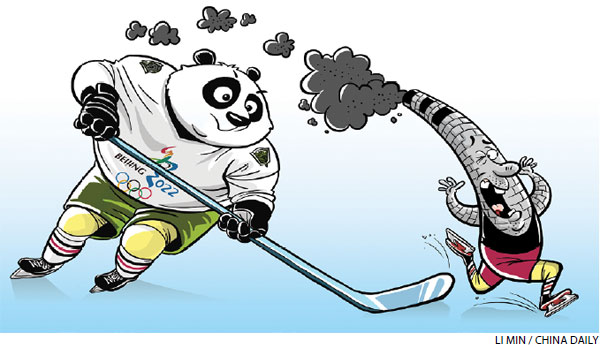
Last year, the IOC presented its Olympic Agenda 2020 aimed at promoting sustainability and reducing costs. The agenda seeks to transform the Olympics into a "plug-and-play" event. Moreover, selected host cities must fit the games into their environment with minimal damage.
In 2008, Beijing shut down many factories and plants to curb pollution, and the cost of hosting the Summer Olympics was $44 billion. During the 2022 Winter Games, however, Beijing hopes to portray a greener China, with a construction budget of only $3.1 billion.
At the same time, the capital region is likely to benefit from investments in infrastructure, including the Beijing-Zhangjiakou intercity railways, expansion of Beijing subway systems, upgraded highway networks and another regional airport.
What about the environmental effects?
Beijing's vision is to develop a winter sports market for more than 300 million people in northern China. The plan is to reuse 11 of 12 venues built for the 2008 Olympics. The goal is to integrate the Winter Games with sustainable development plans for the wider region, focusing on clean energy, green technology, and improvement in ecology and air quality.
In 2008, polluting factories were moved out of Beijing, and anti-smog regulations were implemented during the games. But the smog returned with revenge after the Summer Games. In 2022, the city's air is expected to be significantly better, thanks to the government's $7.6 billion anti-smog program, which is not directly linked to the Winter Games.
The skiing events will be held in the mountains of Zhangjiakou in Hebei, one of China's most polluted provinces. In the arid region, the ultimate challenge is to make snow for the duration of the Winter Games.
In Sochi, Russia stockpiled snow. Beijing aims to manufacture most of the snow in an environmentally friendly way. The IOC has suggested that Beijing may be overestimating its supplies and underestimating the water needed to make snow, but it believes "adequate water for Games needs could be supplied".
The 2022 Olympics rely on efforts to clean the air with long-term regional solutions. In that sense, the stakes are high both for Beijing and the IOC.
In addition to costs and environment, the IOC's decision to make Beijing the first city to host both the Summer and Winter Olympics has been criticized. But given the fact that one in every five people in the world lives in China, Beijing's role as the host of both games is hardly surprising.
Some skeptics also argue that many Beijing and Zhangjiakou residents opposed the Games. Yet in December 2014, the IOC's independent public poll on Beijing's bid showed overwhelming support for the games in Beijing (88 percent), Hebei (93 percent) and China overall (92 percent).
Ever since the first games in France in 1924, the Winter Olympics have not been immune to scandals and controversies, from allegations of bribery and doping to Cold War politics. Yet, for nine long decades, these games were held mainly in advanced economies, while several countries - including Switzerland, the United States and Japan - hosted them twice, or more.
In the past few years criticisms seem to have become more pointed. Perhaps one reason for the sharper tone is that Russia hosted the Winter Olympics in 2014, and the Republic of Korea and China will host the games in 2018 and 2022. Indeed, the Olympic torch is shifting from advanced countries to emerging economies, reflecting the shift of economic power from the West to emerging Asia.
In the past, the Winter Olympics were dominated by advanced economies. As emerging economies join in, the games are gradually becoming truly global.
The author is research director of International Business at India, China and America Institute (US), and visiting fellow at Shanghai Institutes for International Studies (China) and the EU Centre (Singapore). The views do not necessarily reflect those of China Daily.
















