


RIP cash? Instant, online finance is here to stay
|
A customer uses Yu'ebao, an Alipay's online money-market fund, on his smartphone.Provided To China Daily |
Three weeks ago, I arrived at the Vietnamese Embassy to apply for tourist visas for myself and my family. But after filling in the forms, I was told the fees had risen, and I would have to pay a total of 1,380 yuan ($222) for three of us. It accepts cash only, and I was 140 yuan short.
With the nearest ATM a mile away, the thought of rushing off in the hot summer sun didn't appeal. But what to do? I normally wouldn't think of borrowing money, let alone from complete strangers.
In this case, however, it seemed the only option was to ask a fellow applicant and I had a secret weapon: Alipay, the country's leading Internet payment service owned by Alibaba Group Holding Ltd.
I plucked up the courage and asked a girl if she could lend me the cash, explaining I'd pay her back instantly via Alipay's app, using my debit card.
Not only did I find a nice person willing to help, but with visas secured and debt instantly repaid, right there for the first time I realized just what impact mobile payments, or e-payments, could offer, which conventional finance never could.
It was the 19th century British philosophy and political economist John Stuart Mill who first penned the earliest actual thoughts on what constitutes currency.
He came up with his equation of exchange, MxV=PxT, where M is money supply, V is velocity of payment, P is average price level of goods, and T is expenditure - or in layman's terms, he said hard currency was the simplest invention yet to save time and labor in transactions and trade.
His theory has certainly lasted a long time but I now firmly believe this early basis for conventional banking is being reshaped by Internet-based payments.
China has already been pursuing its "Internet Plus" economic action plan, which focuses especially on cloud computing - the business model that allows companies and individuals to access stored, shared data over the Internet via third-party data centers.
This new phenomenon is rapidly consigning expensive, slow, complicated and often heavily commercially slewed financial services - characterized by the brick-and-mortar bank branches - to the history books.
Premier Li Keqiang has already called vociferously for cheaper and faster mobile Internet access. The latest estimate is that there are now nearly 900 million mobile internet users in China, according to the Ministry of Industry and Information Technology.
E-payments, of course, are only a small part of the fast-growing Internet finance sector, which also includes peer-to-peer lenders, the insurance, investment, consumer finance and equity-based crowdfunding sectors.
In the first half of this year, Internet lending hit 300.6 billion yuan, more than the total 252.8 billion yuan for the whole of 2014.
However, problems have also started emerging with this new generation of financial services, the growth of bad loans creating the worst headlines.
Last year almost one in every four P2P companies in Shenzhen, home to the largest number of Internet lenders, were found to be having growing incidents of debt defaults.
To better regulate the Internet financing industry and boost investor confidence, late last month the authorities rolled out a raft of policies and measures to support innovation and minimize risk to ensure the healthy development of the sector.
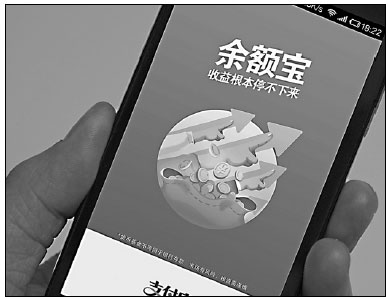
I had my first experience of Internet finance two years ago, when Alipay launched the country's first online money-market fund, Yu'ebao. It featured higher investment returns of around 5 percent, against savings deposits in traditional Chinese banks limited to an annual return of 0.35 percent, with the minimum initial investment volume as low as 1 yuan.
I started using Yu'ebao when the rate was 6.7 percent. I deposited 10,000 yuan two years ago, meaning I would earn 1.83 yuan daily, almost 20 times the daily yield if I put the same amount in a bank.
After attracting 100 million users with a total fund value of 600 billion yuan by July 2014, that number now stands at 49 million, and 250 billion yuan. Its current interest rate has lowered to 3.2 percent, half the yield when I first entered.
Swings and roundabouts, clearly, but the die has been cast.
With this sophisticated finance market already part of life in China, people are clearly willing to embrace more ambitious, more convenient and more sophisticated forms of investment and payment than ever before, than simply having a wallet full of money.
Contact the writer at liuweifeng@chinadaily.com.cn
















