


New rules can put banks on digital path
Traditional financial services providers must grasp technology to avoid seeing their market share erode
The tech giants are definitely moving in on banking in China. Their growth has been so significant and influential that the central government recently released guidelines to "promote the sound and steady progress of the emerging industry".
But do not rely on the conventional wisdom that the regulators' move will be a blow to the digital disrupters and a blessing for the traditional banks being disrupted.
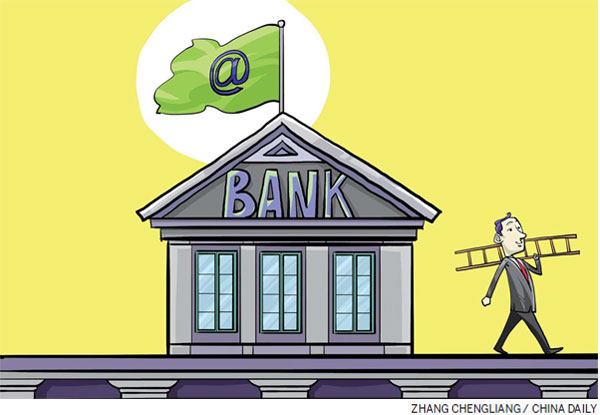
Internet finance - the catch-all term for loans, investments and other financial services provided through online channels rather than banks and other traditional institutions - is seen as innovation and entrepreneurship, and the government's intention is to further open up the financial industry.
Alibaba's Yu'ebao, an online investment fund with 185 million individual investors, is now the nation's biggest money-market fund. Ant Financial, Alibaba's financial affiliate, which operates the popular Alipay payment system, launched MYbank in June with registered capital of 4 billion yuan ($626 million; 558 million euros). In April, it introduced the CSI Taojin Big Data 100 Index, which tracks e-commerce activities to gauge the performance of companies.
Tencent Holdings also has a 30 percent stake in WeBank, which began trial operations in January and offered its first loans in May.
In short, digital banking is on the rise, and it's tech giants that are offering it.
The traditional banks in China have to take the guidelines over Internet finance as yet another whip of innovation and transformation. The reason is simple. Since policymakers clarified the roles of regulators corresponding to each type of Internet finance, including digital banking, all the digital players now have the legitimate status to collaborate and compete in the new ecosystem - as long as there are no compliance issues endangering bottom line requirements, such as crime control, consumer rights and information security.
So what do traditional banks need to do to retain their competitiveness while the industry barriers are officially lowered?
Go digital, without hesitation. China has the largest Internet subscription globally and is predicted to continue to grow during the next few years, according to the China Internet Network Information Center, a state-affiliated research organization. The number of fixed-line and mobile Internet users in China increased to about 648 million in December, and the research center expects this figure to grow. It also says one-third of China's 650 million Internet users are younger than 30, while almost 90 percent of Chinese netizens access the Internet from home, and 450 million have 4G or 3G mobile connections.
Banks should be catering to this highly digital society, which is also willing to spend online. According to Accenture research, the forecasted compound annual growth rate of online payments in China between 2010 and 2017 will be 51 percent. The rate for the same period for mobile payments is forecasted to be 114 percent.
If China's customers are digitally savvy and willing to pay for products online, banks looking to secure the consumers and the businesses selling to those consumers should be offering digital solutions for online and mobile services.
Some banks may evaluate becoming purely digital. This is already considered a possibility. About 60 percent of bank customers globally purchased bank products and services online last year, up 6 percent on the previous year, while in-branch purchases declined 6 percent, according to a survey of more than 16,000 retail bank customers in 33 countries by Accenture. The survey also found that customers in emerging markets such as Brazil, China and Indonesia are most receptive to the idea of a purely digital bank - open 24/7, with no branches or call centers.
Overall, nearly half of respondents to the survey in emerging markets said they would consider using a purely digital bank, compared with just 22 percent in mature markets such as the United States, United Kingdom and Australia.
Chinese banks should consider three key aspects in their journey toward becoming digital. First, make the entire customer experience digital - from taking on clients and educating them about new products to self-service banking and reporting. Second, customize information to suit each client and provide better advice through digital channels. And third, give customers more control with digitalized self-service tools, personalization, curation and reporting.
Whether a bank chooses to go down the route of exclusive digital services or the more traditional blend of brick-and-mortar banks with digital capabilities, it doesn't matter. What is key is that it ensures services are seamlessly integrated. If a customer begins a service transaction on his or her smartphone, that customer should be able to complete it on a laptop, tablet or in person. If a customer provides personal data once to a bank, that information should be available across all networks and channels of the bank and not repeatedly obtained.
For most banks, that digital experience implies an operating model transformation at all levels, from the branches to the back office to the customer-service functions. It is extremely important that banks become more collaborative. It won't work otherwise. It requires a new level of automation and digitized processes to enable the "just in time" services that customers want. And this requires breaking down bank silos and ensuring collaboration.
What kinds of bank are likely to achieve this? Those that truly embrace technology.
Signs of that include, but are not limited to, banks that put "tech people" on their boards and in their corporate suites because it implies that it sees technology and digital strategies as important, strategic capabilities; banks that demonstrate they see the importance of being an integral part of customers' everyday lives; banks that embrace new solutions, developing in-house incubators and accelerators; banks that renew or replace core systems, instead of constantly reinvesting in legacy systems; banks that spend on acquisitions and partnerships to gain access to new digital technologies; and banks that bring business and technology together and create a joint culture around innovation of the customer experience, and reward people for that.
Banks in China have a choice when it comes to these new digital disruptors of Internet finance at their door. In fact, leading banks can demonstrate their leadership not only in their compliance capabilities, but also in technology innovation, when the market and the regulator request them to collaborate with the digital players, such as platforms for peer-to-peer online loans for small enterprises. They can stand back and watch their market share be eroded, or they can tune in and recognize the threat and decide that digital has to be a priority. Now.
Albert Chan is managing director and head of Accenture's Greater China financial services business. David Levi is managing director of Accenture Strategy. The views do not necessarily reflect those of China Daily.
















