


Removal of 20-year-old rule a boon to banks
Measure will boost the marketization of interest and deposit rates and provide more funding channels
A few days ago, legislators adopted an amendment to the Law on Commercial Banks, removing a stipulation of a 75 percent loan-to-deposit ratio.
The China Banking Regulatory Commission, the industry watchdog, required banks in the country to have a loan-to-deposit ratio of no higher than 75 percent, which means a bank could only lend 75 yuan out of every 100 yuan it took from depositors. The measure was first proposed by the central bank in 1994 to manage assets and liabilities of some joint-stock banks. The next year, the rule was written into the Commercial Banking Law, becoming a major policy tool for the government to manage the banking sector.
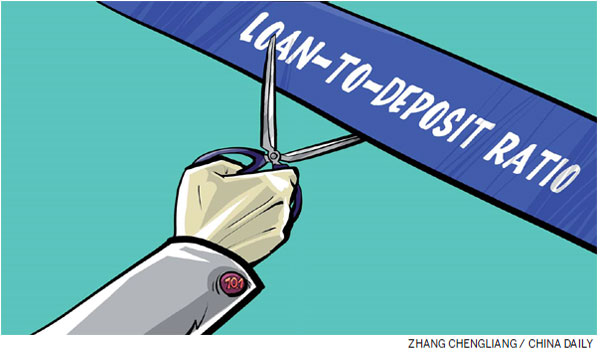
In the initial stages of implementing the Commercial Bank Law, the LDR rule was a simple and effective regulatory measure. It was designed to tie lending closely to the level of deposits, providing a stable source of capital for creating credit and reducing bank exposure to short-term funding and leverage risks.
But China's financial markets have experienced great growth over the past 20 years. With the rapid development of the country's stock market, funds market, gold market, trusts, Internet banking industry and other investment channels, the LDR had increasingly become a hindrance to the healthy development of the banking sector. The tight cap constrained the ability of banks to lend, a problem particularly in China, where new lending is directed at Beijing's behest as a key component of monetary policy operations and a crucial barometer of economic activity. As a regulatory indicator, the LDR limited banks' ability to offer loans and engage in other commercial activity. As Internet finance and the stock market become more popular, bank deposits are being depleted.
When the LDR changes from a regulatory index to a reference index, what effect will it have on the banking industry? How will it affect the country's macroeconomic policy and policy direction?
First, for banks whose commercial activities have long been restricted by the LDR requirements, the new rule lifts a great burden.
As noted by the State Council meeting, the cancellation of the ratio improves the financial regulatory transmission mechanism and boosts lending capacity of financial institutions to institutions or companies engaged in the agriculture and small and micro-sized enterprises. More importantly, it will put an end to such practices as banks illegally signing up new depositors in a desperate attempt to enlarge deposits.
Second, removal of the longstanding LDR does not mean that banks can lend as much money as they want, because there are other constraints, including capital adequacy ratio and loan quota restrictions. The current credit weakness is largely due to the economic downturn. The market lacks effective financing bodies, and it is not uncommon to see banks finding it difficult to find ways to lend even when they have a sufficient deposit base.
Third, the abolition of the LDR will boost the marketization of interest rates. The only obstacle to market-oriented reforms of China's interest rate is the problem of its liberalization. If deposit interest rates are not reduced, banks have limited room to reduce their lending rates. The new move will lead to rational pricing by banks and lead to marketization of interest rates and reduce their financing costs.
Fourth, the abolition of the ratio will promote the healthy transformation of the financial sector. In the past, as in the real estate up-cycle, there ware a lot of lending requirements from the property market. However, due to the LDR restrictions, banks' lending amounts were limited. This meant that banks were forced to broaden their financing channels by investing in trusts, brokerages and fund subsidiaries.
But now as traditional financing channels gradually decline, such institutions are being forced to reform. They will transform from financing-channel businesses to asset management, which will eventually lower the cost of funds.
Fifth, the future of macroeconomic policy will remain accommodating. Removal of the LDR seems like a micro policy adjustment, but it reflects the current trend of the country's macroeconomic policy. When downward economic pressure is increasing, maintaining an accommodating macroeconomic policy is essential for stabilizing the domestic market.
In addition to conventional monetary policies such as lower deposit reserve and interest rates, further reducing constraints on banks and stepping up efforts to push forward banks' market-oriented reform are also important easing measures.
There are also market analysts who believe that after canceling the LDR, the rule that prohibits banks from engaging in securities business may also be relaxed, which is a significant reform.
The LDR is an outdated regulation that had long constrained the healthy development of China's banking sector. Its abolition not only has a significant impact on the country's banking market, but also helps increase the banking sector's market-oriented reforms, and promotes the marketization of interest rates.
The author is a senior researcher with Anbound Consulting, a think tank for public policy. The views do not necessarily reflect those of China Daily.
















