


Need to give square dancing a human face
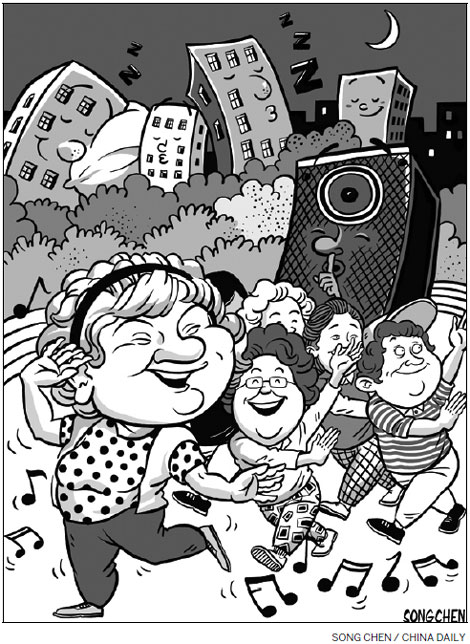
Chinese people's attitude toward public square dancing is quite complicated. Senior citizens, especially aged women, find a new lease of life by being part of modern dancing groups, while many young and middle-aged people don't support their dancing in neighborhoods because of the din it creates.
No wonder, the public has responded differently to the recent news of four government departments, including the Ministry of Civil Affairs and the Ministry of Housing and Urban-Rural Development, jointly issuing a statement encouraging dancing in public areas. Some people have even said that the Dama (literally, big mamas) have finally got government endorsement to practice group dancing in public areas, while others are worried that the joint statement could cause more frictions over the use of limited urban public spaces.
Controversies over public square dancing, in fact, reflect a generation gap and conflict of individual interests. For many senior citizens who grew up in the times of collectivism and enjoy public square dancing, the activity helps them to not only maintain an active life, but also recall their "good old days" when they were young and played and worked together. The members of the younger generations, many of whom are overtly stressed, can hardly understand the joys that orderly public square dancing brings to the elderly.
Moreover, modernization, urbanization and public sphere, and individual rights consciousness are new concepts in Chinese society that are less than a century old. Frictions and disputes in daily social interactions are understandable, because Chinese people need time to get used to new rules of life and the boundary between private and public life, as well as their rights and obligations in modern society.
To properly deal with this issue, the government has to make special efforts in two areas; it has to effectively coordinate between conflicting social groups, and provide sufficient public facilities and services to do so.
Every citizen has the right to use public facilities. So how can the government effectively coordinate between conflicting interests? Most complaints against public square dancing are because of the loud noise it creates. The law against noise pollution that took effect in 1997 is not of much help in this regard because it is quite vague on the permissible decibel level in public areas.
Besides, it is difficult to impose the same standard throughout the country. But legislators in some cities could try out pilot legislation to make the standard suitable to local conditions. And only in this way can frictions between square dancing groups and those opposed to it be reduced.
More importantly, the government should provide sufficient public facilities and service to make square dancing possible in public areas.
The joint departmental announcement encourages public square dancing and urges local authorities to provide convenient public venues and facilities for such an activity. This has heightened the opposing groups' concerns over whether the limited urban public spaces will be "officially" occupied by dancing Dama. The authorities should realize that the dearth of public spaces is the prime reason for the controversy over square dancing. Hence, to meet Dama's square dancing requirements, the authorities have to provide more public facilities and services, rather than undermine other groups' rights to access public spaces.
Properly dealing with public square dancing is of great significance in today's China, which faces increasing pressure of an aging society. Public square dancing is not only a mass recreational activity that many senior citizens enjoy, but also the most widespread workout and social interaction channel for them. Therefore, encouraging public square dancing by providing more convenient venues and facilities is conducive to not only helping senior citizens lead a healthy life, but also have a harmonious effect on society.
The author is a writer with China Daily. wangyiqing@chinadaily.com.cn
















