


TCM works to gain recognition in West
Interaction between modern science and ancient texts needed to boost acceptance
Traditional Chinese medicine, practiced in China for thousands of years and used globally, has been gained worldwide attention with the announcement that a Chinese pharmacologist was awarded this year's Nobel Prize in Physiology or Medicine on Oct 5.
Tu Youyou, 85, a researcher at the China Academy of Chinese Medical Sciences in Beijing, was honored for developing artemisinin (qinghaosu), a drug therapy for malaria that has saved millions of lives across the world, the Nobel Assembly said at Karolinska Institute.
|
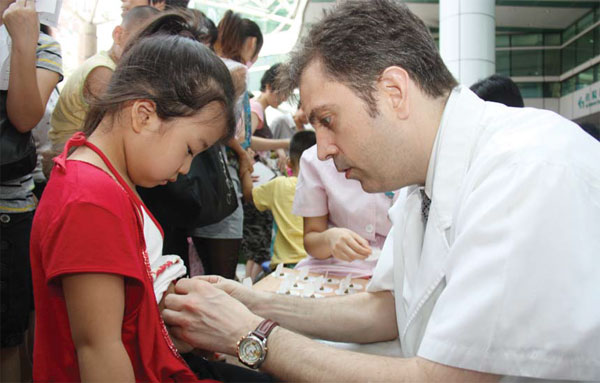
Paul Ryan, a US doctor studying traditional Chinese medicine in Guangzhou, capital of Guangdong province, treats a girl with sanfutie plaster in July 2012. Provided to China Daily |
Qinghaosu, first acquired by Chinese scientists, including Tu, in the early 1970s, was extracted from Qinghao, a commonly seen traditional Chinese herb. The substance later became the standard regimen for malaria adopted globally.
TCM has won more recognition in Western countries in recent years, but the 5,000-year-old medical science still faces many challenges to break into the mainstream Western market, analysts say.
According to the Beijing-based World Federation of Chinese Medicine Societies, more TCM clinics have opened in the West and more colleges are starting to offer TCM education, but TCM has not attained legal status in many countries.
In some countries, TCM is considered a food supplement rather than having medicinal effects.
One reason that TCM is not widely acknowledged in these countries is a lack of research on TCM such as its pharmaceutical details and its interaction with other medicines, the federation says.
The number of registered TCM practitioners worldwide is estimated at about 500,000.
A cooperative project between the Guangdong Provincial Hospital of Chinese Medicine and Royal Melbourne Institute of Technology in Australia is trying to combine TCM with modern interpretations of ancient documents and high-level clinical research.
"International society has increasing recognition of traditional Chinese medicine," says Lu Chuanjian, vice-president of the TCM hospital based in Guangzhou, capital of Guangdong province. "TCM's natural therapies are in fashion, with many Western pharmaceutical companies looking for a formula for natural products when they develop new drugs."
"Tried and tested throughout several thousand years, the effectiveness of TCM is indisputable, with all the ineffective medicines and those with adverse reactions eliminated over time," she says.
"Now we need to use modern technologies and ways of thinking to explain to the world how TCM works on specific diseases and prove that it can cure diseases.
"The modernization of TCM is the prerequisite for it to go global."
The cooperative project began in 2008. It has chosen 26 diseases and is collecting evidence of TCM's curative effects.
It requires a huge amount of work to search among the sea of ancient documents for descriptions of the symptoms and pathogenesis, and compare them with modern descriptions. The research team will then use the assessment system it established to evaluate the therapies.
Besides collecting evidence from documents, the team also conducts clinical research combining approaches of TCM and Western medicine.
The research on psoriasis and chronic obstructive pulmonary disease is almost finished and the results will be published in papers and as part of the book collection Evidence-based Research of Clinical Chinese Medicine.
The books on the two diseases, with Chinese and English versions, are expected to be published this month, Lu says.
Meanwhile, select young Chinese scholars were sent last year to work and study at the Royal Melbourne Institute of Technology, where they will obtain doctorates. The project plans to cultivate 20 such doctors by 2025, Lu adds.
Traditional Chinese medical science relies largely on herbal medications to prevent and help the human body fight ailments, relieve pain and restore health. It also adopts therapies such as acupuncture, blood letting and medical massage.
Yang Zhen, an associate professor in pharmacology at Beijing University of Chinese Medicine, says acupuncture has become popular in many countries, such as the United States, Canada and Australia.
"Acupuncture has been accepted in American society as it has proved effective in many cases, and acupuncture services are available in many big hospitals in the US," says Yang, who is also a licensed acupuncturist in California.
Acupuncture can cure many diseases that modern medicine fails to handle, such as in alleviating vomiting after chemotherapy for cancer patients and easing the side effects caused by taking painkillers, he says.
"Many big insurance companies have included acupuncture treatment to attract more people. In many states, the US government medical insurance plans also cover acupuncture."
California alone has an estimated 15,000 acupuncturists, most of them non-Asians who serve not only Chinese but also others, Yang says.
However, compared with acupuncture, traditional Chinese medicine is not well accepted in the US, he says.
Medical insurance plans do not pay for TCM expenses, which affects the popularity of TCM, he says.
China will make greater efforts to promote overseas development of TCM and medical care in the next five years, according to a national plan issued by the State Council in April.
Under the plan, China will encourage reputable TCM enterprises and medical institutions to set up hospitals or clinics to provide services to locals.
The government will also take measures to nurture big enterprises that provide TCM service internationally, and encourage TCM colleges in China to intensify international cooperation and provide TCM education overseas, under the plan.
Lu of the Guangdong Provincial Hospital of Chinese Medicine called for more government funding on international cooperative projects initiated by Chinese universities and research institutes. For example, government subsidies cover less than one-tenth of the huge expenses on the cooperative project with the Royal Melbourne Institute of Technology.
More importantly, the Chinese government should promote the legalization of TCM practitioners in other countries, as Australia did in 2012, Lu says.
"Legalization can protect the rights of overseas TCM practitioners and also supervise their behavior. It will spoil the reputation of TCM if some unqualified or inexperienced practitioners work underground without legal supervision overseas."
"Also, the Chinese government should ask foreign countries to set standards on developing and registering Chinese patent drugs together, rather than using their own standards to assess our products," Lu adds.
"TCM may break the fortress and enter the mainstream markets overseas in five to 10 years if the government can create such a favorable environment."
The first Chinese medicine center to train doctors in Central and Eastern Europe - the Czech Chinese Research Center of Traditional Chinese Medicine in Prague, opened in June.
It is a joint project by Shuguang Hospital, affiliated to Shanghai University of Traditional Chinese Medicine, and the University Hospital Hradec Kralove.
In June, the United Kingdom's Medicines and Healthcare Products Regulatory Agency also accepted an application for approval of Isatis Cold and Flu Relief, based on Radix isatidis (banlangen in Chinese).
The application to sell the popular Chinese medicine in the UK was submitted by Phynova, based in Oxford, in collaboration with TCM manufacturer Xiangxue Pharmaceuticals.
It could take the agency 210 days to reach the decision. The application sends a positive signal for companies making TCM products, analysts say, following the UK's decision in 2013 to stop selling unlicensed herbal medicines by the end of that year.
Contact the writers through xujingxi@chinadaily.com.cn
















