


The Silk Road - and how it made history
Historian says his book on ancient trading routes shows globalization is an old concept
Peter Frankopan believes we have all been looking at history the wrong way.
Often seen only from a Western perspective, the accepted story of mankind largely ignores the contribution made by that huge bridge between the West and the East that is now often referred to as the Silk Road.
In his new 636-page history, The Silk Roads, the historian aims to put that right by showing how the interconnectedness of Europe, the old Ottoman Empire, Central Asia, the Caucasus and China have for millennia been the very cradle of civilization.
He argues history did not begin with the ancient Greeks and Romans and that European movements such as the Renaissance or the Enlightenment were not new but partially derived from a fusion and exchange of ideas, cultures and religions along what we now see as some old caravan trail.
"We are all brought up in the West being taught this monolithic story which hasn't really changed for 200 years. If you went back to a classroom in 1850 England, you would find much of the same topics being taught. I am not sure what relevance the Battle of Hastings would have to a boy growing up in Shanghai today."
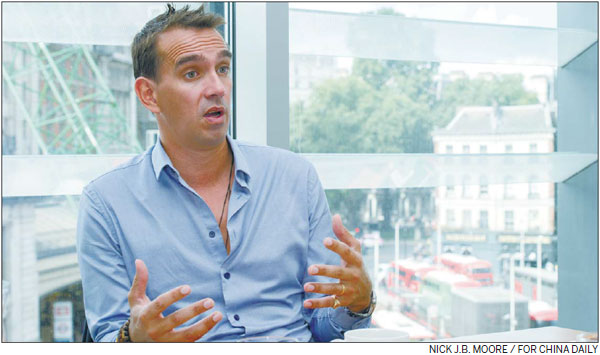
Frankopan, 44, who is director of the Centre for Byzantine Research at Oxford University and was speaking in offices overlooking Victoria station in central London, believes his book's essential theme is globalization - not as a new but a very old concept.
"It certainly ain't nothing new. We might think we are living in a new age of exchanges between China and the West but we can go back 2,500 years and find Chinese sources that suggest a world where the exchanges were just as strong."
Frankopan points out the term "silk road" is not as old as what it describes and dates back only to the 19th century when it was used by German geologist Ferdinand von Richthofen - uncle of World War I flying ace Manfred von Richthoven, otherwise known as the Red Baron - when he used the word "seidenstrasse".
He believes one of its leading modern reincarnations, the Chinese government's Belt and Road Initiative, accurately sums up what the concept is in reality: myriad maritime and overland links and not one central highway.
"I think to many Western eyes and ears, the concept of the silk road is almost like a semi-motorway, a single path that links Venice, through Constantinople and central Asia, to China. We also only think of it as going from east to west but, of course, the traffic was in both directions.
"It was also not always about goods and traffic going vast distances from China to the West. Much of the exchanges, in fact, were highly local, trading between towns and villages near to each other, building up to a sort of long chain."
Frankopan became interested in the eastern world largely due to an inspirational teacher at Eton.
"I had a fantastic Russian teacher who used to say the best way to learn a language was to sing its peasant songs. He was sent by the school to Baghdad and when he came back he said he would teach us Arabic if we wanted to learn," he recalls.
"We were introduced to Arabic literature and poetry and had discussions about Islam and contemporary Muslim society."
Frankopan went on to study Russian at Jesus College, Cambridge, where he switched to history and received a prize for the highest first of his year.
He then did both a master's and a doctorate in Byzantine history before embarking on an academic career, which he has mostly spent at Oxford, apart from brief spells at Harvard and Princeton.
He has something of an exotic background in that he is also a Croatian prince. "In a bygone age that might have meant something," he says. "I am from a very old family that traces itself back to the Dalmatian coast 700 or 800 years. Nowadays, it closes as many doors as it opens."
Nonetheless it led to his becoming president of the Croatian cricket board and playing for the national team, including at Lord's (cricket ground in London, considered to be the home of cricket).
"A lot of them (his teammates) have been brought up in Australia and they are bloody good."
The book, hugely ambitious in its scope and which takes the reader from the ancient Persian civilizations to the recent wars in Afghanistan and Iraq, has a compelling narrative and is jampacked with stories.
It contains numerous snippets of information that shed new light on major world events.
The huge Buddha statues in the East did not exist before those traveling up the Silk Road saw such statues in ancient Greece.
We also learn from Saddam Hussein's own surprisingly meticulous records that he thought the US ambassador to Baghdad, April Glaspie, had given him a green light to invade Kuwait in 1990.
"I was aware that it needed to be readable and not self-indulgent with endless footnotes. As a student I used to read books that you couldn't make head or tail of. It wasn't because the author was very clever but actually was a bad writer," he says.
Frankopan says he had been itching to write such a book that gave a different perspective on world history since starting his doctorate more than 20 years ago.
"Many academics spend years contemplating and don't write anything at all. This is such an ambitious book, I can't quite believe I have written it. If you ask me why I have done it, I don't really have a very good answer."
Bio
Peter Frankopan
Director, Centre for Byzantine Research, Oxford University Author, The Silk Roads by Peter Frankopan (Bloomsbury)
Age: 44
Education
Eton College 1984-89 (Music scholar and also winner of the Duke of Newcastle Russian Prize).
BA in modern history, Jesus College, Cambridge, 1993 (Schiff Foundation Scholar and history prize for the highest first class degree)
M Phil in Byzantine studies, Corpus Christi College, University of Oxford, 1995
D Phil in Byzantine History, Corpus Christi College, University of Oxford, 1998
Career
Summer fellow, Dumbarton Oaks, Harvard University, 1996
Junior research fellow, Worcester College, Oxford, 1997-2000
Stanley J. Seeger Visiting Fellow in Hellenic Studies Princeton 2002-03
Senior research fellow, Worcester College, Oxford, 2000-present
Director, Centre for Byzantine Research, Oxford University, 2010-present
Book, The Alexiad by Anna Komnene "A 12th century Greek text explaining the changing world of the Middle Ages and the conflict between Christianity and Islam."
Film, Indiana Jones and the Last Crusade (1989, dir. by Steve Spielberg). "I have a soft spot for Indiana Jones films - an academic having adventures around the world rings a bell."
Music, Grieg's piano works performed by Ivana Gavri. "Ivana is a good friend and is rightly becoming a major artist."
Food, Vietnamese. "I spent some time in Southeast Asia this year to look at the spread of Hinduism and Buddhism in the Middle Ages, and got hooked on the street food of Hanoi."
andrewmoody@chinadaily.com.cn
















