


IMF leadership vote a chance to reform
Months before Christine Lagarde's term ends, China should put its weight behind search for her successor
In 1944 the eventual winners of World War II met in New Hampshire to discuss how the world should be organized and governed when peace came. Fresh in the victors' minds was the Paris Peace Conference of 1919, when the huge financial compensation loaded onto Germany after it lost World War I paved the way for the collapse of the country's economy, hyperinflation and a right-wing Nazi dictatorship that brought the world back to war in 1939.
So at Bretton Woods in 1944 the discussion among the Allies, which included China, focused on creating a global governance and economic system that was sustainable and would promote prosperity.
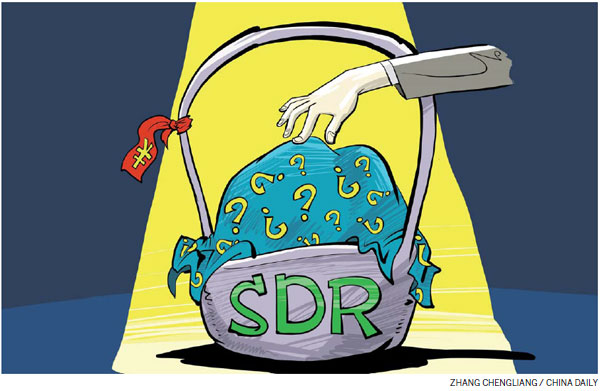
The International Bank of Reconstruction and Development (World Bank) was created to help plan and finance the rebuilding of the shattered European economies, and the International Monetary Fund was established to act as a global central bank, with its own supranational currency, for a postwar world order that would avoid the damaging economic protectionism and imbalances of the 1930s.
Both institutions were conceived by British economist John Maynard Keynes. But Keynes' desire to create new institutions that would stand above purely national interests conflicted with the determination of the chief US negotiator Harry Dexter White, backed by the US government, to make it the dominant financial and economic force after the war.
In place of Keynes' supranational organization to control and monitor the global financial system, the US dollar became the global currency, and the world economy was recreated with the US at its head. The IMF's role became quite different to the one Keynes conceived, and the Federal Reserve became the global central bank.
Immediately after World War II, the US economy accounted for more than half of global output. The world needed the motor of the US' huge power and energy to drive it on a path of reconstruction, growth and increasing prosperity. So although Keynes objected to one country dominating the world financial system and warned against the imbalances and instability that this would eventually bring, he lost the argument, and most people agreed with the solution.
Today the world is very different to what it was in 1945. Last year the US' share of global economic output was 23 percent, calculated at market exchange rates. The emerging world, led by China, accounted for 39 percent of the global economy. Yet the institutions created in 1944 to manage the global economy have hardly changed. The US continues to dominate the World Bank and the IMF by virtue of the 85 percent voting majority needed under the original constitution, for any fundamental change. Today, just four countries (Britain, France, Germany and the US) hold more than 30 percent of the voting rights of both the IMF and World Bank, even including the results of reforms agreed in 2008 that recognized that control of these institutions should recognize the larger role being played by emerging countries in global economic and political affairs.
At a time when the US no longer has the will or the economic strength to act as the police officer, and as powerful new forces in the Middle East and elsewhere threaten to upturn global stability, this narrow control means these institutions no longer command the broad support they need to provide guidance and leadership to the global economy.
Disillusioned by the US shunning calls to reform the global monetary system after the 2008 financial crash, and irritated by the refusal of the US Congress to ratify IMF voting changes that the IMF Board agreed to in 2010, China has started to go its own way. In 2013 it announced the establishment of the Asian Infrastructure Investment Bank with $100 billion in capital. US lobbying has been unable to prevent developed countries outside Asia from joining the new institution. Sadly, US intransigence has created a split over global governance, which looks to be getting deeper.
Against this background, the end of the term of office of Christiane Lagarde, the IMF chief executive, next June looms at a decisive moment. Will Lagarde be reappointed for a further five-year term to 2021, as she wishes to be, prolonging the postwar period of European domination of this key post? Or will the IMF leader election process be opened up to a proper global search, with qualified candidates from emerging countries in the running, such as the Agustin Carstens, governor of Mexico's central bank, and Tharman Shanmugaratnam, Singapore's deputy prime minister?
Whatever the merits of Lagarde's candidature for a second term as IMF head, (and overall it is generally agreed that she has been successful), a gradual economic and geopolitical shift away from the developed toward the emerging world is an unstoppable momentum that we see before us.
Lagarde's reappointment for a second term would signal that, once again, the aspirations of the emerging countries are being ignored by their richer partners. Emerging countries would be encouraged to find other ways forward to global governance, such as the Asian Infrastructure Investment Bank. The IMF would continue to lose credibility and support as a genuinely global institution, and the main beneficiaries of its current important position, Europe and the US, would be the biggest losers of its decline in influence.
The emerging countries have to demonstrate unified leadership in order for global governance to reflect the underlying changes in geopolitical power. Last time in 2011, good alternative candidates to Lagarde emerged from Nigeria and Mexico, but the support from Latin America and Spain for a Mexican candidate and from Africa for a Nigerian candidate ended up splitting the forces, which were arguing for a change to the old system.
China, which supported Lagarde in 2011, could be one of the leaders of a movement to find a new IMF leader through a formal search process, rather than by an informal consensus. The alternative is that the old consensus continues, and the IMF loses relevance and power to competing institutions like the Beijing-based Asian Infrastructure and Investment Bank, in which China is the largest shareholder. By establishing this bank, China has shown that it is capable of forming its own governance institutions and attracting support not just from other Asian countries but from developed countries as well. While all would lose if the IMF becomes marginalized, it is in the particular interest of the US to breathe new life into the IMF it still controls.
The author is a visiting professor at Guanghua School of Management, Peking University. The views do not necessarily reflect those of China Daily.
















