


High stakes gamble across Asia-Pacific
Casino operators are banking on more betting tables in the region as some countries aim to relax regulations
For decades, Macao has been well known as a gambling destination, dubbed Asia's Las Vegas, with millions of players flocking to the gambling tables and, increasingly, the shopping malls and entertainment facilities.
The peripheral attractions, including the flashy theaters and movie-themed features, are relatively new additions to the main event: Gambling.
|
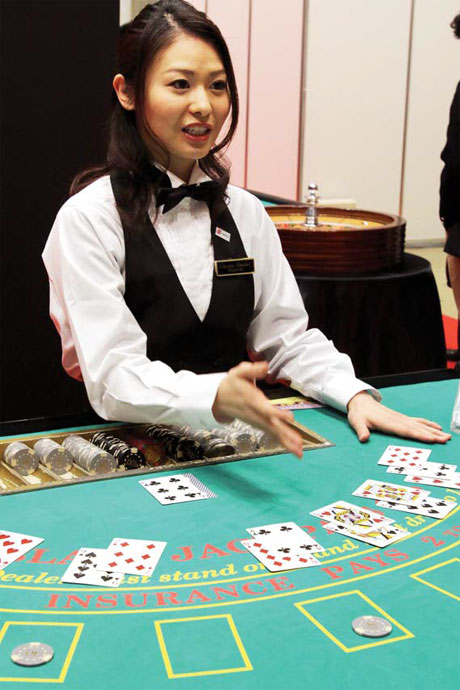
A dealer demonstrates how to play blackjack at a leisure exhibition in Tokyo. Some Japanese lawmakers are seeking to legalize casinos. AFP |
Across the Asia-Pacific, demand for gambling options is much higher than the number of available seats. Even as the industry goes through testing times, several countries within the region are continuing a rush to change legislation and build integrated resorts with casinos to attract more tourists with a penchant for gambling.
CLSA, a Hong Kong-headquartered brokerage and investment company, estimates there will be 230 casinos in the region by the beginning of the next decade, up from about 200 at present.
As new casinos pop up across the region, emerging markets like Cambodia and Vietnam are looking to leverage gambling revenue to shore up state budgets and tourism.
South Korea and Japan are moving to legalize gambling and attract more investors. Analysts expect both countries to emerge as lucrative gambling markets.
"The gambling industry in Asia will continue to grow in the next three years," says Lantis Li, a gambling industry analyst at Capital Group in Hong Kong. "The market is not yet mature, so it is expected that more casinos will open across the region."
While gambling is still banned altogether in the Chinese mainland, Myanmar and Thailand, as well as among locals in Vietnam and Cambodia, many fly elsewhere, including to neighboring Laos.
The Chinese-owned Kings Romans Casino in Laos' Ton Pheung district, in the Golden Triangle Special Economic Zone in the country's northwest, bustles with activity seven days a week, 24 hours a day. It is known as the Macao on the Mekong.
The Lao government has signed over 10,000 hectares to the Kings Romans Group on a 99-year lease. The company's total investment in the special economic zone is expected to reach $2.25 billion by 2020.
Cambodia, for its part, has 57 casinos spread around 14 clusters. These cater to gamblers from abroad, mostly China, Thailand and Vietnam.
In May, Australia's Donaco International paid $360 million for the acquisition of a casino called Star Vegas in Poipet, a Cambodian town, which is a three-hour drive from Bangkok. The group also owns casinos in Vietnam, just over the border from Southwest China's Yunnan province.
Vietnam and Cambodia have welcomed foreign gambling companies with open arms after some hiccups.
A case in point is Vietnam. In 2012, Genting Malaysia pulled out of a project after local gambling restrictions made the project impractical. Since then, Vietnam has worked on some of the pitfalls of its gambling laws. At the top of the list is a move to allow local residents to gamble.
Earlier this year, Hong Kong's property-to-jewelry conglomerate Chow Tai Fook Enterprises announced plans to develop a $4 billion casino resort in Vietnam.
The country's Ministry of Finance said legal gambling businesses contribute significantly to the state budget. Total casino revenue last year reached over $1.3 trillion dong ($61.4 million), which contributed $15 million to the state budget.
Capital Group expects Vietnam's GDP to increase by 0.58 percentage point if foreign investment in the casino sector increases by $3 billion.
Yet, it is the more deveveloped countries of Japan and South Korea that offer the greatest opportunities for investment and the biggest potential returns in the gambling industry.
CLSA foresees that Japan, where casinos are still banned, could turn into Asia's second-largest gambling hub, possibly worth as much as $40 billion in annual revenue as early as 2025.
Some Japanese lawmakers have submitted bills seeking to legalize casinos.
Sheldon Adelson, chairman of Las Vegas Sands, the world's largest gambling company in terms of market value, announced last year the company's plan to build a casino in Japan if the ban is lifted. MGM Resorts also expressed its readiness to spend between $5 billion and $10 billion to put up Japan's first casino.
"As per our Japan casino time line, we do not expect door opening until 2023 if the integrated resorts Implementation Law (the second of a two-statute process) is passed in spring 2017," says a recent CLSA report.
South Korea is also looking to build new casinos amid its growing cultural popularity with tourists from around the world. There are now 16 foreigner-only gambling properties across the country.
In 2013, these facilities generated $2.7 billion in revenue and attracted more than 2.7 million international visitors, according to research house CIMB.
The South Korean government has invited applications for two gambling licenses to build integrated resorts comprising casinos, which would probably be open only to foreigners.
"The (South) Korean government wishes to open two integrated resorts by 2020," Choi Min-young, deputy director of Invest Korea, told investors in April. "We expect more rapid growth of Korea's tourism industry in the future."
















