


Cyberspace a frontier for global cooperation
President Xi calls on nations to work together on Internet development and build shared future
If you had taken a walk in eastern China's Wuzhen this week, there is a good chance you could have bumped into some of the world's most influential people, for instance, Alibaba founder Jack Ma.
The big names were in Wuzhen, Zhejiang province, for the second World Internet Conference, also known as the Wuzhen Summit, between Dec 16 and 18. The theme was "Building a Cyberspace Community of Shared Destiny".
|
President Xi Jinping addresses the opening of the Second World Internet Conference in Wuzhen, Zhejiang province, on Dec 16. Wu Zhiyi / China Daily |
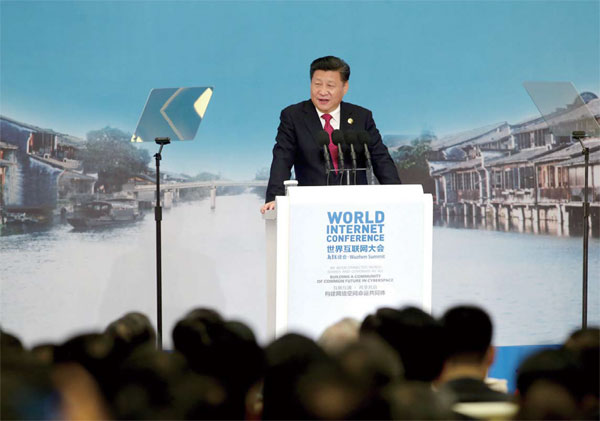
China connected to the Internet 21 years ago and today has 670 million Internet users, about one-fourth of the global total, and more than 4.13 million websites.
"The Internet has penetrated all aspects of China's social and economic development," says Lu Wei, director of the Cyberspace Administration of China, the regulating body. "China is on course to become an Internet powerhouse."
President Xi, in his keynote speech to open the summit, said China has put forward five principles of innovative, coordinated, green, open and shared Internet development. In the 13th Five-Year Plan (2016-20), he said the country will implement strategies that aim to harness the power of the Internet and big data.
"China will develop a positive Internet culture and promote the integrated development of the Internet, economy and society," he said. "Our goal is to let the achievements of the Internet benefit 1.3 billion Chinese people, and create better livelihoods for people around the world."
More than 2,000 people attended the Wuzhen Summit, half of them from overseas. Eight government leaders, including Russian Prime Minister Dmitry Medvedev and Pakistani Prime Minister Nawaz Sharif, joined about 50 ministerial officials, as well as heads of more than 20 international organizations, and more than 600 Internet entrepreneurs and experts.
They exchanged ideas on communication, innovation and development, digital economic cooperation, cybersecurity, the Chinese government's Internet Plus strategy, cyberspace governance and the so-called Digital Silk Road.
The summit also included the Light of Internet Expo, which showcased the latest advanced technologies, such as Baidu's self-driven vehicles, Volvo's smart cars, Nokia's virtual reality shooting platform and China Telecom's 5G network.
In his speech, Xi said cyberterrorism is a global scourge and that "cyberspace should not become a battlefield for countries to wrestle with one another or become a hotbed of crime". He called for the international community to work together to prevent cybercrime.
The president predicted the Internet will play a bigger role in the progress of human civilization. He said maintaining cybersecurity is the shared responsibility of the international community and that all countries should work together to contain the abuse of information technology and "step up communication and exchanges, improve dialogue and consultation mechanisms on cyberspace, and study and formulate global Internet governance rules".
Xi said the robust growth of China's Internet sector has provided a big market for enterprises and startups from overseas. "As long as they abide by Chinese law, we warmly welcome enterprises from all countries to invest and do business in China," he said.
He also put forward five proposals: to accelerate construction of global network infrastructure to advance interconnectivity, to build online platforms for cultural exchanges and promote mutual communication, to promote innovative development of the Internet economy to boost common prosperity, to safeguard Internet security, and to establish an Internet governance system to promote equity and justice.
The Internet has already altered most aspects of China, from economics and culture to education and healthcare, but it will be more integrated with social and economic development in the future, according to a report by the Chinese Academy of Cyberspace released shortly before the Wuzhen Summit.
The report says China has the world's biggest 4G mobile network, with more than 250 million users, and that the Internet sector now accounts for 7 percent of GDP. Meanwhile, online retailers made 2.95 trillion yuan ($455 billion; 416 billion euros) between January and October, it says, more than anywhere else in the world.
Internet enterprises' market value has also continued to rise, the report says, with China's 328 listed Internet-related companies now having a combined market value of about 7.85 trillion yuan.
Li Yuxiao, a researcher with the Chinese Academy of Cyberspace, says the Internet has deeply changed people's lifestyles, regardless of region, income or age.
"No matter whether you are in a big city or small village, are an ordinary worker or a CEO, you have the same access to information because of the Internet, which is a huge change," Li says.
Jim Breyer, founder and CEO of Breyer Capital, a venture capital company, says he was impressed by Xi's long-term vision.
"When it comes to the Internet and technology, in the United States and elsewhere, we don't often see leaders articulate a 10- to 20-year plan," he says. "For me, as a long-term venture capitalist and investor for entrepreneurial companies, it's very exciting to think about the Internet 10 years from now and what it means for our entrepreneurial opportunities in China and in the US."
Kamel Mellahi, a professor of strategic management at Warwick Business School in the United Kingdom, adds: "President Xi's speech underscored the important role the Internet is going to play in the future Chinese economy, and hints at how China is planning to unleash its potential."
Wu Jiangang, a researcher with CEIBS Lujiazui International Finance Research Center, says China's determination to make the Internet more open is unquestionable. He says the country is using the Web to promote a more modern economy, a more open society and more-enlightened politics.
Although China has a positive outlook, he says the country still needs to be cautious going forward but agrees with President Xi's call for countries to strengthen communication.
"The Internet essentially belongs to all mankind. China's large-scale application is not only bringing more business ideas, more technological innovation and cheaper technological applications, but also management experience, which is a welcome and happy thing," he says.
Zhao Huanxin and Shi Jing contributed to this story.
chenyingqun@chinadaily.com.cn
















