


Embracing age of supply-side reform
Goals include reducing overcapacity, bad loans and local government debt, and boosting the service sector
The Chinese government, long used to demand-side management, is now trying to change its role and is putting more of its energies into supply-side reform.
There are two ways to shed overcapacity: one is to increase demand; the other is to reduce supply.
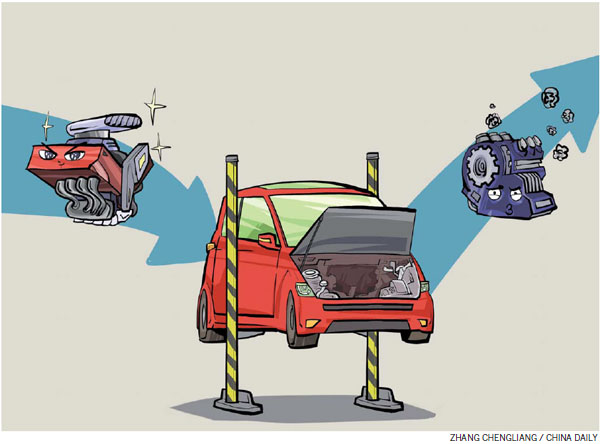
In the 1990s, both methods were used. The government cut supply. And then demand increased due to globalization (China joined the World Trade Organization in 2001) and real estate became a pillar industry.
But things have changed again.
Instead of having a globalization dividend, China now faces pressure from global rebalancing. Instead of opportunities like joining the WTO, the country faces pressure from the Trans-Pacific Partnership and the Transatlantic Trade and Investment Partnership. Moreover, as its advantage in low-cost labor disappears, exports may no longer solve the problem of overcapacity.
In addition, the real estate dividend has changed to a situation in which the number of unsold homes needs to be reduced.
Over the past 10 years, China has built 17,400 square kilometers of new homes. Yet over that time, just 11,700 sq km of homes have been sold, of which at least 30 percent are secondhand. The difference between supply and sales is vast.
In 2015, the amount of newly built homes (1,400 sq km) was again bigger than the amount sold (1,300 sq km). It could take five to 10 years to reduce real estate stock to meet the level of demand.
In general, a move toward innovation, which means putting more emphasis on the service sector and high-end manufacturing, could stimulate demand, but it will do little to boost demand in traditional sectors such as construction. For example, 100 yuan ($15; 14 euros) of GDP generated by the construction industry could create 50 yuan in demand for steel, but 100 yuan of GDP generated by the service sector may only create 1 yuan in demand for steel.
So only by reducing supply can we shed overcapacity. If the government makes the decision early, there will be more room to maneuver. If not, more elements will be beyond control.
There are several issues that need to be resolved in this round of supply-side reform:
Reform of administrative management and enhancement of administrative efficiency. China needs a performance-related evaluation of civil servants, and employees at state-owned enterprises and public institutions. The key is to make salaries flexible and remove permanent job security. People who don't work well should be downgraded, while people who do excellent work should be promoted.
Proper expansion of the fiscal deficit, tax cuts and the large-scale release of bonds. In 2015, China's fiscal deficit target was 2.3 percent, well below the international alert level of 3 percent and lower than our own level in 2009 and 2010. So as a next step we can expand the fiscal deficit. There are two ways to do this: one is for the central and local government to release more bonds; another is major tax cuts.
The cleanup of nonperforming assets and motivating commercial banks. The ineffectiveness of monetary policy is mainly because of the unwillingness by banks to issue loans, which stems from nonperforming assets. Now, most nonperforming assets are with regional commercial banks, so the government needs to accelerate regional asset management companies and strip banks of nonperforming assets so they can develop without too much burden.
Getting out of the debt black hole. During times of economic prosperity, local governments supported the development of industries through credit guarantees. But when an economy slows down, the disadvantages of these guarantees become obvious: the crowding-out effect, which twists capital allocation; alienation of the financing demand and increased cost of financing; and swallowing the profits of enterprises. These challenges can also become opportunities if they push reform.
Speeding up mergers and acquisition by enterprises and the reduction of overcapacity. The core of an economic crisis is surplus; if you don't solve overcapacity, it's difficult to get out of a crisis. Many policymakers are scared when they hear the word "overcapacity reduction" as they fear it will cause social unrest. Actually, M&As can effectively relieve the pain of reducing overcapacity and motivate the vitality of companies.
Building a national-level research and development center. About 2.01 percent of China's GDP is put into R&D, less than South Korea and Finland (both about 4 percent). Technology innovation needs capital market incentives and government support, especially major scientific research that needs to be done quickly. Based on all the research institutions and colleges today, China should build an independent national-level R&D center.
Participation in the making of international rules and use outside forces to push domestic development. If China wants comprehensive reform, it has to open up more. The opening-up under China's new normal is different from the first reform and opening-up in the 1980s. In the past, the strategy was to accept international rules, but now there should be more activity in changing and making the rules.
Promoting public-private partnerships and mixed ownership to enhance state capital cooperation with social capital; or, more precisely, the government should share the profit with social capital, which is a must under China's economic dilemma. Privatizing all Chinese state-owned enterprises is unrealistic. A more realistic way is to develop mixed ownership and public-private partnerships.
Greatly reduce the threshold to access the service sector and let market forces break the bottleneck of insufficient supply. The service sector is key to China's economy and society. It will help stabilize the economy and employment. Latest data from the National Bureau of Statistics show 1 percent of GDP growth in the service sector will generate about a million jobs, which is 500,000 jobs more than the industrial sector. The bottleneck in development of the service sector is not because demand is insufficient, but because supply is insufficient. The next step should be opening the supply side and reducing the threshold for accessing finance, education and healthcare industries.
The author is head of macroeconomics for the Minsheng Securities Research Institute. The views do not necessarily reflect those of China Daily.
















