


Trucking into Africa for growth
Sinotruk plans to build warehouses, service centers, assembly lines
China National Heavy Duty Truck Group Co Ltd, or Sinotruk, the country's largest truck manufacturer by revenue, plans to build five spare parts warehouses and service centers in South Africa, the Democratic Republic of Congo and Nigeria this year to keep pace with established European and US rivals in the region.
The Shandong-based company assembles medium-duty trucks in Nigeria, delivers lengthened-chassis to Angola and ships heavy-duty trucks to Ghana. This has helped build for itself a reputation for competitively priced and easily serviceable products, including heavy military off-road vehicles, heavy and light trucks, large and medium-sized passenger cars, minivans, engines and spare parts.
|
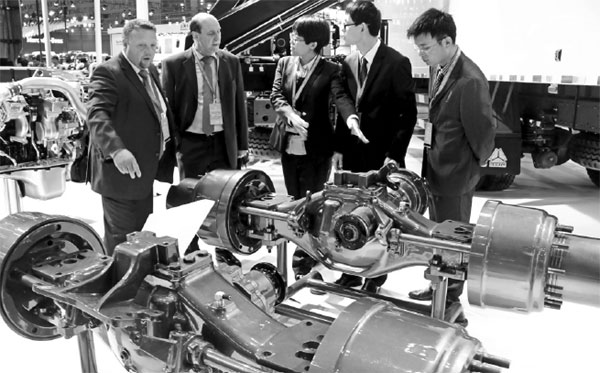
Foreign clients inspect a transmission bridge produced by Sinotruck during a recent auto show in Shanghai. Provided to China Daily |
Sinotruk exported 12,470 trucks to Africa in 2015, up 13 percent year-on-year, thanks to growing demand from fast-growing markets like Senegal, Angola, Benin, Mali, Niger, Ethiopia and South Africa. It has exported more than 270,000 finished trucks to African markets since 2010.
Cai Dong, general manager of Sinotruk, said continued foreign and domestic investment in infrastructure, energy and trade development will be vital to supporting economic growth in Africa over the next decade. The Chinese company is now seeking opportunities to build a new assembly line in an East African country.
The Beijing-based China Chamber of International Commerce said that truck sales in Africa accounted for 17 percent of global sales in 2015, driven by an infrastructure boom and the surging consumer goods and logistics demand of more than 1.15 billion people, which offer rich opportunities for Chinese and foreign truck manufacturers.
Cai said it was not easy to gain a foothold in these markets. Logistical issues like ensuring spare parts reached customers on time and setting up adequate number of after-sales branches posed difficulties early on.
Eager to establish a reputable brand image in a new market, the company initially shipped spare parts by high-cost air cargo via airports in Dubai or Qatar to various African country markets. It also invested heavily in regional service centers in major cities such as Lagos, Accra and Dar es Salaam.
"Government procurement is another important growth channel for Chinese automobile companies. In Africa, the biggest consumer is often the local government," said Cai. "If Chinese automobile companies get included in government procurements in Africa, they would stand to gain a lot.
"The majority of African nations are still in the early stages of economic development, and the strategic sectors of infrastructure services, transport and logistics companies are under state control, which means when it comes to buying trucks, the government is one of the biggest customers," said Cai.
However, this is easier said than done. To win a share of the government procurement market, Cai said Chinese companies must continue to increase their own strengths and credibility, as this will create an overall favorable impression.
To date, Sinotruk has built a global market network in 96 countries and regions, including 41 African countries. It has eight overseas manufacturing facilities in countries such as Russia and Malaysia. Its production bases in Africa are located in Nigeria and Morocco.
Supported by more than 25 subsidiaries, Sinotruk shipped 27,876 trucks with various functions to global markets, mainly to Africa, Central Asia and Latin America in 2015, up 12.43 percent year-on-year.
Liu Wei, deputy general manager of Sinotruk, said the main competitors in African markets are European truck makers such as Sweden's Scania AB and Volvo Car Group, Germany's Mercedes-Benz and MAN AG. Many of these European trucks are second-hand vehicles, widely used in construction work and logistics services.
The governments of Nigeria, Ghana and Kenya have all made changes to import regulations to try to reduce the country's dependence on imported second-hand trucks and encourage companies to buy new ones to help protect the environment and reduce heavy smoke on roads.
The Nigerian transportation authorities said only trucks first registered six years ago can now be imported after inspection.
Liu said the registration period may be reduced to three years this year and it is possible that imports will be banned eventually, presenting Chinese brands with a clear advantage.
Many local governments and logistics companies in Africa have also been keen to seek solutions and tackle problems of air pollution caused by heavy trucks.
Eager to meet market demand in the continent as well as other markets, Sinotruk started to design and produce compressed natural gas, liquefied natural gas, electric and other new-energy heavy-duty trucks since 2014.
China's 15 major automakers, including Shaanxi Automobile Holding Group, Chongqing Lifan Group and Great Wall Motors Group, have established 58 overseas plants. By 2015-end, they produced more than 200,000 vehicles in different regional markets, commerce ministry data show.
They have also created an $18-billion market for export of auto parts from China.
"The truck market is usually seen as a barometer of the macroeconomy, since it reflects the scale of commodity flow, regional trade, as well as infrastructure development," said Zhao Ying, a researcher at the Institute of Industrial Economics under the aegis of the Chinese Academy of Social Sciences in Beijing.
In terms of competing with foreign rivals, Zhao said Chinese automobile makers must pay attention to sales details to secure their market share in a sustainable way.
"Many of their passenger vehicles and trucks often have incomplete user manuals. These product manuals have just one or two foreign languages, not in Africa, but in global market, while many foreign vehicles come with manuals in more than 10 different languages," he said.
Contact the writer at zhongnan@chinadaily.com.cn
















