


Supply-side reform key for SOEs
Technology upgrades promise rebirths and returning to profits
Kocel Machinery Company, a State-owned enterprise that had been struggling in the anemic foundry industry, is recovering amid a wave of economic reforms in China. After piloting an employee stock ownership plan and introducing 3D printing techniques, the 50-year-old manufacturer, located in Yinchuan in West China's Ningxia Hui autonomous region, has seen improved productivity and worker morale.
A computerized production system has cut the time needed for casting engine parts from over a month to just 10 hours. Precision machinery has narrowed sample errors to 0.3 mm from 1 mm. Workshops are no longer filled with powders and fumes.
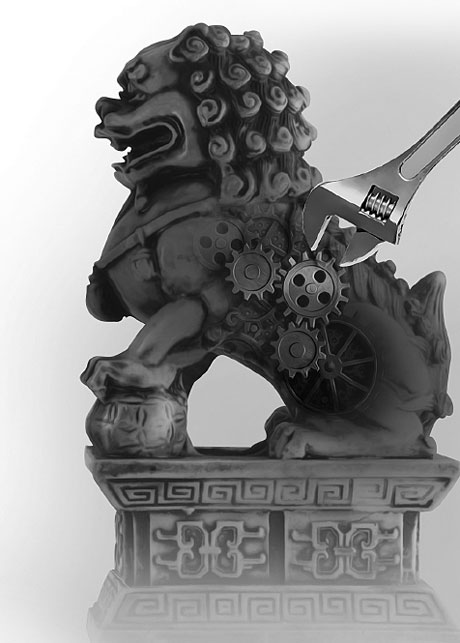
"The company has been reborn," said Kocel president Peng Fan. "I am confident profits will double this year."
Given that the foundry sector is still dominated by old techniques globally, Kocel is aiming to become an industry leader, Peng said.
The SOE's transformation is a remarkable example of ongoing upgrades in sluggish traditional industries, as China promotes an ambitious economic overhaul to achieve rebalancing amid downward pressure.
"Supply-side structural reform" was proposed by China's policymakers in November 2015 as the latest remedy for economic ills caused by breakneck growth.
It quickly became a buzzword among economists and has been a highlight of the legislative session that began on March 5.
The reforms were prioritized in this year's government work report delivered by Chinese Premier Li Keqiang and further elaborated in the 13th Five-Year Plan (2016-20) to be approved by legislators.
The country's most significant annual political event, the Fourth Session of the 12th National People's Congress focused on economic issues this year due to grim domestic and global outlook.
Around 3,000 deputies to the NPC, including those from Ningxia, where Kocel is based, gathered in Beijing to map out economic development over the next five years.
For nearly three decades, China's economic miracles were envied and admired, until a slowdown in recent years left many jittery. In 2015, the country's GDP growth dipped to its weakest level in 25 years.
What lies behind the sagging growth appears to be structural ills, according to policymakers.
Growth fueled by investment and exports cannot last due to mounting local government debt and weakening global demand. Traditional industries, plagued by excess factory capacity and falling productivity, are losing steam, while emerging ones are not prepared to grab the baton.
Demand-side support, such as investment stimulus, has become less effective as China's most pressing economic issues lie on the supply side, said Li Zuojun, a researcher with the State Council Development Research Center, a government think tank.
As an example, Chinese shoppers flocked to Japan to buy heated toilet seats last year, indicating a supply-demand imbalance rather than a lack of money or willingness to spend, Li said.
Despite a shortage of some products, supply gluts have been seen in sectors including manufacturing, coal and steel.
The economy urgently needs a new strategy.
Supply-side reform will advance economic restructuring by reducing ineffective and low-end supply, and boost productivity by expanding medium-to-high-end supply, President Xi Jinping said.
Ren Zeping, chief macro analyst at Guotai Junan Securities, said given weakening labor advantages and a property downturn, the economy will likely experience a V-shaped movement, which requires reforms on the supply-side to refuel growth.
In addition to industrial upgrades, overcapacity reduction and support for emerging sectors are also priorities on the government's agenda, said Xu Shaoshi, head of the National Development and Reform Commission, the top economic planner.
The government has stepped up efforts to slash excess production capacity in saturated sectors, announcing in early February that another 150 million tonnes of steel capacity and 500 million tonnes of coal capacity will be shut down from 2016 to 2020.
Sainty Marine Corp became the country's first listed shipbuilder to apply for bankruptcy and reorganization after its application was accepted by authorities. The company posted huge losses for two consecutive years as the shipbuilding industry struggled.
However, emerging sectors, inspired by government support for innovation and entrepreneurship, have developed rapidly, accounting for 8 percent of GDP.
Chinese homegrown smartphone makers Huawei and Xiaomi have taken the lion's share of the market. Services ranging from car cleaning to manicures can be easily booked via mobile apps as online-to-offline commerce develops, and new energy vehicles are rolling out of assembly lines at an unprecedented pace.
















