


British passion for Chinese porcelain shines in sale
A "time-capsule" collection that highlights the British connoisseurship of Chinese porcelain and Britain's golden period of collecting Chinese art will be auctioned in Hong Kong next month. The sale hopes to attract keen Chinese mainland buyers who scout out quality, fresh cultural goods worldwide and ship them back home.
One hundred ceramics and other mixed works of art from the Song (960-1279), Ming (1368-1644) and early Qing (1644-1911) dynasties will go under the hammer at Sotheby's major spring auctions from April 2 to 6. The total estimated value is more than HK$225 million ($28.8 million).
The collection was composed by Roger Pilkington, a member of the Lancashire-based glassmaking family and one of the most active collectors in the 1950s and '60s.
|
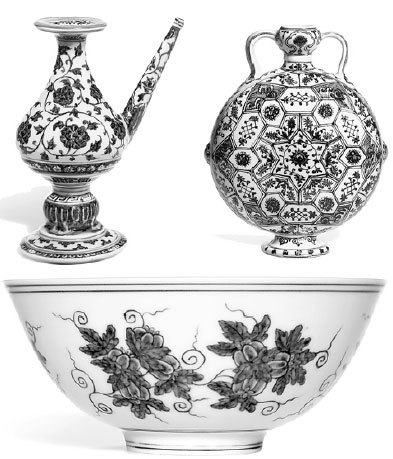
Three blue-and-white porcelains of Ming Dynasty in Pilkington's collection will be auctioned. Photos Provided to China Daily |
Pilkington's assembly spans some 1,000 years of Chinese porcelain-making - the earliest objects in his collection date to the Tang Dynasty (AD 618-907). He ascended to one of the top second-generation collectors of Chinese art in Britain, who continued the tradition from the 1920s to the post World War II period, according to Nicolas Chow, deputy chairman of Sotheby's Asia.
"For anyone who is interested in the Chinese art market, what is important to know is that England played a central role particularly in developing the market for pure porcelain," he tells China Daily, noting that the 1921 founding of the Oriental Ceramic Society in London spurred a movement of interest in Chinese art across the country.
That interest spawned a collectors' group in the following decade that included prominent figures such as Sir Percival David (1892-1964) and Alfred Clark.
A second generation of collectors arose after World War II, who bought from the early collections of Chinese art. Pilkington was part of this wave, building up his own accumulation with the aid of key Chinese antique dealers in London.
Pilkington died in 1969, at age 40, ending a mere decade of collecting.
Chow says Pilkington, however, put together "a strong collection that shows the high standards and character of English collecting" of his time, and the aesthetic taste of that tradition later influenced collectors in Hong Kong and Japan in the 1970s.
Pilkington's collection of Song ware celebrates the diversity of non-official kilns at the time. His assembly of fine porcelains of early and later Ming periods would be difficult to acquire these days, Chow adds.
He says a bulk of Pilkington's collection to be hammered are small objects that can be handled in the palm of one's hand, and that's quite typical of traditional collectors' appetites.
Three examples of Pilkington's connoisseurship of Ming blue-and-white porcelain will lead the sale on April 6.
One is a "palace" bowl that features patterns of clusters of flowers and fruits. It stands 15 centimeters tall and was produced during the Chenghua reign, in the late 15th century. A similar Chenghua-period "palace" bowl bearing okra (gumbo) patterns sold for HK$141 million at a Sotheby's sale in October 2013.
A blue-and-white "holy water" vessel, which was used at Buddhism worship ceremonies in the court of Emperor Yongle, is very similar to an example housed at the Palace Museum in Beijing.
Another Yongle-period moon-shaped flask incorporates classical Chinese decoration elements, such as lotus and waves, and symbolic Islamic motifs, which is also reflective of the booming trade between China and the Islamic world at the time.
The sale will mainly target Chinese mainland collectors who are acquiring Chinese cultural heritage pieces that had been transported abroad and who have recently rediscovered the values of Ming porcelain.
Qing porcelain, especially pieces of the Kangxi, Yongzheng and Qianlong periods, flooded the market for several years before 2015. The prices shot up because of competitive bidding among deep-pocket buyers.
The situation changed after the market slumped last year. Beijing-based Art Market Monitor of Artron says in a report of the second half of 2015 that while the craze for Qing wares cooled as they are too pricey, buyers instead eyed Ming objects which have come out to the market in collections, including many objects from important private holdings.
The reports notes that new collectors have acquired more scholarly knowledge of Ming art. Their aesthetic passion for Ming objects, such as blue-and-white porcelains of the Yongle and the Xuande periods, doucai ceramics of the Chenghua period and Ming-style furniture, is growing.
linqi@chinadaily.com.cn
















