Tipping scales in favor of craftsmanship
With modern tools to measure weight widely available these days, craftspeople around the world are struggling to keep handmade steelyards from dying out.
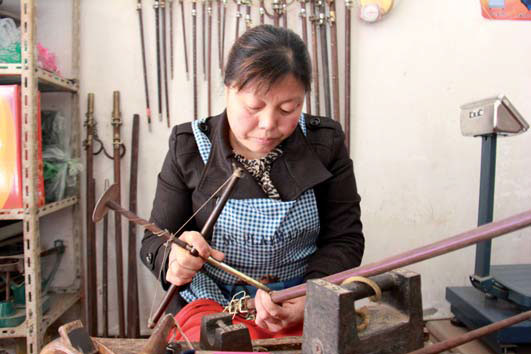
Liu Guangcui, who inherited tools and techniques from her father more than two decades ago, is among the few Chinese makers of steelyards.
At her shop in Hefei, capital of East China's Anhui province, Liu makes the steelyards by setting dozens of scale markings on a straight beam made of mahogany. Once the beam is ready, she assembles a hook and sleeves made of copper. The entire process can take her days.
"To make a traditional Chinese steelyard, everything should be finished by hand," the 48-year-old says.
The steelyards Liu works on can weigh goods up to 20 kilograms and takes about 48 hours to finish. Larger ones with weighing capacity of 150 kg or so take even longer.
Liu's shop, in a rural township of Hefei's Shushan district, is popular among residents because "it seems buyers here don't have many choices", she says.
Her father had been engaged in the business since the 1950s. "During my father's time, private businesses weren't permitted to make steelyards, so he would often travel to villages and make them at people's homes."
After the economy opened up in the late 1970s, the demand for steelyards soared, and many more private businesses and street vendors got into the trade.
As the oldest daughter in her family, Liu inherited her father's business and opened a workshop in 1990. In the first years of her business, there were many buyers of steelyards, she says. The prices back then averaged 10 yuan.
The steelyards were also considered important for locals. "Since steelyards are used to measure how much you harvest (among other things), Chinese people treasure them very much and hope they bring good luck."
During Spring Festival, the annual Chinese New Year holiday, people often paste a piece of red paper with the characters huang jin wan liang (thousands of kilograms of gold) on their steelyards, hoping for a good harvest in the new year, Liu says.
The peak time for her business came in the 1990s, when she was able to sell as many as 10 steelyards a day with the help of her husband.
Liu's younger sister is in the same business in nearby Changfeng county. Their father didn't allow their younger brother to inherit the business, as he wanted his son to receive a good education and have a different career. Besides Liu and her sister, their father also taught the craft to six others, who ran their own businesses for several years before quitting.
"Today, there's just no need to hurry anymore," says Liu, who also started to sell electronic scales in 2008, when she moved her shop to a new street in Xiaomiao. She says she sold only 130 steelyards last year.
Many buyers today buy the steelyards not for weighing but for their cultural importance.
In Chinese, steelyard is pronounced cheng, which sounds similar to the word for "content".
In traditional Chinese weddings, the bride uses a piece of red cloth as a veil, and to lift the red cloth the groom often uses the beam of a steelyard instead of his hands, showing that he is "content" with his wife.
"Although rare now, traditional weddings can still be seen in rural areas, so the steelyards are needed," says Liu, adding that there are also customers buying them for collection purposes in the fear that they may disappear in the future.
"It's also my fear, but it seems I can do little to change the situation," she adds.
Contact the writers through zhulixin@chinadaily.com.cn
|
Liu Guangcui runs a steelyard shop in the eastern city of Hefei. She continues to practice the traditional craft, which she learned from her father, despite shrinking demand. Zhu Lixin / China Daily |