


Confused debate on China's role in Africa
Researcher says even congressional studies in Washington paint a false picture of the relationship
Philani Mthembu says the US is being hypocritical when it warns African leaders of the dangers of deepening relations with China when Washington itself is Beijing's largest trading partner.
The senior researcher at the Institute for Global Dialogue, a leading South African think tank, insists there cannot be one rule for Washington and another for everyone else.
|
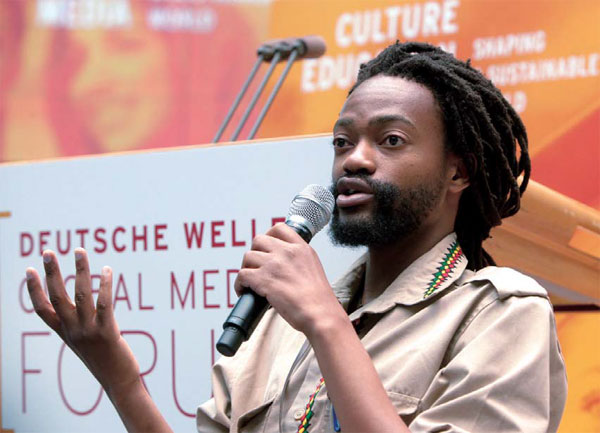
Philani Mthembu says China has actually been more active in some of the sectors African countries have been wanting international players to be active in. Provided to China Daily |
"This in a way is a very condescending attitude, you know, the idea that you have to warn (African) leaders about China," he says.
"The US' biggest trade partner is China. I mean, how do you tell anyone not to have strong ties with the second-largest economy in the world?"
Mthembu, highly articulate and regarded as one of Africa's rising intellectuals, was speaking at the think tank's offices in central Pretoria.
IGD, which is a partner of German foundation Friedrich Ebert Stiftung and the UK's Department for International Development, was co-founded in 1995 by then South African president Nelson Mandela.
It is sometimes referred to as the ruling African National Congress party's think tank, but Mthembu insists this is not the case.
"It's not the ANC's think tank. It is independent. It is just that its foundation had links with the ANC. Our core funding actually comes from the University of South Africa."
Mthembu's main specialization is the impact of emerging powers such as China and India and how they cooperate on development with Africa.
China channels its assistance to Africa partly through the Forum on China Africa Cooperation, which at its December summit in Johannesburg, the first to be held in Africa, tripled loans and grants assistance to the continent to $60 billion (53.6 billion euros). India held its biggest ever India-Africa forum in New Delhi in October.
Not surprisingly, Western powers have felt the need to revitalize their relationship with the continent with the European Union holding an EU-Africa Summit in Brussels and the US hosting the first-ever US-Africa Leaders Summit in Washington in 2014.
The academic says even congressional studies produced in Washington paint a false picture of the relationship between China and Africa.
"What I have found is that a lot of discussion has taken place without the empirical knowledge to back it up. There are a lot of myths such as that China is only interested in natural resources in Africa. You could make the same critique about the United States or anybody.
"The reality is that China has actually been more active in some of the sectors African countries have been wanting international players to be active in, such as construction and manufacturing, which have a real impact on people's lives."
Mthembu, who is of Zulu descent and whose parents were teachers, was brought up in a middle-class household.
"They were poor but like most of the middle class in South Africa, you can trace links in the past to missionaries. My grandmother (also a teacher) was very strict with her children. It was all education, education, education."
This has certainly been an influence on Mthembu, who studied international relations at the University of the Witwatersrand before going on to do a doctorate at Freie university in Berlin, which involved spending a term at the School of International Studies at Renmin University of China in Beijing.
He has had links with the Institute of Global Dialogue since he was an intern in 2009. He joined as a research fellow in 2014 before becoming a senior researcher in 2015.
He is also a founder of the Berlin Forum on Global Politics, an organization he launched while in Berlin.
His writings, including papers, articles and blogs, add to his reputation as a leading thinker in South Africa.
Mthembu says there is often also a confused debate about China's role on the African continent.
"It has been largely led by people's own preconceived ideas and prejudices, so people either say China is the greatest country for Africa or it is completely bad.
"None of it is informed by the realities that are taking place, the impact of (Chinese) hospitals in various villages on the local communities, the impact of road infrastructure, dams and the training programs that have been put in place. This story does not really come out."
He is concerned that with the South African economy being hit hard by the commodities recession, a false narrative is taking hold about the direction of his country.
"I would always argue with people who just want to paint it, you know, black and white. I've even heard people say South Africa is moving toward a failed state and I'm like, 'What? What are you talking about'?"
He says many commentators do not give South Africa enough credit for the difficult transition it has gone through since apartheid ended more than two decades ago.
"They forget what South Africa did in terms of managing the transition without serious conflict. There was very good leadership from all sides of the political spectrum. Then you look at poverty reduction and indicators such as access to electricity, water and heath, and all those have expanded a lot."
Some have accused South African President Jacob Zuma of pursuing the same policies as Robert Mugabe in Zimbabwe with recent legislation empowering the government to take land into public ownership.
"People look and they say, 'Oh, we are going to adopt the Zimbabwe model'. That is not going to happen. Zimbabwe is more dependent on land and agriculture than South Africa. So the question of agriculture plays a lesser role here."
He says the "Africa Rising" narrative about the continent being one of the fastest growing areas of the world has taken a hit from the fall in commodity prices, but he insists there is still an emerging middle class.
"The reality is that you have a growing middle class who have more buying power than in the past. It is perhaps a vulnerable middle class. There is a joke in South Africa that the middle class is only two pay checks from falling back, but the reality is that it is still growing."
Mthembu says people are wrong to think the continent is just about resources because many manufacturing and services jobs are being created and also benefiting from the democratic dividend of a youthful population.
"If you look at the last 10 years, many of the fastest-growing economies in the world have come from Africa, and they keep changing from those that are resource rich to those that are not. Tanzania is not the most indulged in terms of natural resources but it has been among the fastest-growing and there are many other examples."
andrewmoody@chinadaily.com.cn
















