


SOEs must be careful with EU filings
Commission views Chinese state-owned enterprises as insufficiently autonomous of the state, leading to regulation complexities
Chinese state-owned enterprises will be seeing a lot more of the European Commission in the future. After a run of decisions by the EU regulator, such businesses are much more likely to have to file deals in the EU than Chinese private-sector businesses, or indeed SOEs from other countries. If they do not, significant fines may be imposed on them.
This is more than a minor nuisance. Filing deals can be time-consuming and expensive, with large information requests from the regulator. What is more, such deals cannot be implemented until they are cleared by the commission.
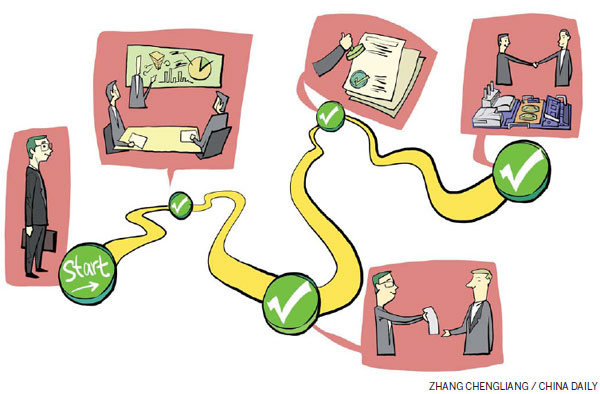
The commission has fined companies up to 10 percent of their global turnover for failing to notify or complete preclearance - even where there were ultimately no competition concerns. The largest fine was about 150 million yuan ($23.1 million; 20.5 million euros).
Why is this happening? The reason is highly technical, but the consequences are anything but.
The technical reason is this: The commission only reviews deals if the parties generate enough turnover in the EU. When it comes to a Chinese SOE, the commission takes the view that it is insufficiently autonomous of the Chinese state. It therefore counts not only the turnover of the Chinese SOE doing the deal, but also the turnover of all other Chinese SOEs (or at least those controlled by China's State Assets Supervision and Administrative Commission). So deals involving Chinese SOEs with little or no EU turnover may be caught.
It doesn't stop there. When a deal is caught by the EU, the commission then has to decide if it raises any competition concerns. For example, does the deal involve a significant overlap between the parties in an already concentrated market? The commission would normally look at the activities of the parties directly involved in the deal. But when it comes to Chinese SOEs, the commission has been looking at the activities of all other Chinese SOEs in the relevant market, not just the ones doing the deal.
This means the commission is more likely to identify a competition concern. It also means that much more data needs to be gathered and provided to the commission - not just about the SOE doing the deal, but also about all Chinese SOEs in the sector.
Take the recently cleared joint venture between China General Nuclear Power Corporation and French energy company EDF. The commission only looked at the deal, which involves the construction and operation of three nuclear power plants in the United Kingdom, because CGN is a Chinese SOE. If it had been a private company, the deal would not have fallen within the EU jurisdiction, as the company's sales in Europe are far below the threshold. It is only because the commission aggregated CGN's sales with those of other SOEs that these thresholds were met.
Second, once the deal fell within the EU jurisdiction, the commission's competition assessment looked not only at CGN's activities in the nuclear and other energy markets, but at those of all Chinese SOEs - in Europe and around the world.
The CGN transaction was ultimately cleared, but this took months of detailed information-gathering and submissions to the commission. And this was a deal that, according to the commission, ultimately did not raise any competition concerns.
Other deals have involved Chinese SOEs with enough EU turnover of their own to trigger an EU filing without the need to aggregate their turnover with other Chinese SOEs. But they have still had to contend with a competitive assessment that has taken into account the activities of other Chinese SOEs.
This was the case for the acquisition of Pirelli by China National Tyre and Rubber Co, a wholly owned subsidiary of China National Chemical Corp. It was also the case in relation to the joint venture between DSM and Sinochem in the chemicals sector.
Up to this point, the commission has tended to widen its net to encompass the turnover and activities of SASAC-controlled SOEs. Indeed, most of the deals it has reviewed have involved SOEs operating in key markets that tend to be the preserve of SASAC SOEs. However, this could change.
The commission's decisions indicate that it could also look at local government SOEs. Given that there are thousands of such businesses in China, the information-gathering involved may be harder than counting the bricks in the Great Wall.
Chinese SOEs would be wrong to consider these consequences as being limited to deals involving activity in the EU. A joint venture between two non-EU businesses may trigger EU jurisdiction, even if the joint venture will not be at all active in the EU, providing the two parent groups have sufficient EU turnover from their other unrelated activities.
This means that, for example, a joint venture between a Chinese SOE and a Japanese conglomerate that will only produce and sell goods in China could be caught, provided the Japanese conglomerate has enough EU turnover. Even if the Chinese SOE does not have enough turnover in the EU, the turnover of its sister Chinese SOEs may push the deal over the jurisdictional line.
In short, the following scenarios could unexpectedly trigger an EU merger filing:
* A Chinese SOE that has little or no presence in the EU when acquiring a business in the EU;
* A Chinese SOE entering into a joint venture in the EU with a non-European partner;
* A Chinese SOE entering into a joint venture even where that joint venture will not be active at all in the EU;
* A Chinese SOE and another party (even a non-European one) jointly acquiring a target that has little or no presence in the EU.
As noted, transactions requiring an EU filing must be cleared by the European Commission before they can be implemented or significant fines can be imposed. Not only can they be imposed, but they almost certainly will be imposed if the commission learns of them.
This may be as a result of the deal being reported in the media through notification of another competition authority (for example, the Chinese Ministry of Commerce), or because the parties notify the commission of another deal that refers directly or indirectly to the earlier deal that wasn't the sbuject of a notification.
The other implication is that Chinese SOEs notifying about transactions will need to provide information not only about their own activities, but also about other Chinese SOEs in the same or related markets. Notified cases involving Chinese SOEs are therefore likely to require longer prenotification discussions with the commission (or, if this is not done, the risk of such cases being referred to a detailed phase 2 investigation will increase).
Chinese SOEs will therefore need to consider their future transactions carefully with their advisers before stepping ahead. Otherwise, the European Commission maybe an unexpected gatecrasher to the party.
Simon Holmes is a partner at law firm King & Wood Mallesons and Michael Reiss is a managing
associate. The views do not necessarily reflect those of China Daily.
















