


Long journey from coal mines to wine
After quitting his job as a civil servant in his hometown Xiangning county in North China's Shanxi province in 1997 when he was in his mid-30s, Zhang Wenquan became a billionaire by operating several coal mines, coking plants, a cement plant and a power station.
But when the financial crisis and the subsequent economic recession hit his coal business, he decided it was time for another change and he fixed his mind on making wine. He spent more than 600 million yuan ($92 million) to create a 400-hectare vineyard and a 30-hectare park with chateau in the county.
Summing up this change, he said, "My business contacts were mostly rough guys. As long as they had enough to eat and enough alcohol to drink, they were happy. Now my partners are elegant, educated, and have seen the world."
He named the vineyard Rongzi Chateau after a local woman who it is said to have made the first wine in China about 2,700 years ago. Rongzi's son became the Jin Kingdom's king during the Warring States Period (475 BC - 221 BC) and wine-making became popular in the region.
The soil and climate in Xiangning are all favorable for grape growing, but to ensure the success of his vineyard, Zhang invited Kong Qingshan, a top grape planting scientist at the Chinese Academy of Agricultural Sciences, and Jean-Claude Berrouet, a world-renowned French winemaker to be consultants, and he imported advanced wine making and storage equipment from France, the United States, Australia, Italy and Hungary.
"Many people ask me whether China can produce good wines," Berrouet said. "I answer yes. Techniques and technology can flow around the world, but the soil and climate cannot. China has many places such as Shanxi and Gansu provinces and the Ningxia Hui autonomous region that can produce world-class wines."
"The natural advantages of Xiangning - the vine roots can extend 8 meters into the soil here, the deepest in the world - were the reason I made the investment," Zhang said. "And the historical legacy was the source of my inspiration for the chateau. The favorable growing conditions and the region's history of wine making are two of the reasons I am confident in the prospects for my wines."
The chateau includes a temple memorializing Rongzi and her son, a wine museum, a business school, a school of Chinese studies, a hotel and several exquisite parks. About 200 local residents work at the chateau, and more than 3,000 farmers from 22 villages work in the vineyard.
"I hope the chateau and vineyard can become sustainable contributors to the local economy and improve the lives of local people. It is a good way to return what I have earned from the land," Zhang said.
He has also donated about 62 million yuan in recent years to assist more than 300 college students from poor families and build agricultural water conservancy projects, roads and schools in local poverty-stricken villages.
After his wines started wining some prizes in Europe three years ago, Zhang began receiving orders from the US, Thailand, Macao and Hong Kong, and his sales revenue was 20 million yuan in the second half of 2014, when Rongzi wines were first launched. It more than doubled to 50 million yuan last year, and Zhang predicts the figure will hit 80 million yuan this year, as wine grows more popular in the country.
According to Vinexpo, an international wine and spirits exhibition established in 1981 in Bordeaux, France, wine consumption started rising markedly in China in 2005. And from 2008 to 2013, wine consumption in China increased nearly 1.8 times hitting about 1.5 billion liters, in contrast with the 5.8 percent decline in Italy and 18 percent drop in France. Since then, China has overtaken both countries to become the largest wine consumer.
"There is great potential for growth", Zhang said, and he plans to put his money where his mouth is and expand the vineyard to about 660 hectares by 2020.
liyang@chinadaily.com.cn
|
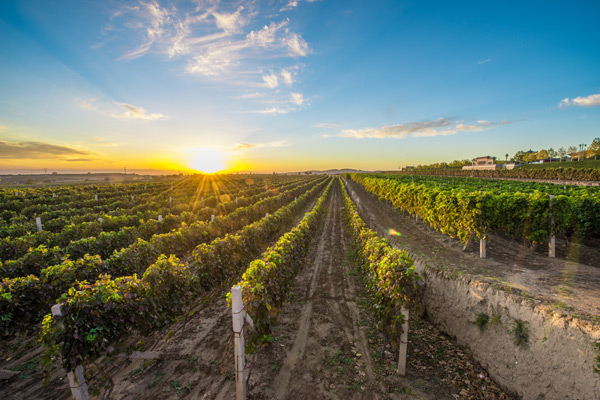 A vineyard of Rongzi Chateau in Shanxi province, North China, where their roots can grow meters deep into the soil on the loess plateau. Sun Ruisheng / China Daily |
















