


Steel capacity not just a China problem
Nation faces challenges from high debt and risks to social stability, but progress is being made
China, together with other countries and regions, is facing severe challenges from overcapacity in steel production, which requires the joint efforts of international players to solve.
During the 12th Five-Year-Plan (2011-15), China cut around 90 million metric tons of crude steel capacity. At present, China's steel capacity is more than 1 billion tons.
The utilization rate is below a reasonable level, which led to an industrial operating margin of negative 2.23 percent, and many small-sized companies have gone bankrupt due to losses.
Even so, the country plans to cut crude steel capacity by another 100 million to 150 million tons in the next five years, according to the 13th Five-Year-Plan (2016-20).
It shows that the country has done, and is still doing, lots to help solve the global oversupply problem in the steel industry. China's large and medium-sized steel companies are leading these efforts and are determined to cut overcapacity.
Hesteel, formerly Hebei Iron and Steel Group, for example, plans to cut 5 million tons of crude steel capacity by the end of next year.
The United States' steel industry should stop its narrow-minded understanding of China's steel business and take responsibility, together with China and the steel industries of other countries, to reduce overcapacity, which is a historical task for all of us.
Reducing overcapacity is a challenging process; it involves huge numbers of employees, large amounts of debt, and risks social stability. It's a task that takes a long time, strong perseverance and full preparation.
For China, particularly, there are several difficulties.
First, up to 500,000 employees in the steel sector will need to find a new job to achieve the country's capacity reduction goal.
Although some companies have transferred employees smoothly through detailed preparation and high costs, others are unable to do that because of a shortage of capital or local policy support. The large number of people who will lose their jobs will bring uncertainty to society.
In addition, another big headache for steel companies is money. Due to the falling steel prices in the past several years and weak demand, some steel companies have become "zombies".
Zombie companies are economically unviable businesses, often in industries that have severe overcapacity, and have been kept alive long after they should have died thanks to money poured in by governments and banks.
Zombie companies often have complicated debts concerning upstream and downstream companies. If those problems cannot be solved, a new debt crisis will be created for individuals and companies in the industrial chain.
China's steel companies' debt ratios average around 70 percent, and in some cases it is higher.
For instance, Shanxi Haixin Iron and Steel Group, established in 1987, has more than 900 creditors and total debts of 23.4 billion yuan ($3.5 billion; 3.1 billion euros). The company owes 7 billion yuan alone to China Minsheng Banking Corp Ltd. However, its book assets totaled only 6.9 billion yuan.
Another steel company has a severe wage arrears problem of more than 360 million yuan.
Such debt issues are hard for the local government or a single company to solve.
Last but not least, steel companies usually play an important role in a local economy, more so in areas where steel is the pillar industry. If a steel company goes bankrupt and the local government is not ready for economic development transformation, it may trigger a dramatic slump in the local economy and lead to further social instability.
The US, Japan and European countries have spent more than 10 or 20 years solving the overcapacity issue in their steel sectors. The scale of China's reduction plan is much bigger than that of those countries, which means China is facing much more difficulties.
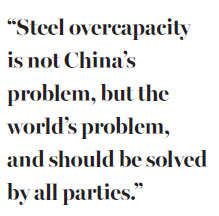
At present, the utilization rate of the world's steel capacity is around 66 percent, and that of China is 71 percent. So, we have to be clear that steel overcapacity is not China's problem, but the world's problem, and it should be solved by all parties.
Steel, a material widely used in construction and other applications because of its high tensile strength and low cost, has made an unprecedented contribution to global economic development and human civilization.
In the future, it will continue to play an important role in the world's economy because of its high quality, low cost and greenness, even though it will face competition from other advanced materials.
Everyone in the steel industry should focus on working harder to meet the growing requirement of clients and spend more passion on technology innovation and new applications.
The author is the head of the China Metallurgical Planning and Research Institute. The views do not necessarily reflect those of China Daily.
















