


E-commerce lets a village thrive
|
Top: A willow weaved craft is among the exhibits on show at the willow weaving cultural heritage center near Xuezhuang village in Shandong province. Above left: A local villager makes willow products at home. Above right: Two women make Chinese knots at the factory owned by entrepreneur Wang Chao at Honghua town in Linyi. Photos By Lu Peng / Xinhua |
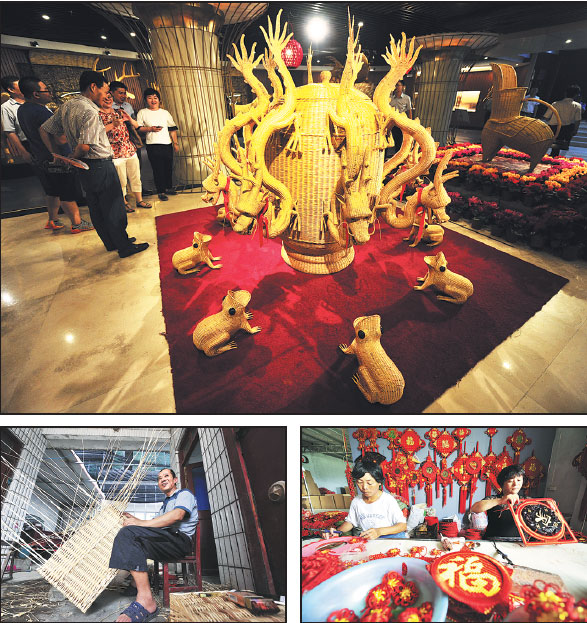
Xuezhuang, a village in southern Shandong province, is well-known for its willow products. Now, the internet is letting its residents, including its young people, make a decent living. Chen Nan reports.
As the temperature rises to 35 C in the early afternoon, Liu Yuesheng places another finished pet basket on the pile in his home, which is almost touching the ceiling. And despite sweat streaming down his face, he is working on weaving a willow cushion.
Born and raised in a small village called Xuezhuang, located in Tancheng county, 90 kilometers from Linyi city, in southern Shandong province, Liu, 48, has been weaving willow since young.
He says that the people of the village have been planting willow trees and weaving willow straw into various products - from furniture to decorations - for generations.
The villagers never made much money from their willow products until the village comprising around 1,000 people - led by pioneers like Liu - discovered Taobao, an online shopping platform of Chinese e-commerce giant Alibaba Group, in 2011.
Now, with four online stores on Taobao.com and one store on Alibaba's business-to-consumer site Tmall, Liu has sold thousands of products nationwide with yearly income crossing 4 million yuan ($601,000).
"In the past, we sold our products to nearby commodities markets, but now we run our own businesses, which gives us freedom and more money," says Liu.
"All my family members, including my two sons, who have just graduated from university, are working for the online stores. Our buyers range from individuals to companies. We also design products for customers."
According to Wang Yanping, the head of Xuezhuang village, weaving willow is a traditional skill in the village with a nearly 300-year history.
Following Liu's success, nearly all the families in the village have learned how to combine their traditional skills and e-commerce.
The village, which has land measuring more than 1,100 mu (73 hectares) under willow cultivation, sold woven willow products worth more than 60 million yuan in 2015, earning it the title "Taobao village".
Slogans written on the village walls now say "Gold bowls and silver bowls can't beat willow bowls", replacing phrases promoting the family-planing policies.
In recent years, the country's urbanization has changed people's lives in rural areas. One of the biggest challenges that the rural areas have faced is that young people left for cities to make a living, which resulted in "empty nests" and "left-behind children".
Empty nests refer to the elderly, who live alone unaccompanied by any family as their children have grown up and left to pursue their own careers, while left-behind children are those left behind in rural areas under the care of relatives, mostly grandparents with little or no education, and family friends as their parents move to cities in search of work.
But thanks to the success of the willow-weaving businesses, almost all the young people are now staying in the village and managing online stores, says Wang, adding that even major delivery companies, such as Shunfeng Express, have built offices in the village to ensure good service.
"We send some of our young people to learn about e-commerce in the city and they then return and pass on their knowledge to the villagers. They also teach the older generation how to use computers, and how to set up and manage a Taobao store."
Last October, the village started working on an e-commerce industry park with an investment of 20 million yuan. It will provide offices, factories and warehouses to the villagers. Many residents from nearby villages have also been coming to Xuezhuang village to work and learn willow-weaving skills.
Meanwhile, according to statistics from the China Center of Information Industry Development, China's internet population has grown dramatically in the past decade and by June 2015 China had 667 million internet users.
The online business model has had a dramatic impact on the lives of village youth. An example of this is Wang Chao, a 28-year-old resident of Honghua town, located at the southern end of Tancheng county.
Speaking of how the online model has made a difference to his life, Wang, who owns Linyi Qiaoyi E-Commerce Company - the biggest online company selling Chinese knotted products - says: "Thanks to the development of e-commerce and the rising number of Chinese online consumers, we (online entrepreneurs) not only make more money now, but also enjoy better lifestyles."
With three registered brands and nine online stores on popular e-commerce platforms - Taobao, Tmall and Jingdong - Wang sells products worth around 15 million yuan a year.
"Opening an online store is free. You don't need a large space, or much funding," says Wang, who also attributes the popularity of Chinese knots to the growing awareness of Chinese consumers about traditional Chinese culture.
"People like decorating their rooms and cars with traditional folk artwork, especially during Chinese festivals," he says.
In 2012, like many young people, who were leaving their poor villages to seek better opportunities in the cities, Wang joined an internet company in Shenzhen, in Guangdong province.
He came up with the idea of selling Chinese knots online after seeing his colleagues buying the products before the traditional Spring Festival celebrations.
He tested his idea by opening a Taobao store and selling Chinese knots, which he bought from nearby commodities markets.
The following year, Wang quit his job and returned to his hometown to start his own company.
Separately, the local government is also supporting the e-commerce trend by offering free or cheaper land for entrepreneurs to build offices and factories.
"We all want our villages to become richer and better," says Wang.
"The success of companies is not just about reviving traditional folk art, but also offering job opportunities to young people, so they don't have to leave their villages to seek jobs."
Contact the writer at chennan@chinadaily.com.cn
















