


Art reflecting art
Jazz maestro brings curtain down on Rauschenberg retrospective in Beijing with unique collaborative performance
While there may be many parallels between painting and jazz as art forms, for Ted Nash, there is one major difference.
"The two both involve a lot of colors, textures and layers, but the end result is so different," says the jazz saxophonist and composer. "A painting exists forever, exactly how it is, and with jazz music, it changes all the time."
|
Ted nash, playing in front of The 1/4 Mile or 2 Furlong Piece at Beijing's Ullens Center for Contemporary Art, says he sees parallels between jazz and painting. Zhang Hongyang / For China Daily |
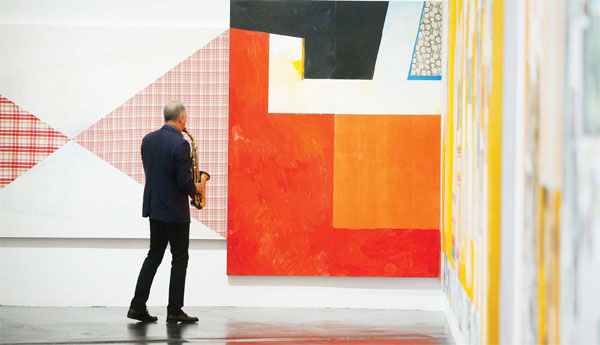
The excitement involved in combining a fixed piece of art with a free-flowing jazz performance was one of things that led him to accept an invitation to run a week of intense workshops with professional and amateur Chinese musicians that culminated in Rauschenberg in Jazz: Nine Details.
On Aug 19 and 20, Nash and nine local musicians performed the unique show at Beijing's Ullens Center for Contemporary Art, using as a backdrop some sections of Robert Rauschenberg's The 1/4 Mile or 2 Furlong Piece. The show concluded Rauschenberg in China, the gallery's retrospective of the late American artist's work.
Nash, a 56-year-old musician with the Jazz at Lincoln Center Orchestra in New York City, arrived in the Chinese capital on Aug 15. He spent the next few days hanging out at the gallery in front of the giant piece and improvising with a saxophone and flute.
"The piece is a quarter mile (402 meters) long. You can focus on one area of the piece and get so much. You can also stand back to get a feeling overall," he says. "It's like music. When you listen to a small piece of music, you focus on one instrument and listen to one passage, while you can also step back and listen to a whole piece of music and get a different feeling about it."
Nash first saw Rauschenberg's artwork in New York City in 1978. He was 18 and had just moved to the city from his native Los Angeles.
"I spent a lot time in galleries and museums. I loved impressionism, but I was particularly moved or fascinated by contemporary art. Rauschenberg was then very popular. You saw his works in many museums."
Decades later, when he saw The 1/4 Mile or 2 Furlong Piece, he recalls feeling very moved. "He had an amazing imagination. The knowledge that I was going to be involved in composing a piece of music to it made me also look at it differently, looking for specific sort of signals, symbols and ideas."
More than 20 Chinese musicians joined Nash at the workshops, marking the first time he has composed with a group.
During afternoon sessions, they would spin through the exhibition hall with instruments, sometimes playing and sometimes just looking and taking pictures.
"It's a fresh yet challenging process," says bassist Wang Chenhuai, a second-year postgraduate studying composition. "Music and visual art are two different art forms. They cannot be transformed directly. You have to be focused to get inspiration while you're surrounded by curious gallery visitors who talk and take pictures of you."
Back in the studio, Nash asked his collaborators to go through the images they had taken, talk about their feelings and each provide a musical phrase.
"It was to offer them the idea that the first thing is the best," says the American composer. "A lot of people take too long to make music, as they don't trust their own musical instincts."
Rehearsals also involved a lot of improvisation, he adds. "That's the nature of jazz - influence each other, react and be engaged and have musical conversations with other players. That's when the music is strongest."
Nash wrote down each suggested phrase and organized them into a form. The final result was nine movements, or details, for a selected nine sections of The 1/4 Mile or 2 Furlong Piece. The performance was coupled with slide projections, too.
Cathy Barbash, who helped organize the event, says Nash's talent, combined with his warm personality and generosity of spirit, made him the ideal director for the project.
Nash has been with the Lincoln Center orchestra since 1997. Its artistic director, Wynton Marsalis, calls him "the wildcard chair" in the band.
"He plays, on a virtuoso level, all of the reed instruments," Marsalis says. "He plays them all perfectly in tune, and he has a personality on each one that's different. And he can read music unbelievably well."
In 1999, Nash made his breakthrough album, Rhyme & Reason, for a jazz quartet and strings.
"That was really the first hint of what a great arranger he is, in addition to being a composer," says pianist Frank Kimbrough, who played on the album.
Born to a musician family - his father was trombonist Dick Nash and his namesake uncle was also a saxophonist - he was a prodigious talent. Starting at age 16, he held down jobs with a succession of first-rate big bands, and after moving to New York he was a prominent member of the Jazz Composers Collective, which was dedicated to fostering original music. He was part of its best-known ensemble, the Herbie Nichols Project.
In 2007, Nash debuted Portrait in Seven Shades, a large-scale jazz suite inspired by pieces from the New York Museum of Modern Art's collection, divided into seven movements, each referring to a visual artist, including Claude Monet and Salvador Dali. The work, released on album in 2010, was nominated for a Grammy Award.
"As a composer we look for inspiration in many forms," Nash says. "It can be from people. It can be from architecture. It can be from the music itself. And it can be from art."
lijing2009@chinadaily.com.cn
















