


Duterte starts pivoting Philippines to China
Just when some of China's neighbors were seeking to curtail its expansionism, along came Rodrigo Duterte.
In less than three months on the job, the 71-year-old Philippine leader has used expletives in talking about US President Barack Obama and vowed to end cooperation with the US military in both fighting terrorism and patrolling the disputed South China Sea. He's moved to boost economic and defense ties with China and Russia.
While Duterte is unpredictable - one day calling China "generous" and the next threatening a "bloody" war if Beijing attacked - his behavior has undermined US efforts to rally nations from Japan to Vietnam to Australia to stand up to China's military assertiveness.
|
Philippines President Rodrigo Duterte reviews honor guard upon his arrival during the 250th Presidential Airlift Wing (PAW) anniversary at the Villamor Air Base in Pasay city, metro Manila, on Sept 13. Romeo Ranoco / Reuters |
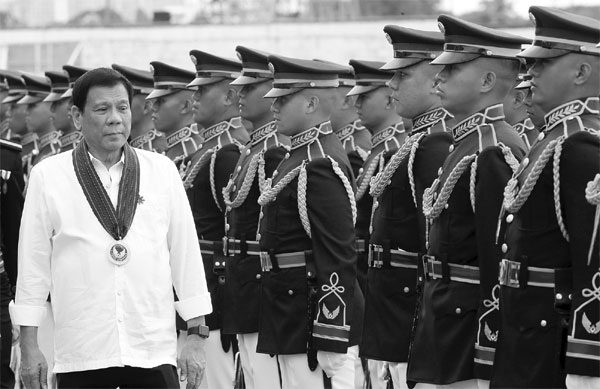
In doing so, he risks shifting from the 1951 Philippine-US defense treaty, which has been a bedrock of American influence in the region. While Duterte has said he'll respect the alliance, he's repeatedly stressed the need for an "independent foreign policy" and questioned America's willingness to intervene if China were to seize territory in the South China Sea.
"This could be the game changer for the South China Sea situation in general and Sino-US regional competition specifically," said Zhang Baohui, director of the Center for Asian Pacific Studies at Lingnan University in Hong Kong. "Duterte's foreign policy may dramatically shift the geostrategic picture of the region, leaving China in an advantageous position versus the United States."
One of the biggest benefits for China is the potential for a deal over the South China Sea. Just weeks after Duterte took office in late June, an international arbitration panel ruled that China's claims to most of the waterway had no legal basis - a win for the Philippines in a case brought by Duterte's predecessor.
While Duterte has said he'll respect the agreement, he's signaled he's open to talks with China, the country's biggest trading partner, and he did not push for the ruling to be mentioned in the communique last week from a summit of Southeast Asian leaders in Laos. Before taking office, he said he'd consider setting aside territorial disagreements to get a Chinese-built railway.
In July, Duterte sent former president Fidel Ramos to Hong Kong to explore common ground with China. Ramos later called for a bigger role for the Philippines under China's plan to link ports and other trading hubs throughout Asia to Europe.
Foreign Ministry spokeswoman Hua Chunying said on Sept 6 that China is "willing to make a joint effort with the Philippine side to rebuild mutual trust and push forward the bilateral ties".
"Let's not be naive about this, there's no other country that will benefit from our differences with the US and our other allies but China," said Lauro Baja, a former Foreign Affairs undersecretary who served as the Philippine permanent representative to the United Nations under ex-president Gloria Arroyo. "Whether we like it or not, we're sending the wrong message to the US, China and our other allies with these actions and pronouncements."
China claims sovereignty over all features that lie within a nine-dash line drawn on a 1940s map enclosing more than 80 percent of the South China Sea. It says that gives it the right to interdict military ships close to its territory - a position the US opposes.
Fu Ying, who chairs the Foreign Affairs Committee of China's top lawmaking body, this month framed US-China tensions in the South China Sea as a fight over the freedom of navigation for naval warships and other non-commercial vessels within the 200-nautical-mile exclusive economic zones of coastal states.
"The Chinese want the South China Sea to become a Chinese strait, with control of the maritime space and the air space above it," said Malcolm Davis, a senior analyst at the Australian Strategic Policy Institute in Canberra. "That is the long-term game, and flipping Duterte over to Beijing's side is part of the play."
China's land reclamation and military buildup in the waters have in recent years pushed some neighbors closer to the US. The Obama administration has boosted military cooperation with nations such as Vietnam, the Philippines, Singapore and Japan.
Still, at the summit last week in Laos, a spat with Obama over Duterte's war on drugs and the thousands of deaths it has caused overshadowed any criticism of China.
"That's a very bad scenario," said Hideki Makihara, a senior lawmaker in Japan's ruling Liberal Democratic Party, referring to a potential Philippine strategic alignment with China. In that case, "at least we need Vietnam, Malaysia and other countries surrounding the South China Sea in our group", he said in an interview this week in Tokyo.
For now, US officials are emphasizing the benefits of defense ties with the Philippines.
"We've got a wide range of shared concerns and shared interests, and the United States and the Philippines have been able to work effectively together in a variety of areas to advance our mutual interests," White House press secretary Josh Earnest said on Monday.
A shift toward China may be difficult for Duterte to sustain. If China refuses to make any tangible concessions on the South China Sea, particularly over fishing resources at the disputed Scarborough Shoal, Duterte may face a domestic backlash, according to Richard Javad Heydarian, an assistant political science professor at De La Salle University in Manila.
"This is precisely why security relations with the United States will remain indispensable for the Philippines," he wrote in an article last week for the Washington-based Asia Maritime Transparency Initiative.
Still, the US can no longer expect the same level of strategic deference and diplomatic support. "This is the new normal in Philippine-US relations."
















