


China OKs puffer fish encore on restaurant tables
After nearly 20 years, Chinese authorities have lifted the ban on the sale of puffer fish.
Earlier this month, the Ministry of Agriculture and the China Food and Drug Administration jointly issued a new regulation, allowing certified companies to raise the blowfish, named for their inflated appearance, and sell processed products.
Chinese people regard puffer fish or hetun - "river hog" in Chinese, as one of the most delicious delicacies the Yangtze River offers. The earliest record of puffer fish consumption in the area dates back to Shanhaijing, a collection of mythical legends written more than 4,000 years ago.
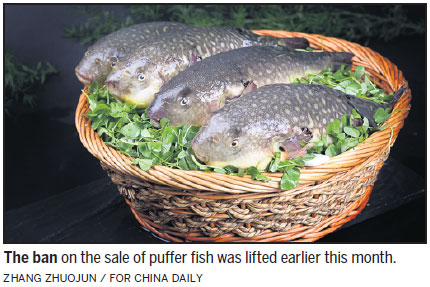
However, the fish contains tetrodotoxin, a lethal poison. A tiny amount can kill a human in few hours. Moreover, the poison that exists in many parts of the fish, including the eyes, blood, ovaries, liver and other inner organs, can become more toxic once heated.
It needs skill to carefully separate the edible parts, usually the skin and meat, from the poisonous organs to cook the fish, and such skills require training and experience. Only a few chefs master the art, according to Yang Zhanwen, a famous chef with expertise in Chinese and fusion cuisine in Beijing.
In 1990s, the central government officially banned the fish from entering the market.
A popular saying, "Risk your life to eat puffer fish", reflects the appeal of the blowfish in China, and according to Yang, serving puffer fish is a more or less open practice in many restaurants, because there is huge demand from diners, and "even the regulatory authorities will turn a blind eye as long as no one reports to them".
In fact, despite the government's ban on distributing and serving puffer fish on the Chinese mainland, quite a few cities in China have become famous for raising puffer fish, such as Yangzhong in Jiangsu province, and Dalian in Liaoning province. Some farm owners have even became star entrepreneurs that made news headlines over the past years.
Puffer fish from these farms are exported to loyal diners in Japan and South Korea, but many are distributed to Chinese markets and restaurants, according to Yang.
However, Yang emphasizes, farm-raised puffer fish are much less poisonous than wild ones.
Yun Wuxin, a widely acclaimed science writer on food safety, also says farm-raised puffer fish are much safer to eat.
In an article he published in Oriental Outlook magazine, Yun explains that tetrodotoxin builds in puffer fish through the food chain, and farms are able to control the food supply and water quality rather strictly to avoid accumulation of the poison in the fish.
Moreover, there are different kinds of puffer fish. While some have poisons mostly in inner organs, and some in almost all parts of the body, others are less likely to acquire the toxin, which makes it practical to provide low-toxic and even poison-free puffer fish through farming, Yun writes.
However, the new regulation allows only certified companies to raise two species of puffer fish, and the fish can only be distributed as processed products, not alive, Yun emphasizes.
Chef Yang says he applauds the government's new move to regulate the farming and sale of puffer fish.
In the past, despite the ban on puffer sale, many restaurants and individuals bought puffer fish secretly, which raised safety issues, especially when the original suppliers of the fish were not traceable. Now the new regulation sets clear practices for the industry to follow, and buyers are able to buy puffer fish produced with strict quality control, he says.
However, an anonymous executive of a famous restaurant chain says the new regulation only allows certain farms to raise and sell puffer fish, and doesn't allow restaurants to buy and cook living puffer fish - which means there will still be restaurants buying live specimens illegally to satisfy diners.
liuzhihua@chinadaily.com.cn
















