Mobiles surge ahead in the game of catch-up
As players switch from PCs to phones, manufacturers enjoy leap in sales
Personal computers continue to be the dominant device for online gaming in China, but mobile games are starting to close the gap.
In 2012, mobile devices accounted for just 5.4 percent of all gaming in the country. Last year, the figure was more than 30 percent, according to digital games data analysis firm DataEye.
|
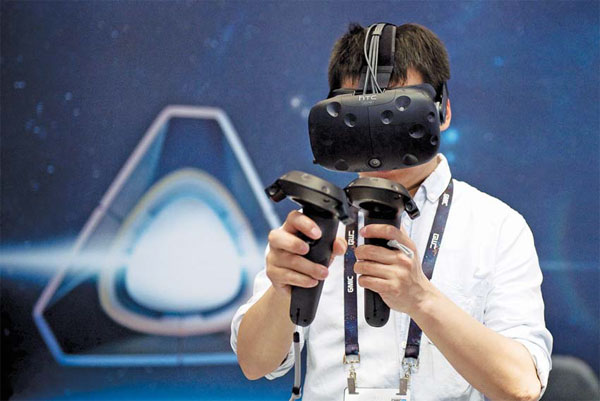
A MAN uses a HTC virtual-reality mask to play a game during the Global Mobile Internet Conference in Beijing on April 23. PCs remain the most common device for playing online games in China, but mobile phones are catching up. AFP |
One of the most significant trends in mobile gaming last year was the entry of China's top online PC gaming companies, according to a report published in April by Forbes.
The report says the top seven companies - which include NetEase Tencent and Giant - released more than 150 mobile games last year. Of these, Tencent and NetEase accounted for the top 10 titles.
"This was a big move for China's top online PC gaming companies. While Tencent has previously showed interest in mobile gaming, the rest of China's gaming giants had largely steered clear of the mobile space, staying focused on the bigger portion of games revenue, PC online games," Forbes says.
"The top seven's expansion into mobile gaming serves as powerful validation that mobile gaming is a space worthy of their efforts, and it will be interesting to watch how the big players shape their mobile gaming presence moving forward."
Jelle Kooistra, head of product development at Newzoo Mobile, a division of research firm Newzoo, says the rapid increase in internet and smartphone penetration is one of the main reasons for the growth of mobile games.
This is true not only in China but throughout Asia, Kooistra says.
He says many parts of Asia are also "mobile-first" regions, where most people do not own PCs or consoles, and hence play games on mobile devices.
"As a result, the share of money spent on mobile games versus other devices is much higher in Asia than in other regions," Kooistra says.
"In China, core PC gamers are shifting part of their game spending from PC to mobile, pushing up mobile revenues in China, and subsequently, all of Asia."
Kooistra says within the next few years most of the growth in mobile games in Asia, expected to be worth around $9 billion, will come from China.
"This growth is (already) driven by the increasing smartphone and mobile internet penetration, as well as growing economies and wealth."
According to a research report by Newzoo and its strategic alliance partner TalkingData, there were more than 16,500 mobile games available in the many Chinese app stores last year, with more than 50 percent falling into the casual and card genres.
Of the genres that saw the most new launches last year, role-playing games and strategy games represented half of the total, while casual and card games represented only 30 percent.
"This surge in RPG and strategy games on mobile is exemplified by NetEase's Fantasy Westward Journey, a longstanding PC game that was launched on mobile devices last year in response to the audience migrating between platforms," according to the Newzoo and TalkingData report.
With China now comfortably emerging as one of the biggest mobile markets in the world, Chinese mobile device makers are also increasingly fighting one another overseas.
Newzoo's Global Mobile Device Intelligence service, which tracks close to 2 billion monthly active iOS and Android devices across the world, shows different device manufacturers are winning wars on different fronts.
While Xiaomi is in a fierce battle with Huawei for local dominance in China, the company's recent disappointing financial performance is reflected in its underwhelming overseas success, where Huawei currently rules the roost, according to Newzoo's data.
Though it has not found a way to the No 1 slot in foreign markets yet, One Plus - a smartphone maker based in Shenzhen in South China's Guangdong province - is quietly performing well abroad. This puts it on course to become the breakout brand from the country's device scene.
Although Chinese handset manufacturers are doing well in China, "it is important to point out that Apple is clearly the top device brand (in the country)", according to a Global Mobile Device Intelligence report published by Newzoo.
"Examining the number of devices actually used in a single month, rather than new units shipped, it emerges that Apple has the largest market share in China," the Newzoo report adds.
"As local brands are able to provide an increasingly high standard of quality and polish, maintaining this dominant position in the long term is anything but guaranteed."
Focusing on Chinese brands though, Huawei and Xiaomi are in close competition, with mobile device market shares of 10.5 percent and 10.4 percent respectively in China.
The other major local brand in the top five is Oppo - in fifth place with a 7 percent market share.
"Away from home, Chinese device manufacturers have smaller market shares," Newzoo says.
"Diluted by the size of the global mobile market and losing the cover of an increasingly protectionist domestic market, none of the Chinese brands have more than 5 percent market share abroad."
In the overseas market, among Chinese device manufacturers Huawei tops the table with a 4 percent share of the segment, followed by Lenovo and Asus, which hold about 3 percent and 2 percent of the market respectively.
HTC and Xiaomi are also among the top five Chinese device brands overseas, each with about 1 percent of the market.
Finding the precise reasons behind each device manufacturer's performance is difficult, according to the Newzoo report.
For the most part though, the success (or otherwise) of brand building in Western markets appears to be a major factor behind the fortunes of Chinese companies that operate abroad.
Many of the companies with smaller market shares lack that identity.
As a brand, Xiaomi has little resonance in the West, while HTC has struggled for a number of years to establish a distinct brand identity.
"On the other hand, those who have made steps toward creating a brand are present higher up the charts," Newzoo says.
"Huawei, for example, has been using celebrity endorsements in advertising and brand ambassadors to increase awareness of its devices globally. And Asus and Lenovo have each leveraged their broader low-cost technology brand, often associated with laptops, to reach into the likes of India successfully."
Ultimately, the most successful Chinese device makers abroad have had at least a basic brand or some brand marketing to support their global pushes, Newzoo says.
This idea is supported further by the success of One Plus outside of China. The company is only the 30th-largest brand by active users in China.
However, it performs much better abroad, Newzoo notes. One Plus is the 20th-largest brand globally and among the top 10 in the United Kingdom, Germany, and the Netherlands where it stands at No 7.
"The success of One Plus comes down to the way it has reinforced its market pitch with a sensible brand campaign," Newzoo says.
"Offering high-quality, contract-free Android smartphones to users across the world, One Plus initially operated a limited 'invite only' policy to reward early adopters with the power to allow others to buy handsets."
Newzoo notes that the local Chinese market is fiercely competitive, with relatively new brands competing on price and quality to attract local consumers.
In this scenario, Xiaomi has managed to reach a strong position by focusing on high-end devices with a low price point. But there are multiple competitors nipping at its heels.
"To head abroad successfully, Chinese manufacturers need to consider constructing a brand that will encourage international consumers to spend. That means considering how to create a brand that, like One Plus, excites new customers and retains the interest of its local Chinese audience too," Newzoo adds.
karlwilson@chinadailyapac.com