


Concern over higher income tax fuels debate
The debate on whether a person earning 120,000 yuan ($17,720) a year belongs to the high-income group seems to have abated after several financial and taxation experts close to the government said reports saying "individuals with incomes above 120,000 yuan will have to pay higher taxes" were the result of the media's misunderstanding of government rules. But that has failed to ease people's worries over higher taxes.
The well-intentioned government policy aimed at increasing people's incomes hasn't drawn enough attention. Instead, the public seems to be obsessed with one sentence in the document: higher taxes for the higher-income group.
The controversy may be the result of the media's misunderstanding, but there are some important social problems behind that misunderstanding. Direct taxes, especially those imposed on individuals, are a big public concern not only in China but also in other parts of the world, because they relate to people's vital interests.
The problem is, as the experts clarified to the media, there is no official definition for the "high-income group". The only point seems to be what the media highlighted: the system of self-declaration of "high incomes" that requires individuals earning more than 120,000 yuan a year to declare their incomes to the taxation authorities.
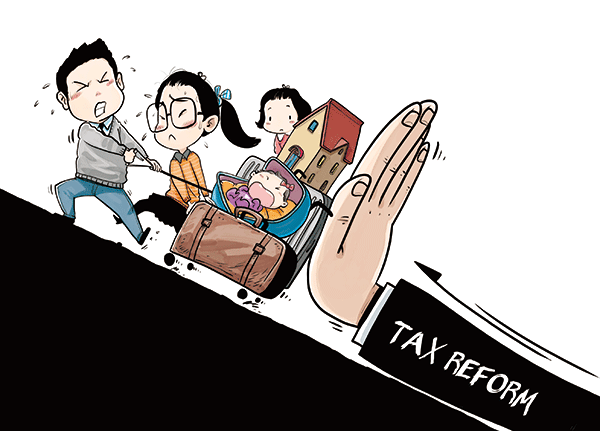
Of course the media should not equate the term "high-income group" with the self-declaration system because government documents or laws don't say so. But the fact is people believe the "high-income group" earns huge amounts of money because it has been singled out by the taxation authorities as a key target of inspection.
That, to a large extent, has forced the public to debate whether an annual income of 120,000 yuan or more is really high in China today. Since the average annual income of Beijing wage-earners last year was 85,038 yuan, people rightly assume an income of "120,000 yuan or more" is not high.
However, China is a large nation with huge regional disparities. China's rural population is more than 600 million, including more than 50 million impoverished people. In a country where the per capita annual disposable income was only 21,966 yuan in 2015, an annual income of 120,000 yuan or more is definitely high.
The controversy over the definition of the "high-income group" reflects the anxiety of China's rising middle class. Those who have strong opinions on this issue are more likely to be frequent internet users with keen interest in adjustments to individual tax norms. In other words, they definitely do not belong to the low-income group. People with really low income struggle to make ends meet and don't know what happens on the internet, let alone debate the issue in cyberspace.
But the middle-class in the formation shouldn't take blame for the wealth gap, and they have full rights to defend their interests by expressing their opinions. In this context, quick and strong response is not only desirable but also a good thing for policymaking. The strong public reaction to the may-not-be-true information shows people lack the necessary sense of gain and security despite the comparatively high salary they earn. It is also true that the heavy economic burden owing to the rising day-to-day expenditures of individuals - such as high rents and housing loans - make the annual income of 120,000 yuan a year just enough for some residents in big cities to make ends meet.
The central government, however, has decided to expand the middle-income group as part of its strategic goal. The authorities in charge of reforming the individual income tax rules system should take people's living expenses into consideration before increasing taxes.
Moreover, the policy asking people who earn 120,000 yuan a year or more to voluntarily declare their incomes was implemented in 2006 when Chinese people's annual disposable income was only 11,759 yuan, but the per capita disposable income has almost doubled in the past decade. And the cost of living increases even more in both urban and rural areas, yet the 120,000 yuan benchmark hasn't changed. This calls for a serious debate on taxation standards.
Individual tax reform, therefore, requires comprehensive and all-round considerations, because it relates to a majority of people's interests.
The author is a writer with China Daily.
wangyiqing@chinadaily.com.cn
















