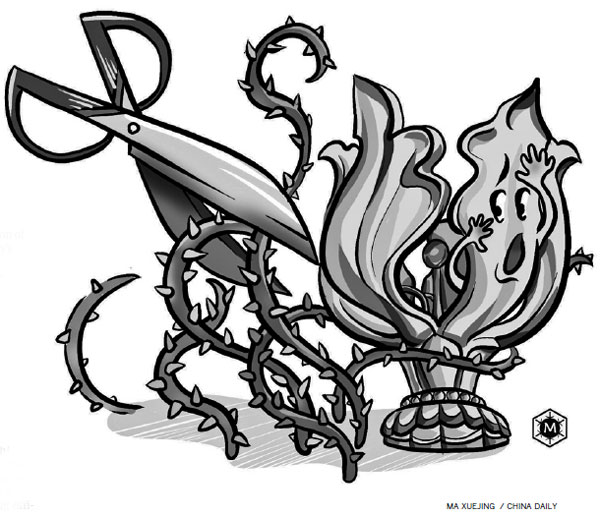
Protecting authority of Hong Kong's Basic Law
The National People's Congress Standing Committee's interpretation of Article 104 of the Basic Law of Hong Kong not only reaffirms the legal attribute of the Basic Law, but also makes clear that only a person who pledges loyalty to the Basic Law can take the oath as a member of Hong Kong's Legislative Council.
The interpretation was necessitated because two legislators-elect altered their oaths and made obscene remarks about the nation during their swearing-in on Oct 12.
According to Article 104 of the Basic Law, those holding public offices in the HK Special Administrative Region have to take oath before assuming their posts. But such issues as the loyalty of the oath-takers to the nation, and the content and procedure of the oath depends on the interpretation of the Basic Law by the country's top legislature.
The NPC Standing Committee's interpretation stipulates that before assuming office, all senior executive branch officials of the SAR, Legislative Council members, and all judges and members of its judiciary should "swear to uphold the Basic Law of the Hong Kong Special Administrative Region of the People's Republic of China and swear allegiance to the Hong Kong SAR of the People's Republic of China". This is a prerequisite for Hong Kong officials to assume office.
This interpretation essentially confirms the legal attribute of the Basic Law regarding civil servants' swearing-in. It means, to become legislators, the legislators-elect in Hong Kong have to take legal and valid oath of office. Any refusal to do so will disqualify them for the posts.
The NPC's interpretation covers the key aspects of the oath-taking. For example, it stipulates that any oath-taking must conform to the required form and content - accurately, completely and solemnly reading such words as "upholding the Basic Law of the Hong Kong SAR of the People's Republic of China" and "allegiance to the Hong Kong SAR of the People's Republic of China". It also stipulates that any refusal to do so or not taking the oath in a sincere and solemn manner will disqualify the person for a public post in Hong Kong. More important, once a person is disqualified, he/she will not get another chance to take oath.
The interpretation is not to amend or rewrite the Basic Law but to add a legal explanation to it. And such an interpretation takes immediate effect. Thus, while fully assuming the supreme legal authority, the NPC's interpretation will help resolve possible judicial disputes over the implementation of the Basic Law.
The interpretation constitutes an important component of the Basic Law. Hong Kong's executive departments, Legislative Council and the judiciary must deal with cases in accordance with the Basic Law and the interpretation .
Apart from being a necessary and timely move, the interpretation of the Basic Law also embodies the central authorities' restrained attitude toward the region's affairs. Given that the "One Country, Two Systems" principle is the central authorities' basic tool to deal with Hong Kong and Macao issues and the Taiwan question, any unexpected cases resulting from its implementation in Hong Kong requires the NPC Standing Committee to give an interpretation on its implementation or on the clauses of the Basic Law that have or could lead to a dispute.
As such, the NPC's interpretation will help resolve the problems arising from the implementation of the Basic Law and ensure Hong Kong's development, and political and economic stability.
Democracy in Hong Kong must be built on its sound legal system, and the Basic Law offers an important legal ground for that. In this context, the NPC Standing Committee's interpretation will help maintain the authority of the Basic Law in Hong Kong.
The author is a professor of law at Zhongnan University of Economics and Law.